


Outlining Ghana’s Potential Benefits as ‘Partner State’ of BRICS+
By Kester Kenn Klomegah, Moscow Bureau Chief, The Diplomatic Society
20 October 2026
Joining BRICS+, an informal association comprising Brazil, Russia, India, China and South Africa, would distinctly open up Ghana's economic options and diversify and consolidate more partnerships within the Global South framework.
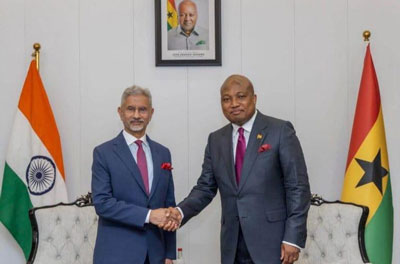
Indian Foreign Minister, Subrahmanyam Jaishankar, and Foreign Minister Samuel Okudzeto Ablakwa discussed Ghana's intention to formally apply for Partner Country status in October 2026. The decision followed Cabinet approval in pursuit of closer engagement with the alliance, with India expressing support for Ghana's aspirations. The application remains subject to consideration by BRICS members.
Seeking deeper engagement with other emerging powers, the Foreign Ministers acknowledged that joining BRICS+ would complement, rather than replace, its existing relationships with the International Monetary Fund, World Bank and other traditional partners.
Formally established in 2009 through its first summit, BRICS originated as BRIC, comprising Brazil, Russia, India and China. South Africa joined in 2011. The bloc has since expanded to include six new full members: Ethiopia, Egypt, Indonesia, Iran, Saudi Arabia and the United Arab Emirates.
BRICS Growing in Weight
Under India's chairmanship, BRICS leaders in New Delhi seek greater global influence. The last country accepted as a full member was Indonesia in January 2025. Ten other countries — Belarus, Bolivia, Kazakhstan, Cuba, Malaysia, Nigeria, Thailand, Uganda, Uzbekistan and Vietnam — are currently BRICS partners, invited to take part in summits but without full voting rights. If Ghana's application succeeds, it would become another West African country in this partner category alongside Nigeria, reflecting the region's economic potential and diplomatic engagement.
According to a report published in March 2026 by the United Nations trade and development agency UNCTAD, trade between BRICS members has grown rapidly over the past two decades, "driven by strong complementarities in natural resources, manufacturing and technology, as well as a changing global context". Yet while BRICS members collectively account for over two-thirds of the Global South's total GDP, trade between members accounts for only about 20 percent of South-South trade, according to UNCTAD, which says "the enormous potential of the intra-bloc trade is yet to be fully tapped".
What Ghana gains from BRICS+
Certainly, ascending onto the BRICS+ platform would become a historical landmark for Ghana, which has attained prestigious status in multilateral institutions and organisations such as the Economic Community of West African States (ECOWAS), the African Union (AU) and the United Nations. Ghanaian Shirley Ayorkor Botchwey also assumed office as Commonwealth Secretary-General in April 2025.
Unlike South Africa, which became a full-fledged member in 2011, and Ethiopia, Nigeria and Uganda, which are associated with BRICS as full members or partner countries respectively, Ghana has the potential to pursue closer engagement with the BRICS+ alliance. It is necessary to understand the basic definition and meaning of BRICS+ in the context of the changing geopolitical world. The BRICS alliance operates as a forum for consultation and cooperation, with members retaining their sovereignty and independence in foreign policy. As a grouping of emerging economies, it remains open to cooperation with countries that share its objectives.
BRICS members have the freedom to engage in bilateral relations with any external country of their choice. In addition to that, the BRICS+ strategic partnership has explicitly shown that it is not a confrontation association, but rather one of cooperation designed to address global challenges and based on respect for the right of each country to determine its own future.
South Africa and Other African Countries Associated with BRICS+
South Africa is strongly committed to its engagement in BRICS+. It has, so far, hosted two of its summits. In future, Egypt and Ethiopia could have the chance to host a BRICS+ summit. Egypt and Ethiopia have relations with members and simultaneously transact business and trade with other non-BRICS+ external countries. The New Development Bank (BRICS) was established in 2015 and, according to its published information, had approved 96 projects with total financing of US$32.8 billion. Its headquarters are in Shanghai, with offices in São Paulo and Gujarat, India. South Africa can be an investment gateway to the rest of Africa. Bangladesh, the United Arab Emirates and Egypt have joined the NDB, while Algeria became a member in May 2025.
The BRICS Bank is mandated to mobilise resources for infrastructure and sustainable development projects in BRICS countries and other emerging market economies and developing countries, complementing existing multilateral and regional financial institutions. Its tasks include investing in the economy through development financing, alleviating poverty and working towards sustainable economic growth. According to President of the BRICS New Development Bank, Dilma Rousseff, “The bank should play a major role in the development of a multipolar, polycentric world.”
Ethiopia and Egypt are among the countries that became full members of BRICS in January 2024. South Africa and Egypt are significant African economies, while Ethiopia is also a major economy on the continent. In terms of demography, Nigeria is the most populous African country, with a population exceeding 220 million, while Uganda has a population of approximately 46 million. South Africa, Ethiopia and Egypt are full members, while Nigeria and Uganda are partner countries. These partner countries have opportunities to pursue multidimensional cooperation with external countries. BRICS+ places no general restriction on members and partners establishing bilateral relationships outside the grouping.
From the above premise, Ghana’s new administration, within the framework of BRICS+, could work out a strategic plan to establish full coordination with and request support from African members, including South Africa, Egypt and Ethiopia. Worth noting is that the potential benefits of closer engagement cannot be underestimated in this era of shifting economic architecture and geopolitical change.
Queuing for BRICS+ Membership
Burkina Faso, Mali and Niger, which historically share the cross-border region of West Africa, have pursued closer cooperation with emerging powers and expressed interest in alternative international partnerships. The trio has formed its own regional economic and defence pact, the Alliance of Sahel States (AES), in September 2023, and has sought to address development and security questions through greater international cooperation. Brazil, as BRICS chair in 2025, set priorities that included integrating new members and partners into the grouping's activities. More than 30 countries have expressed interest in participating in BRICS, either as members or partners.
Perhaps the most crucial moment is for Ghana, which shares a border with Burkina Faso. Its military leader, Capt. Ibrahim Traoré, attended the inauguration of the new President John Dramani Mahama on January 7, 2025. Burkina Faso has pursued initiatives to transform its agricultural sector to ensure food security and invest in educational and health facilities and sports infrastructure, marking a new chapter in its political history.
In early January 2025, the National Democratic Congress (NDC) took over political power from the New Patriotic Party (NPP). Historically, the political transition has been quite smooth and admirable down the years. Ghana was ranked seventh in Africa out of 54 countries in the Ibrahim Index of African Governance. The Ibrahim Index is a comprehensive measure of African governance, including the rule of law, accountability, participation, rights, human development and economic opportunity.
Ghana produces high-quality cocoa. It has huge mineral deposits, including gold, diamonds and bauxite, as well as petroleum resources. President John Dramani Mahama has reiterated his intention to unlock the country's potential, creating a resilient and inclusive economic model that would empower citizens and ultimately attract foreign investment. Ghana has been implementing economic reforms under its programme with the IMF to stabilise and resuscitate the economy. Ghana’s involvement in BRICS+ could enhance its international economic engagement in an increasingly multipolar world.
Outlining Ghana’s Potential Benefits
Currently, Ghana has myriad economic tasks to implement and aims at recovering from previous economic mismanagement. It could take advantage of BRICS+’s diverse partnership opportunities. Closely related to this, Ghana’s hosting of the headquarters of the African Continental Free Trade Area (AfCFTA) further offers an appropriate basis for collaboration in boosting both intra-BRICS trade and intra-African trade. With Egypt, Ethiopia, Uganda, South Africa, Nigeria and Ghana, these countries could provide a broader African geographical representation in BRICS+ and present a collective African voice on the international stage, should Ghana's application succeed.
After studying the article report titled “Ghana Should Consider Joining the BRICS Organization” (Source: http://infobrics.org), the author Natogmah Issahaku explained, in the first place, that Ghana’s relations with other external nations, particularly those in the West, will not, and should not, be affected by its BRICS engagement. According to the expert, Ghana needs infrastructural development and sustainable economic growth in order to raise the living standard of Ghanaians to middle-income status, which could be achieved through participation in BRICS+. In return, Ghana can offer BRICS+ members exports of finished and semi-finished industrial and agricultural products as well as minerals in a win-win partnership framework.
As an Applied Economist at the University of Lincoln, United Kingdom, Natogmah Issahaku emphasised the importance of the BRICS New Development Bank (NDB), which could play a role in financing Ghana’s development agenda, subject to the Bank's eligibility requirements and approval processes. BRICS development cooperation offers another avenue for Ghana to pursue partnerships and optimise potential benefits. Given the scale of the economic problems confronting the country, President Mahama should take strategic steps to pursue Ghana's proposed BRICS Partner Country status.
Notwithstanding worldwide criticisms, BRICS+ countries have advanced manufacturing, vast markets and technological advantages. As often argued, BRICS+ is another avenue to explore for long-term investment possibilities and to work closely with its stakeholders.
These above-mentioned factors are attractive for advancing Ghana in the Global South. Based on this, it is time to explore the emerging opportunity to drive increasingly high-quality cooperation, focus on hope rather than despair and step up broadly for more constructive parameters in building beneficial relations into the future! Over to the new Government of President John Mahama, the estimated 35 million people and the entire Republic of Ghana.