
India and Africa are Joined at the Hip in the Rise of the Global South
By Kirtan Bhana and Anisha Pemjee
17 May 2026
An update on the India–Africa Forum Summit IV - 21 MAY 2026
The forthcoming fourth edition of the India–Africa Forum Summit IV (IAFS IV), scheduled to take place in New Delhi from 28–31 May 2026 in collaboration with the African Union Commission, arrives at a defining historical moment for both Africa and India. After an eleven-year hiatus shaped by geopolitical instability, shifting global alliances, and the disruptive aftershocks of the COVID-19 pandemic, the summit is a strategic convergence of two of the most dynamic forces of the Global South.
On the India–Africa Forum Summit IV - UPDATE ON 21 MAY 2026
1. The Government of the Republic of India and the African Union have been working closely on the convening of the Fourth India–Africa Forum Summit (IAFS IV), initially scheduled to take place in New Delhi from 28–31 May 2026.
2. The two sides exchanged views on the evolving health situation in parts of Africa and reaffirmed the importance of continued cooperation in strengthening public health preparedness and response capacities across the continent, including through support to Africa CDC and relevant national institutions.
3. India reaffirmed its solidarity with the peoples and Governments of Africa and expressed its readiness to contribute to Africa CDC-led efforts aimed at addressing the evolving health situation, in line with the shared commitment to an Africa-led response.
4. Recognizing the importance of ensuring the full participation and engagement of African leaders and stakeholders, and mindful of the emerging public health situation on the continent, consultations were held between the Government of India, the Chairperson of the African Union, and the African Union Commission regarding the holding of the Summit and associated activities.
5. Following these consultations, the two sides agreed that it would be advisable to convene the Fourth India–Africa Forum Summit at a later date.
6. New dates for the Summit and its associated meetings will be finalized through mutual consultations and communicated in due course.
7. India and Africa reaffirmed their longstanding partnership founded on solidarity, mutual respect, South–South cooperation, and a shared commitment to peace, development, prosperity, and the well-being of their peoples.
Under the theme “India-Africa Spirit: India-Africa Strategic Partnership for Innovation, Resilience and Inclusive Transformation,” the summit captures the emerging confidence of regions once constrained by colonial subjugation but now increasingly determined to shape the future international order on their own terms.
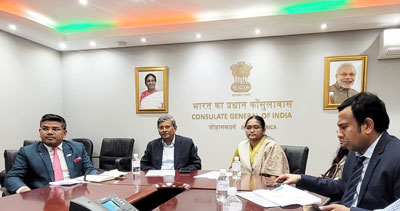
A media briefing hosted at the Consulate General of India in Johannesburg on 15 May 2026 further underlined the significance of the summits taking place in New Delhi. The engagement was presented by Indian High Commissioner Prabhat Kumar, Acting Consul General Harish Kumar together with Deputy Banu Prakash and first secretary Shyam Chand, who outlined the strategic implications of the gatherings for Africa–India relations and the wider Global South. The officials highlighted the growing convergence between Africa’s integration ambitions under Agenda 2063 and India’s Vision 2047 developmental roadmap, as well as the increasing importance of maritime cooperation, technological innovation, sustainable development and environmental stewardship.
The symbolism of New Delhi hosting not only IAFS IV, but also the International Big Cats Alliance Summit 2026 on 1–2 June 2026, is particularly profound. The International Big Cats Alliance (IBCA) Summit will gather world leaders, Heads of State and more than 400 global stakeholders to advance conservation efforts surrounding the world’s seven great big cat species. The summit will culminate in the adoption of The Delhi Declaration, the first global framework dedicated to coordinated international cooperation on big cat conservation.
Yet beyond wildlife preservation, the IBCA carries deeper geopolitical and civilisational symbolism. The habitats of lions, leopards, cheetahs, tigers and other great cats stretch across both Africa and India, creating an ecological bridge between the two regions. Environmental diplomacy has become instrumental for shared stewardship, indigenous wisdom, biodiversity protection and the interconnected destiny of the Global South.
Moving Beyond the Colonial Legacy
India and Africa share historical experiences that transcend ordinary diplomatic relations. Both endured centuries of colonial extraction, arbitrary partition, cultural suppression and economic dependency imposed through imperial divide-and-rule strategies. Yet despite this legacy, both regions have demonstrated remarkable resilience.
Today, Africa and India are no longer content with functioning merely as suppliers of raw materials or peripheral markets within Western-dominated economic systems. Instead, they are proactively crafting independent developmental trajectories rooted in sovereignty, industrialisation, innovation and South-South cooperation.
The Indian Ocean itself historically served as a living corridor of commerce, migration and cultural exchange linking East Africa and the Indian subcontinent long before European colonial powers imposed artificial barriers. Modern cooperation between India and Africa therefore represents not a new alignment, but rather the restoration of an ancient relationship interrupted by colonialism.
Africa and India: Comparative Strengths in a Changing World
The significance of IAFS IV lies partly in the striking similarities — and complementary differences — between Africa and India.
Geography and Strategic Scale
Africa, spanning approximately 30.37 million square kilometres across 54 recognised sovereign states, is the world’s second-largest continent. It possesses immense reserves of critical minerals, agricultural land, hydrocarbons, freshwater systems and biodiversity.
India, by comparison, occupies roughly 3.29 million square kilometres, geographically far smaller, yet functions as a unified sovereign republic with a single constitutional and economic framework.
This distinction is crucial.
Africa’s diversity exists across multiple sovereign systems, while India has managed extraordinary internal diversity within one national political architecture. In many respects, India offers Africa valuable lessons in continental-scale governance, infrastructure coordination, democratic continuity and domestic market integration.
Conversely, Africa’s continental breadth provides opportunities for India in energy security, manufacturing partnerships, food systems, maritime trade and strategic mineral supply chains essential for future technologies.
Demographic Powerhouses of the Twenty-First Century
Together, Africa and India represent nearly three billion people, among the largest concentrations of youthful populations on earth.
Africa’s population now exceeds 1.5 billion and is projected to become the world’s largest labour reservoir during the course of the century. With a median age of roughly 19 years, Africa possesses unparalleled demographic potential.
India, with approximately 1.4 billion people, recently surpassed China as the world’s most populous nation and has already demonstrated how demographic scale can be transformed into economic productivity through industrialisation, technology and education.
Both regions face similar developmental imperatives:
• Employment creation
• Urbanisation management
• Digital transformation
• Food security
• Energy transition
• Youth empowerment
However, India’s comparative success in literacy expansion, pharmaceutical manufacturing, digital governance and technological integration offers practical developmental insights relevant to Africa’s own implementation of African Continental Free Trade Area (AfCFTA).
India’s 2047 Vision and Africa’s Agenda 2063: Parallel Developmental Blueprints
Perhaps the most important strategic discussion for IAFS IV should revolve around the alignment between Africa’s Agenda 2063 and India’s Vision 2047 framework.
Agenda 2063 represents Africa’s long-term blueprint for:
• Continental integration
• Industrialisation
• Infrastructure development
• Free movement of people and goods
• Technological innovation
• Pan-African economic sovereignty
Similarly, India’s Vision 2047 seeks to position India as a fully developed nation by the centenary of its independence through:
• Advanced manufacturing
• Artificial intelligence
• Semiconductor production
• Green energy transition
• Digital governance
• Infrastructure modernisation
• Expanded global trade influence
The parallels are striking.
Where India has already established strong domestic integration through unified markets, transport corridors and digital finance systems, Africa is now attempting similar continental integration through the AfCFTA.
This creates significant opportunities for collaboration.
The Summit Focus
1. Continental Market Integration
India’s experience building one of the world’s largest unified domestic markets offers valuable lessons for AfCFTA implementation.
Africa’s greatest challenge is not lack of resources, but fragmentation:
• Border inefficiencies
• Inconsistent regulations
• Infrastructure gaps
• Currency instability
• Limited intra-African trade
India’s successes with digital payment systems, customs coordination, rail logistics and integrated industrial corridors could assist Africa’s own integration agenda.
2. Industrialisation and Manufacturing
Africa cannot remain merely a supplier of raw minerals while importing finished products.
India’s development trajectory demonstrates how strategic industrial policy can transform a formerly colonised economy into a globally competitive manufacturing and technology hub.
Joint ventures in:
• Pharmaceuticals
• Automotive assembly
• Agricultural processing
• Green hydrogen
• Solar manufacturing
• ICT infrastructure
• Space cooperation
could become defining pillars of the next phase of Afro-Indian relations.
3. Maritime and Indian Ocean Security
The Indian Ocean is rapidly becoming one of the most strategically contested regions in the world.
Both Africa and India depend heavily on maritime trade routes for:
• Energy transport
• Food imports
• Mineral exports
• Global logistics
Enhanced cooperation between African coastal states and India in maritime security, anti-piracy operations, blue economy development and port infrastructure will be essential.
4. Critical Minerals and Green Energy
Africa possesses some of the world’s largest reserves of:
• Lithium
• Cobalt
• Manganese
• Platinum group metals
• Rare earth minerals
These resources are essential for electric vehicles, batteries and renewable energy technologies.
India’s rapidly growing manufacturing sector requires secure access to these supply chains, while Africa requires investment in beneficiation and local industrial value addition rather than simple extraction.
A mutually beneficial framework is therefore entirely achievable.
5. Digital Transformation
India’s globally recognised achievements in digital finance, biometric systems and technology services could assist Africa’s rapidly expanding digital economy.
Africa’s mobile banking revolution, particularly in countries such as Kenya, already demonstrates enormous innovation capacity. Combined Afro-Indian cooperation in fintech, cybersecurity, AI and e-governance could become transformative.
Shared Cultural and Civilisational Strength
One of the most overlooked dimensions of India-Africa relations is the profound cultural affinity between the two regions.
Both remain deeply rooted in:
• Family structures
• Spiritual traditions
• Oral histories
• Community identity
• Indigenous knowledge systems
Both have also used culture as resistance against historical domination.
African music, literature and fashion increasingly shape global popular culture, while India’s cinematic, spiritual and philosophical influence continues expanding globally through Bollywood, yoga, cuisine and digital media.
Historical Indian communities in South Africa, Kenya, Tanzania and Mauritius have further strengthened Afro-Indian cultural fusion across generations.
Conservation Diplomacy and the Big Cats Alliance
The timing of the International Big Cats Alliance Summit immediately after IAFS IV is strategically significant.
Africa and India are among the world’s most important biodiversity custodians. Both possess ecosystems central to global conservation efforts.
The proposed Delhi Declaration on Big Cat Conservation offers an opportunity to integrate:
• Environmental protection
• Indigenous conservation knowledge
• Sustainable tourism
• Climate resilience
• Scientific collaboration
into broader Afro-Indian cooperation frameworks.
Wildlife diplomacy may emerge as an unexpected but powerful unifying dimension of Global South leadership.
Importantly, conservation itself has economic implications. Africa’s safari tourism sector and India’s ecological tourism networks represent major employment generators and foreign exchange earners. Joint research, conservation financing and eco-tourism development could further strengthen bilateral ties.
A New Global South Partnership
The broader significance of IAFS IV extends beyond bilateral relations.
The summit reflects the emergence of a multipolar world in which Africa and India increasingly reject dependency frameworks imposed by external powers. Both are asserting themselves not as passive participants, but as architects of a new global order.
India’s rise into the world’s top five economies demonstrates how scale, democratic continuity and strategic planning can transform post-colonial societies into major global actors.
Africa, through Agenda 2063 and AfCFTA, now seeks its own continental transformation.
The relationship between Africa and India therefore represents a convergence of civilisations seeking to redefine development through sovereignty, innovation, integration and mutual respect.
If effectively aligned, Africa’s demographic dynamism and resource wealth combined with India’s technological, industrial and institutional experience may become one of the defining strategic partnerships of the twenty-first century.
In many respects, Africa and India are indeed “joined at the hip” — linked not only by geography and history, but by a shared determination to move beyond the fractures of colonialism toward a future shaped increasingly by the aspirations of the Global South itself.