

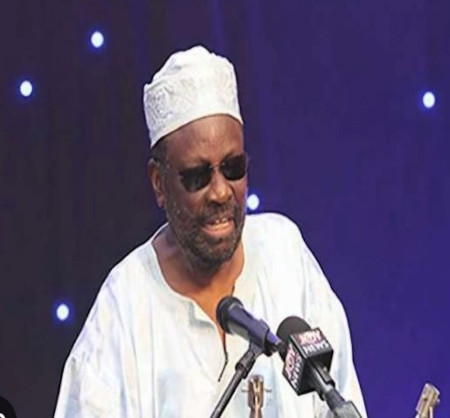
Good Journalism Is the Product of Acute Curiosity - says renowned Ghanaian Journalist Cameron Duodu
by Fiifi Netty
15 May 2026
I had been trying for quite some time to secure an interview with Cameron Duodu, a veteran journalist with more than seven decades of experience in the media industry. His name commands great respect in journalism circles, both locally and internationally. Over the years, he has served as an editor and written for numerous local and international media platforms across the world. Given his rich experience and deep understanding of the media landscape, I wanted him to share his vast knowledge and insights on journalism for an article I was writing.
At first, he postponed the interview, which left me disappointed because I thought my dream of speaking with such a colossal figure in journalism practice was over. Later, however, he sent me a message, but unfortunately, I saw it too late.
Fortunately, he gave me another opportunity, which I gladly accepted. However, the night before the interview, I could hardly sleep. My mind kept racing with thoughts about the kinds of questions I should ask, and I became increasingly nervous. I kept wondering how I, a journalism student, could confidently interview such a respected professor and iconic figure in journalism. Finding the right questions became a struggle, and at one point, fear and uncertainty almost pushed me to cancel the interview altogether.
Cameron Duodu has seen and experienced almost everything in the media landscape and is regarded as an authority in journalism practice. Because of this, it was not easy to decide on the best angle for the interview, even though I already had a general idea of the issues I wanted to discuss and the insights I hoped to gain from him. I gathered the courage, picked up my laptop, scribbling pad, pen, and recorder prepared myself for the experience.
However, instead of focusing only on conducting an interview to get his contribution to my article, I would approach the interview as a learning opportunity for me. I wanted to hear directly from one of the finest journalists about the integrity, values, and responsibilities of the profession.
When I arrived at his home, he received me warmly and led me into his living room. As we settled in immediately, and he explained that he had already structured the interview into three parts. I was genuinely impressed and readily agreed, fully aware that I was in the presence of one of the most accomplished senior journalists whose writing style and depth of experience I have long admired. His journalism career spans the pre-independence era to the present day, documenting major historical developments in both the media landscape and society.
Over the years, his byline has appeared in some of the world’s most respected media outlets, including The Guardian, The Observer, BBC, Financial Times, The Economist, United Press International, Reuters, De Volkskrant, and The Sunday Times. In Ghana, he wrote for major publications such as the Daily Graphic, where he also served as editor, and the Ghanaian Times, where he was a columnist for many years.
He has authored more than 1,033 articles and contributed to the 2014 publication Essays in Honour of Wole Soyinka at 80. He has also made frequent appearances on BBC World TV and BBC World Service radio programmes, where he discussed African politics, the economy, and culture.
Beyond journalism, he is also a playwright, novelist, and poet. His literary works include contributions to the anthology Messages: Poems from Ghana published by Heinemann Educational Books in 1970.
In South Africa, he wrote a weekly column for the Mail & Guardian in Johannesburg and also contributed to the Sunday Times and The Independent, among others. His work has also gained recognition in countries such as Netherlands and the United States, where he contributed to publications including the San Francisco Chronicle and the The Christian Science Monitor.
Interestingly, I did not do any extensive research about his background before meeting him. I knew there were many articles and materials available about him as a journalist, play writer, poet, novelist, editor, but I chose to approach the interview with the mind of a student journalist eager to learn. I felt like a student sent by a lecturer on an assignment — not just to interview a media legend, but to understand the deeper meaning of curiosity, humility, and learning in journalism.
The conversation began with a discussion about his name, Cameron. “Why Cameron?” I asked. Before answering, he told me that my name, Fiifi, reminded him of his close friend, Fifi Hesse, the former Director-General of Ghana Broadcasting Corporation. I realized that although we shared the same name and pronunciation, the spelling was different. He spoke highly of his best friend and recalled how, after Fifi Hesse returned with distinction as the first African Rhodes Scholar from Oxford University, he wrote the very first feature article about him while serving as editor of Drum, the South Africa-based magazine at the time.
He added that," whenever he sees or hears the name Fiifi, it reminds him of a close friend who taught him many valuable lessons in journalism." He said that "was one of the reasons he paid special attention to me."
During our conversation, he noticed that "I was writing with my left hand. That observation prompted him to share a personal story about how he had been forced to stop writing with his left hand and switch to his right. Jokingly, he said the change eventually ruined his handwriting." He added with a smile, “I’m happy your parents allowed you to use your left hand.”
Cameron Duodu said, "the first thing you must do as a journalist is be curious." According to him, "curiosity is one of the most important qualities of a good journalist. He explained that journalists must always be eager to investigate, research, ask questions, and stay well-informed before publishing any story."
He stressed that "anything associated with a journalist’s name becomes part of their reputation, which is why journalists must be careful about what they publish. He emphasized that every piece of information placed in the public domain must be factual, accurate, and properly verified." He advised that "whenever a journalist is uncertain, they should ask questions to obtain the correct information". He further noted that "every journalist must understand the fundamental principles of reporting — the who, what, when, where, why, and how."
Returning to the question about his name, he explained that his father was a cocoa dealer from Asiakwa in the Eastern Region of Ghana, who worked with a white man named Cameron. According to him, although his father was illiterate, he was exceptionally intelligent and could perform all calculations without assistance. He never fell into debt or made losses while working with the white man. Impressed by his honesty and intelligence, the white man became very fond of him and eventually increased his commission on cocoa sales.
He said “when he was born, his father decided to name him after his white friend, Cameron, because of how brilliant and supportive he had been". The name Martin was later added to it, and his full name became Martin Cameron Duodu.
He further explained that as he grew up, he realized that when a writer produces a good article, people often remember the name associated with it, and that eventually makes the writer popular. That was when he truly appreciated the great favour his father had done for him by giving him the name Martin Cameron Duodu.
My interest in writing began at an early age. My father often brought people into his shop to help him write or spell names he could not manage on his own. I would sit around them as they interacted with me, asking many questions and teaching me along the way. When I returned home, I would practice everything I had learned by writing on my mother’s clay kitchen floor.
From that early stage, I began developing my writing skills. When I started school at Kyebi Government Senior School, I performed so well that I topped my class in Class 1 and was promoted directly to Class 3, l also topped the class in Class 3 though my classmates had recieved a whole year's lesson in Class 2 without me. Where I still remained among the best in the class. At the end of Class 6, l received a "High Merit" certificate. Only two were awarded that year to members of my class by the district education authorities. My teacher quickly noticed my ability to learn and absorb information with ease.
However, when I entered middle school, I realized that "we spent more time doing manual labour than focusing on academic work, which was very different from my earlier educational experience". As a result, I decided to leave school and started working as a pupil teacher, my first professional job. During that period, one of my teachers encouraged me to attend a teacher training college and pursue a teaching certificate. However, I declined the offer and instead enrolled in correspondence courses instead. Despite that effort, I was eventually dismissed for not attending the training college.
He told me how he never had the opportunity to attend a formal secondary school or university, yet he educated himself through extensive reading and correspondence courses from the Rapid Results College, London. He recalled meeting a teacher, Mr. E.C.E. Asiama, through the People’s Educational Association (PEA), who encouraged him to attend lectures in history and English. Mr. Asiama greatly admired his exceptional intellect and remarkable determination.
According to him, Mr. Asiama traveled once every week from Abuakwa State College in Kyebi to teach English. He had been assigned by the University of Ghana’s Extra-Mural Studies Department. Mr. Asiama taught the English language exceptionally well and inspired them to develop a deep passion for the subject.
He also played a crucial role in encouraging him to sit for both the O-Level and A-Level examinations. Through self-discipline, determination, and self-study, he successfully passed both examinations within a short period.
While still in school, he began writing, and the first story he wrote, “Tough Guy in Town,” was broadcast on the radio programme The Singing Net and later included in Voice of Ghana, a 1958 anthology regarded as the first Ghanaian literary collection of poems, stories, plays, and essays.
"One important lesson I learned about writing is that you must read, read, and read constantly. I used to borrow books from my friends just to read, and I also visited the Ghana Library to go through foreign newspapers. I read widely, often absorbing knowledge unconsciously without even realizing how much I was learning," he added.
Actually, "l have done journalism since l joined New Nation, a monthly magazine published in Accra in August 1956. After that, I joined the Ghana Broadcasting Corporation (GBC), where I rose to become an editor within three years. I later moved on to Drum Magazine, where I also served as an editor."
Beyond journalism, he told me about his novel, The Gab Boys, his best-known literary work, which was published in 1967. He encouraged me to find a copy and read it so that we could discuss it during our next session.
As we commemorate World Press Freedom Day in this May, a month that also marks his birth month, I celebrate Cameron Duodu, a journalist l personally and widely admired for his fearless commentary, intellectual depth, command over the english language and unwavering commitment to truth and ethical journalism. For more than seven decades, he has remained dedicated to truthful reporting, giving a voice to the voiceless, holding governments accountable, mentoring generations of journalists, and establishing himself as one of the most influential figures in Ghanaian and African journalism and beyond.
My experience with him has taught me the importance of being truthful, humble, focused, determined, and persevering in life and journalism. He also made me realize that curiosity is one of the greatest qualities a journalist can possess. A curious journalist is always willing to learn, listen, ask questions, and seek knowledge beyond fear and uncertainty.