


Africa and Japan, Symbiotic in a Changing World
By Kirtan Bhana and Anisha Pemjee
7 May 2026
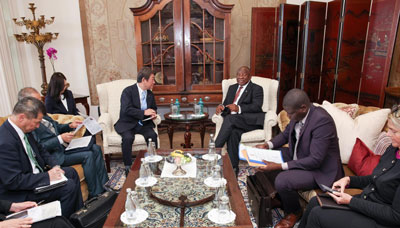
The recent four-nation African tour by Japanese Foreign Minister Toshimitsu Motegi which included Kenya, Angola, Zambia and South Africa was far more than a diplomatic courtesy visit. It was a strategic recognition that the future of the global economy, industrial production, energy security and technological advancement is increasingly intertwined with the rise of Africa.
At a moment when the international system is undergoing profound realignment, Japan’s renewed engagement with Africa reflects a growing understanding in Tokyo that the continent is no longer a peripheral player in global affairs, but rather one of the defining centres of future growth, innovation and geopolitical relevance.
The visit also arrives during a significant political transition in Japan itself. Under the leadership of Prime Minister SanaeTakeshi, Japan’s first female Prime Minister, the country appears to be recalibrating its domestic and international posture with greater dynamism and strategic clarity. Her attendance at the G20 Johannesburg Summit and support for outcomes emphasizing inclusive growth, development reform and Global South cooperation signalled a Japan seeking renewed relevance and influence on the world stage.
For Africa, the relationship with Japan has increasingly moved beyond the traditional donor-recipient framework toward a genuinely balanced and equitable partnership rooted in mutual respect, shared prosperity and strategic co-creation.
Japan was among the earliest nations to recognise that Africa’s development was central to global development. The launch of the Tokyo International Conference on African Development (TICAD) in 1993 positioned Tokyo as a long-term development partner at a time when much of the world still viewed Africa through the narrow lenses of instability and dependency.
Three decades later, that early vision is proving remarkably discerning.
Africa today is emerging as one of the world’s most consequential economic frontiers. The implementation of the African Continental Free Trade Area (AfCFTA), expanding regional integration, massive infrastructure investments, digital transformation and a youthful population projected to dominate the global labour force are reshaping the continent’s trajectory.
The implications for the Far East, and particularly Japan, are immense.
Japan’s economy, despite its technological sophistication and industrial prowess, has endured prolonged economic stagnation, demographic decline and increasing vulnerability in global resource chains. The volatility surrounding energy markets and critical minerals has wakened the urgency for Tokyo to diversify supply networks and secure long-term strategic partnerships.
Africa possesses precisely the assets Japan requires for its next phase of economic revitalisation: critical minerals, vast renewable energy potential, expanding consumer markets and, perhaps most importantly, human capital.
Africa’s agency is growing stronger, more coordinated and increasingly assertive. The era of supplying raw materials to sustain Asian industrial production has rapidly faded. The relationship is being centred on value addition, industrialisation, skills transfer and technological partnership.
This is already becoming visible through Japanese-supported manufacturing and industrial initiatives in cities such as Durban, Nairobi and Jinja, where knowledge exchange and industrial collaboration are creating high-value jobs, advanced manufacturing capabilities and export-oriented production ecosystems.
Japan’s support for innovation and entrepreneurship through initiatives such as the Japan-Africa Co-Creation for Industry programme, including ambitious efforts to train thousands of Africans in artificial intelligence and emerging technologies, reflects a deeper recognition that Africa’s youth dividend is one of the most valuable strategic resources of the twenty-first century.
While Japan confronts an aging population and labour shortages, Africa stands at the opposite demographic spectrum, with nearly 70 percent of its population under the age of 30. This demographic contrast creates an extraordinary opportunity for symbiosis.
Programmes such as the Japan Exchange and Teaching Programme (JET), active in South Africa since 1997, alongside extensive university exchanges and the longstanding work of the Japan Overseas Cooperation Volunteers across Africa, demonstrate that people-to-people engagement remains one of the strongest foundations of Japan-Africa relations.
The future however demands even deeper integration. Africa’s rise will fundamentally reshape global commerce and the strategic orientation of the Far East. As African industrial capacity expands and regional markets become increasingly integrated, Japanese corporations will find themselves engaging not merely with individual states, but with an emerging continental economic ecosystem of immense scale and potential.
The recently announced Economic Region Initiative for Indian Ocean Africa under TICAD aligns closely with Africa’s own development ambitions under Agenda 2063. Expanding logistics corridors from Mombasa to Mozambique and across West Africa signal the acceleration of a continental transformation that is steadily becoming irreversible.
For Japan, partnership with Africa is therefore not an act of generosity; it is an economic and strategic necessity.
At the same time, Africa offers Japan something far deeper than economic opportunity alone.
Japan’s civilisation, philosophy and social values rooted in discipline, wellness, balance, artistic expression and collective harmony resonate strongly with African traditions that similarly prioritise community, spirituality, dignity and interconnectedness. This cultural synergy creates a unique foundation for cooperation that extends beyond commerce into the realms of social development, peacebuilding and human-centred progress.
Japan’s long-standing emphasis on peace and stability across Africa through peacekeeping support, mediation initiatives and security cooperation further demonstrates an understanding that prosperity cannot exist without stability. Through partnerships with the African Union and support for peacekeeping and training initiatives across multiple African countries, Tokyo has contributed toward creating environments conducive to development and investment.
Yet the evolving relationship now requires Africa to be viewed not only as a recipient of stability initiatives, but as a provider of solutions.
African experiences in reconciliation, community resilience, regional diplomacy and social cohesion contain valuable lessons for a world increasingly fractured by geopolitical tensions, social polarisation and economic inequality. In subtle but important ways, Africa’s adaptive governance models and collective approaches to societal challenges may offer nuanced insights for Japan as it navigates regional uncertainty and global competition in the Indo-Pacific.
This is where the relationship matures, from assistance to collaboration, from dependency to co-leadership.
In South Africa, where relations with Japan span over a century, the presence of more than 260 Japanese companies illustrates the depth of economic engagement already underway. Despite persistent challenges of unemployment and inequality, South Africa remains one of the continent’s most diversified economies and a strategic gateway into broader African markets.
As Africa’s commercial influence expands, Japan could become a critical platform through which African goods, services, technology and cultural exports access the Far East.
Minister Motegi’s visit was therefore exceptionally timeous. It reflects a growing awareness that Africa’s rise is no longer speculative; it is imminent.
The Far East will inevitably be economically, strategically and culturally transformed by Africa’s emergence. Those nations that recognise Africa as an equal partner rather than merely a resource supplier will be best positioned to thrive in the next era of global development.
Japan appears increasingly aware of this reality.
The challenge now is whether both sides can build a truly balanced partnership capable of shaping a more inclusive and multipolar world order built on the confidence of Africa.