


From expensive poverty to modest prosperity, China making the world normal again
By Kirtan Bhana - TDS
9 March 2026
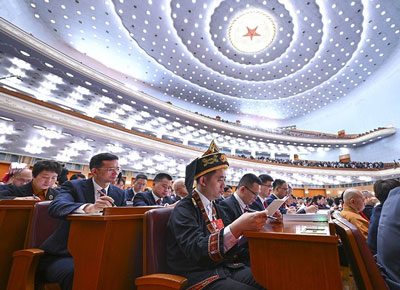
At a moment when the global system appears increasingly unsettled defined by geopolitical rivalry, economic volatility and fractured multilateralism the recently concluded “Two Sessions” in Beijing offered something that has become surprisingly rare in global politics: policy continuity, long-term planning and institutional stability.
The annual meetings of the National People's Congress (NPC) and the Chinese People's Political Consultative Conference (CPPCC) are more than routine political gatherings. They represent a governance mechanism through which domestic priorities are calibrated with international realities. In an era of uncertainty, the proceedings in Beijing underpinned a central proposition that stable domestic governance is the foundation of responsible international leadership.
Domestic stability as the foundation of global engagement
China’s development strategy continues to emphasise a principle that has guided its modern transformation that economic growth must proceed in tandem with social stability. The 2026 Government Work Report delivered by Premier Li Qiang set a growth target of approximately 4.5–5 percent, a figure that reflects pragmatic realism rather than diminished ambition.
Rather than pursuing growth at any cost, Chinese policymakers have clearly signalled a transition toward high-quality development, an economic model driven by productivity, technological innovation and environmental sustainability. Strategic sectors such as artificial intelligence, semiconductors and renewable energy are being positioned as engines of future competitiveness, while domestic consumption is being strengthened to rebalance the economic structure.
Equally significant is the emphasis on employment and social welfare. The creation of roughly 12 million urban jobs and policies addressing housing stability, regional development and local government debt illustrate a governance philosophy rooted in the idea that development must serve the people. This people-centred orientation resonates strongly with the idea of collective prosperity rather than isolated wealth accumulation.
It is precisely this combination - economic pragmatism, long-term planning and social stability - that has allowed China to move hundreds of millions out of poverty while maintaining one of the most consistent development trajectories in modern history.
The strategic logic of long-term planning
Another important dimension of the Two Sessions lies in their relationship with China’s planning architecture. The policy signals emerging from this year’s meetings feed directly into preparations for the next national development blueprint, the 15th Five-Year Plan.
Five-year planning has often been misunderstood as rigid economic engineering. In practice, however, it functions as a strategic compass, linking annual governance decisions with long-term modernisation goals.
In the current global environment, where short-term political cycles often dominate policy in many countries, this long-range strategic planning has become one of China’s distinctive governance advantages. It allows the country to absorb external shocks, adapt to structural economic changes and maintain a coherent trajectory toward modernisation.
The Two Sessions therefore do not simply announce economic targets; they reaffirm the continuity of a development philosophy that combines planning with adaptive governance.
Heads-of-state diplomacy: the anchor of China’s foreign policy
China’s domestic stability also shapes its international posture. Speaking during the meetings, Foreign Minister Wang Yi described heads-of-state diplomacy as the “anchor” of Chinese foreign policy.
Under the leadership of President Xi Jinping, summit diplomacy has become a central instrument for navigating an increasingly complex global landscape. High-level engagements between leaders have facilitated dialogue between major powers, strengthened regional partnerships and deepened cooperation across the Global South.
This diplomatic style reflects an understanding that international relations are ultimately shaped by trust and strategic communication at the highest level. Over the past year, Chinese leadership diplomacy has sought to stabilise relations among major countries while simultaneously expanding partnerships across Asia, Africa, the Middle East and Latin America.
In Wang Yi’s formulation, such diplomacy provides “stability and certainty to a world in turmoil.” The concept speaks to a broader vision: that constructive international engagement should reinforce rather than undermine global cooperation.
China and the search for global normalcy
The broader message emerging from the Two Sessions can be understood as an attempt to restore a sense of normalcy in global governance. Normalcy, in this context, means predictable economic policies, respect for multilateral cooperation and development that prioritizes human well-being.
This perspective stands in contrast to a global environment increasingly defined by protectionism, technological decoupling and geopolitical confrontation. China’s approach emphasizes open markets, industrial cooperation and shared development.
It is not simply rhetoric. China continues to function as one of the primary engines of global economic expansion, contributing roughly 30 percent of global growth over the past decade while playing a major role in worldwide poverty reduction.
Africa and the emerging development partnership
For the Global South, and particularly Africa, the outcomes of the Two Sessions carry significant implications. Africa’s youthful population, abundant resources and strategic geography position the continent at the centre of industrial growth.
China already stands as Africa’s largest trading partner, with bilateral trade reaching approximately $348 billion in 2025. New policies announced in Beijing, including expanded zero-tariff market access for dozens of developing countries, could further integrate African products into the Chinese market.
This opening creates opportunities for structural transformation on the continent. As China shifts toward higher-value production and expands domestic consumption, African economies could diversify exports and accelerate industrialisation.
But the Chinese experience also offers a deeper lesson. Development success is rarely accidental. It emerges from deliberate policy choices, institutional stability and long-term planning, precisely the elements that the Two Sessions represent.
A stabilising pillar in uncertain times
In the broader geopolitical context, China’s governance model increasingly attracts attention not because it seeks to export a political system, but because it demonstrates the practical benefits of policy consistency and strategic patience.
While many parts of the international system remain trapped in cycles of short-term crisis management, China continues to emphasise development, infrastructure, technology and cooperation as the core drivers of global stability.
The message emanating from Beijing is therefore simple but profound: stability at home enables stability abroad.
If the international community is indeed searching for ways to “make the world normal again,” the lessons of the Two Sessions suggest that the path forward lies not in confrontation but in development, not in fragmentation but in cooperation, and not in zero-sum rivalry but in the patient construction of a shared future.