19 September 2026 Issue 356 - Geopolitics of the politicians, by the politicians, for the politicians
|
|
|
|---|
|
| BRICS Plus Delhi Declaration - From Multilateralism to a New Architecture of Cooperation |
|
|
|---|
 |
|
|---|
Leaders of BRICS Countries in a Tree Planting ceremony during the BRICS Leaders' Summit held at Bharat Mandapam in New Delhi, India (photo: Siyabulela Duda/GCIS) |
|
|---|
The 18th BRICS Summit in New Delhi marks an important stage in the evolution of a grouping that has changed considerably since Brazil, Russia, India and China first gave political expression to the BRICS concept. With the subsequent inclusion of South Africa and the more recent expansion across Africa, the Middle East and Asia, BRICS has become considerably more representative of the developing world and of the changing distribution of economic and political influence. The significance of the New Delhi Declaration lies in the number of countries participating as well as in what the expanded grouping is beginning to represent. BRICS now brings together major producers, consumers, energy suppliers, agricultural economies, manufacturing centres, technology powers and some of the world's most rapidly developing markets. Its members and partners collectively represent close to half of humanity and around 40 percent of global economic output on a purchasing-power-parity basis. The 2026 summit, with participation extending across BRICS members, partner countries and international organisations, demonstrated the growing breadth of the platform. India's presidency has placed particular emphasis on resilience, innovation, cooperation and sustainability. |
|
|---|
|
| Bois Caiman - The Night Haiti Began to Change the World |
|
|
|---|
Jean R. Pillard, Ambassador of the Republic of Haiti to South Africa (photo supplied) |
|
|---|
The Haitian Revolution occupies a singular place in the history of freedom. It was not simply a revolt against slavery, it was a revolution in which enslaved Africans defeated a colonial power, abolished slavery and established an independent republic. That history was brought vividly to life by Jean R. Pillard, Ambassador of the Republic of Haiti to South Africa, in a Lecture delivered at the University of Johannesburg on 24 August 2026, entitled “Bois Caïman: The Night the World Began to Change.” For Ambassador Pillard, the significance of Bois Caïman lies not only in what happened on that night in August 1791, but in what became possible because of it. It was, he argued, an act of political imagination: enslaved people who had been stripped of their freedom, identities and dignity began to imagine a different future. That future would eventually become Haiti. Before it became Haiti, Saint-Domingue was France’s extraordinarily profitable Caribbean colony and one of the richest colonies in the Atlantic world. Its plantations produced vast quantities of sugar, coffee, indigo and cotton, enriching merchants, shipowners, financiers and governments. But the wealth of Saint-Domingue was inseparable from the brutal exploitation of enslaved Africans. Men, women and children were transported across the Atlantic from societies including the Kingdom of Kongo, the Bight of Benin, Senegambia and Akan-speaking communities, among many others. They arrived with different languages, histories, traditions and beliefs, but shared the experience of having their freedom taken from them.
|
|
|---|
|
Malaysia Marks National Day, Malaysia Day in South Africa |
|
|
|---|
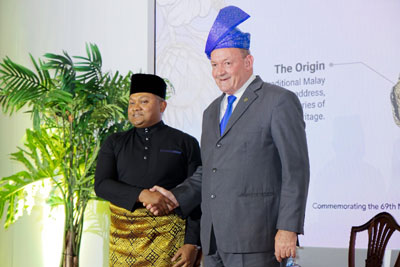
Malaysia’s High Commissioner to South Africa, Datuk Yubazlan Yusof with Acting Deputy Director-General for Asia and the Middle East at the Department of International Relations and Cooperation (DIRCO), Ambassador Dave Malcomson, who was bestowed a tanjak at the event |
|
|---|
Malaysia’s 69th National Day and 63rd Malaysia Day were celebrated in Pretoria on 15 September with a reception highlighting growing Malaysia-South Africa ties alongside the country’s rich culture and heritage. Hosted by the High Commission of Malaysia, the event drew about 200 guests, including representatives of the South African government, diplomatic corps, Friends of Malaysia and Malaysian Technical Cooperation Programme (MTCP) alumni from South Africa and Botswana. Malaysia’s High Commissioner to South Africa, Datuk Yubazlan Yusof said bilateral relations continued to gain momentum following high-level engagements in 2025. He said bilateral trade reached about US$1.33 billion in 2025, with further opportunities in trade and investment, maritime connectivity, defence, the halal economy, green technology and innovation. Yubazlan also highlighted the importance of people-to-people ties, noting that more than 250 South Africans have participated in MTCP training and capacity-building programmes over the years.
|
|
|---|
| Old Roots, New Routes, connecting continents through BRICS - Ethiopia and India |
|
|
|---|
Ethiopian Prime Minister Abiy Ahmed with Indian Prime Minister Narendra Modi (photo: EAM) |
|
|---|
BY DESTA GEBREHIWOT - Deputy Editor, Ethiopian Herald
Known for their ancient civilizations and rich indigenous cultures, Ethiopia and India have turned old trade routes into new foundations for an alliance connecting Africa and Asia. The longstanding ties between Addis Ababa and New Delhi go far beyond modern diplomacy, predating the opening of embassies and the raising of flags in each other's capitals. Long before official visits, well before borders became fixed and air travel brought the two countries closer, their peoples were already connected through trade across the Indian Ocean. Over the centuries, Ethiopia and India became important links between the two vast continents. From the exchange of goods and knowledge to resistance against colonialism and participation in the Non-Aligned Movement, the two countries share striking similarities. Separated geographically but connected historically, they have built strong ties, with leaders from both countries regularly including the other in their diplomatic itineraries. Ethiopian and Indian traders exchanged commodities and took part in maritime networks linking Africa, Arabia and South Asia. These connections were not based on modern political alliances, they grew out of commerce, curiosity and the practical reality that the Indian Ocean brought different peoples into contact. India and Ethiopia established diplomatic relations in 1950, and political contacts gradually expanded. Emperor Haile Selassie visited India, while Indian leaders also developed close relations with Ethiopia. |
|
|---|
| | Celebrating the beauty of a new beginning - Ethiopian New Year |
|
|
|---|
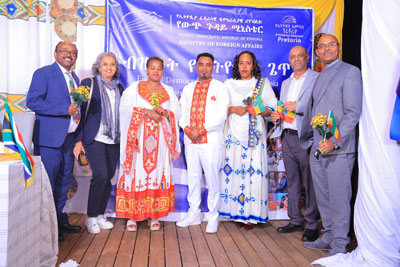
We had the wonderful honour of attending the Ethiopian New Year celebration in Pretoria with the Embassy of Ethiopia and Charge d'Affaires Mrs. Dessie Alebachew,
It was a beautiful evening filled with culture, warmth, friendship, and the spirit of togetherness.
From authentic Ethiopian cuisine and the rich aroma of freshly brewed Ethiopian coffee to wonderful conversations and vibrant traditions, every moment was a true celebration of Ethiopia’s heritage and hospitality. |
|
|---|
| Turkiye Marks 104 Years of Victory with a Message of Independence, Peace and Partnership in South Africa |
|
|
|---|
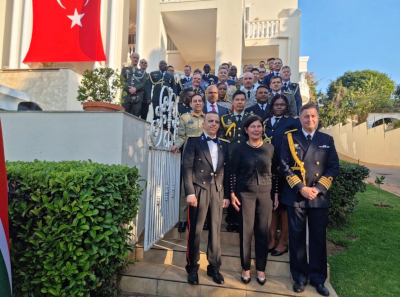
Defence Attaches represented in South Africa with Ambassador Yıldırımgeç (front centre) and Lt. Col. Erdi İsseven (l) (photo supplied) |
|
|---|
The Republic of Türkiye marked its 104th Victory Day on 30 August 2026, commemorating the decisive Battle of Dumlupınar of 1922 and the historic triumph that secured the final stage of Türkiye’s War of Independence. In Pretoria on August 28, 2026, the occasion was marked at the Turkish Residence by Ms. K. Nilvana Darama Yıldırımgeç, Ambassador of the Republic of Türkiye to South Africa, who hosted diplomats, government representatives, military attachés, institutional representatives and distinguished guests. The occasion was also hosted in association with Lt. Col. Erdi İSSEVEN, Armed Forces and Army Attaché of the Turkish Embassy, underlining the close relationship between the diplomatic and military dimensions of Türkiye’s engagement with South Africa. Victory Day, or Zafer Bayramı, is one of the most important dates in the Turkish national calendar. It commemorates the decisive victory at Dumlupınar on 30 August 1922, under the command of Gazi Mustafa Kemal Atatürk, which became the decisive turning point in the Turkish War of Independence and opened the way towards the establishment of the Republic of Türkiye in 1923. The significance of the day was reflected in the Ambassador’s address, which connected the historic struggle for national independence with Türkiye’s contemporary role in international affairs. “On 30 August 1922, the Turkish people achieved a decisive victory at the Battle of Dumlupınar,” Ambassador Yıldırımgeç told guests. “It was a turning point in our War of Liberation, achieved after years of immense sacrifice, hardship and struggle to defend our homeland.”
|
|
|---|
Whispers of Wonderland Stage Production: 29 September/1 October A primary school production as an adaptation of the classical ‘Alice in Wonderland’ story line incorporating drama, movement, music and dance. Show times: 30 September and 1 October 2026 from 18:00 Ticket cost: R150/person Venue: Fairtree Atterbury Theatre No tickets will be available at the door. Tickets are available to purchase only from Seatme at the following link: |
|
|---|
|
|