16 July 2026 Issue 353 - Shaping the World
|
|
|
|---|
|
| At 250 the USA Continues to Shape the World |
|
|
|---|
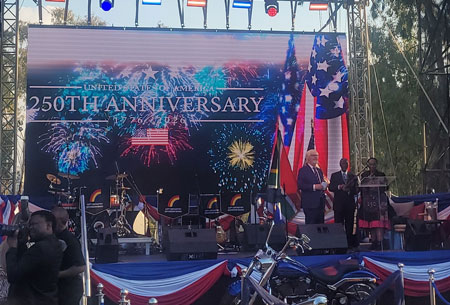
Pictured on stage is US Ambassador L. Brent Bozell with former South African President Thabo Mbeki and Social Development Acting Minister, Sindisiwe Chikunga at a spectacular celebration of the 250th Independence anniversary of the United States in Pretoria, South Africa. Drawing parallels between the two nations Bozell in his address said, “The American experiment endures because it is never finished. Each generation inherits the work of freedom and carries it forward. That belief in the power of ordinary citizens also resonates deeply here in South Africa.” (photo: TDS) |
|
|---|
On 4 July 2026, the United States of America marks a remarkable milestone—250 years since thirteen colonies declared their independence and embarked upon a political experiment that would fundamentally reshape the course of modern history. Few nations have exerted such profound influence on the global imagination. From democracy and constitutional governance to technological innovation, scientific discovery, popular culture and economic enterprise, the American story has become inseparable from the story of the modern world itself.
The United States remains a land of immense contrasts. Stretching from the Atlantic to the Pacific, from Alaska to Hawaii, it encompasses some of the world's most diverse landscapes, cultures and economies. Its universities educate global leaders, its financial markets influence every economy, its technology companies redefine the future, and its entertainment industry continues to shape global culture. American entrepreneurship has transformed industries ranging from aviation and pharmaceuticals to artificial intelligence, biotechnology, space exploration and renewable energy. For much of the post-Second World War era, the United States stood at the centre of the international order. Through institutions, alliances and economic partnerships, it underpinned global trade, security arrangements and technological cooperation. Whether through the Marshall Plan, NATO, the Bretton Woods institutions or the digital revolution born in Silicon Valley, America crafted not only unparalleled power, but also a narrative founded upon opportunity, innovation, reliability and leadership. Yet, like every great nation, the United States is evolving. |
|
|---|
|
| Japan Emerges Eighty Years After War, Shapes its Own Destiny |
|
|
|---|
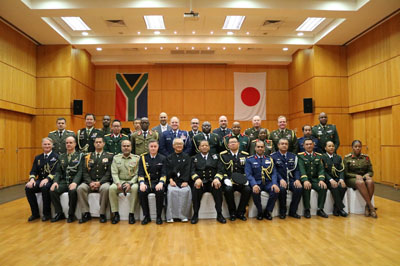
Pictured seated centre are Japanese Ambassador Fumio Shimizu and Chief of the South African Navy, Vice Admiral Monde Lobese with Defence Attaches represented in South Africa (photo: Embassy of Japan) |
|
|---|
The world often remembers Japan through the lens of August 1945. On 6 August, Hiroshima became the first city in history to experience the devastation of an atomic bomb. Three days later, Nagasaki suffered the same fate. Together, the attacks claimed the lives of hundreds of thousands of people, either immediately, or through the long and painful effects of radiation exposure, bringing the Second World War to its conclusion. For Japan, the only nation ever subjected to nuclear warfare, the physical destruction was accompanied by profound national trauma. Entire cities disappeared. Families were shattered. Economic collapse, social upheaval and decades of reconstruction followed. The Japanese people rebuilt their country from the ashes with remarkable determination, choosing not revenge, but renewal. Eighty years later, the story of modern Japan is no longer defined by defeat but by one of history's greatest national transformations. |
|
|---|
|
Informed India, Healthy India |
|
|
|---|
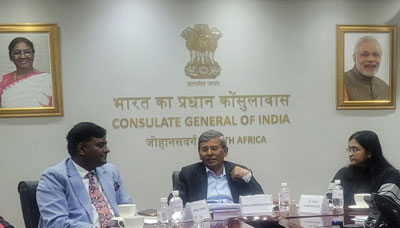
Pictured (l-r) Consul General of India in Johannesburg S. Koventhan, High Commissioner of India Prabhat Kumar and Deputy High Commissioner Banu Prakash at the press briefing (photo: TDS) |
|
|---|
From Data to Diplomacy - How the NFHS-6 Chronicles India's Health Revolution and Expanding Global Influence
When India launched its first National Family Health Survey (NFHS) in 1992, the country was embarking on a period of profound economic reform. Liberalisation had just begun, the economy was opening to the world, and policymakers recognised that sustainable development would require more than economic expansion alone, it would demand a clear understanding of the health and wellbeing of one of the world's largest populations. More than three decades later, the Sixth National Family Health Survey (NFHS-6) tells an extraordinary story. Conducted during 2023–2024 across 715 districts by the International Institute for Population Sciences (IIPS), the survey is among the most comprehensive public health assessments ever undertaken anywhere in the world. Covering a nation of more than 1.46 billion people, its findings are statistical benchmarks as well as indicators of a society that has undergone one of the most significant human development transformations of the twenty-first century. Presenting the findings in Johannesburg, India's High Commissioner to South Africa, Prabhat Kumar and recently arrived Consul General of India in Johannesburg S. Koventhan highlighted the survey as evidence of India's steady progress towards Universal Health Coverage and the Sustainable Development Goals (SDGs). Behind the numbers lies a broader narrative, one that demonstrates how sustained economic growth, political continuity, digital innovation and social investment have combined to improve the lives of hundreds of millions of people. |
|
|---|
| Kwibohora 32 - Rwanda's Journey Continues |
|
|
|---|
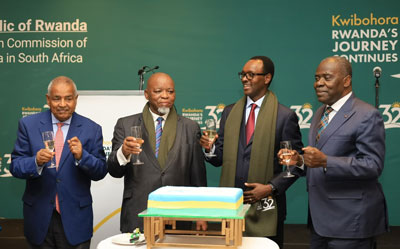
Pictured (l-r) Ambassador of Eritrea and Dean of the Diplomatic Corps. Salih Omar Abdu, Minister Gwede Mantashe, High Commissioner Emmanuel Hategeka and Ambassador of the Central African Republic and Dean of the African Diplomatic Corps Andre Nzapayeke (photo: High Commission of Rwanda) |
|
|---|
Rwanda's 32nd Liberation Day celebration in South Africa honoured the country's remarkable journey of renewal while reflecting the renewed momentum in relations between Rwanda and South Africa.
The afternoon came alive with music, celebration and cultural pride as the award-winning Rwandan dance troupe, Itorero Inyamibwa, captivated guests with energetic performances that showcased Rwanda's rich cultural heritage and national pride. Addressing the gathering, Rwanda's High Commissioner to South Africa, Emmanuel Hategeka, reflected on the meaning of liberation beyond military victory. Quoting former South African President Nelson Mandela, he reminded guests that, "There is no easy walk to freedom anywhere," saying Rwanda understood those words deeply because its freedom had been earned through sacrifice, courage and determination. "The Rwanda we proudly celebrate today was reborn through liberation 32 years ago. One lesson remains unmistakably clear; nations are transformed by the choices they make. Rwanda deliberately chose unity over division, accountability over blame, self-reliance over dependency, and long-term vision over short-term expediency." |
|
|---|
| | 215 Years of Venezuela Independence, Resilience and the Enduring Pursuit of Sovereignty |
|
|
|---|
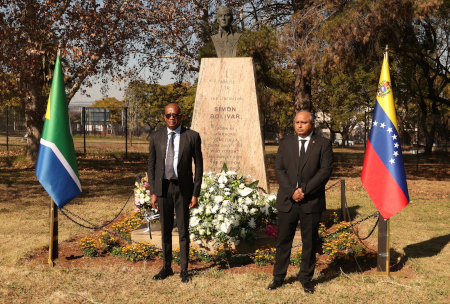
Deputy Minister in the South African Presidency, Kenny Morolong and Ambassador Carlos Feo Acevedo (photo: GCIS) |
|
|---|
Set in the surroundings of the Pretoria Art Museum, home to one of South Africa's most prominent busts of the Liberator Simón Bolívar, Venezuela's 215th Independence Day commemoration unfolded in an atmosphere of solemn reflection rather than celebration. At the foot of Bolívar's likeness, wreaths were laid in memory of those who lost their lives in the recent double earthquakes that devastated parts of Venezuela. A book of condolences was opened, inviting members of the diplomatic corps, government representatives and friends of Venezuela to express messages of sympathy, solidarity and hope for the country's recovery and reconstruction.
Every nation celebrates independence through the lens of its own history. For Venezuela, 5 July is a reaffirmation of a struggle for sovereignty that began in 1811 under the leadership of Simón Bolívar and continues to shape the country's national identity today. This year's 215th anniversary became an occasion of remembrance, resilience and solidarity for the nation that is experiencing widespread destruction, loss of life and communities facing the immense challenge of rebuilding. As one of the world's most resource-rich nations and home to the largest proven oil reserves, Venezuela has long embodied both extraordinary promise and profound contradiction. Its abundant natural wealth has been both a blessing and, at times, a burden, attracting global attention while exposing the country to decades of economic, political and geopolitical pressures. |
|
|---|
| Diplomacy's First Kiss: Ambassador Hoang Sy Cuong Bids Farewell to South Africa |
|
|
|---|
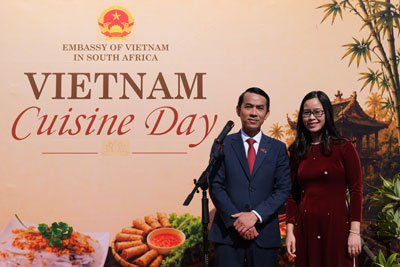
Ambassador Hoang Sy Cuong and Phuong Vu host guests at Vietnam Cuisine Day and to bid farewell |
|
|---|
"If I may say that diplomacy is my first love, then South Africa is my very first kiss. How sweet and memorable a first kiss is."
With these words, Vietnamese Ambassador to South Africa Hoang Sy Cuong captured the affection and gratitude he feels for the country that marked the beginning of his diplomatic journey as he and his spouse Phuong Vu hosted a farewell celebrating Vietnamese cuisine in Pretoria. South Africa is Ambassador Hoang Sy Cuong's first posting as an ambassador, making his departure both a professional milestone and a deeply personal moment. The gathering brought together members of the diplomatic corps, friends and partners to experience the rich culinary traditions of Vietnam. Setting official matters aside, Ambassador Cuong spoke about food as a universal language that transcends borders and connects people. The embassy sought to bring a taste of Hanoi and other regions of Vietnam to Pretoria through a menu featuring traditional dishes, including crispy spring rolls, PHỞ BÒ, BÁNH MÌ, and other specialities rooted in the country's rice culture. "As diplomats, we travel the world and enjoy great food and fine dining experiences, but nothing will ever compare to our mothers' home cooking," he said. "Food is not just about ingredients. It is about love, memory and the comfort of home." |
|
|---|
| The Philippines is a Nation Forged by Freedom, Connected by Friendship, and Looking Confidently to the Future |
|
|
|---|
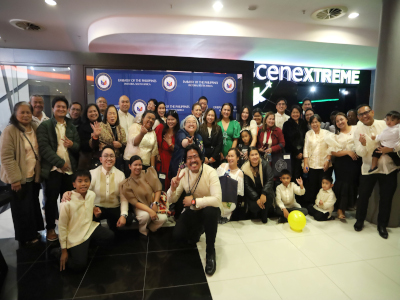
Filipinos celebrating their heritage in Pretoria, South Africa (photo: Philippines Embassy) |
|
|---|
There are few countries whose national story is as compelling as that of the Philippines. An archipelago of more than 7,600 islands scattered across the western Pacific, the Republic of the Philippines is a nation where geography has shaped culture, resilience has defined identity, and history has cultivated an unwavering commitment to freedom.
As the Philippines commemorated the 128th Anniversary of the Proclamation of Philippine Independence on June 12th, the Philippine Embassy in Pretoria transformed the occasion into a celebration of national identity, artistic excellence, enduring friendship and a confident vision for the future. Hosted by Ambassador Myla Grace Ragenia Macahilig, the event, under the theme "SineKalayaan 128: The Philippines in Portrait," used cinema as the lens through which to explore the Filipino spirit. The evening's Guest of Honour, South Africa's Deputy Minister of Cooperative Governance and Traditional Affairs, Dr Namane Dickson Masemola, reflected on the remarkable parallels between South Africa and the Philippines. Both nations, he noted, emerged from long and often painful struggles against domination and oppression. Their democratic journeys were born from sacrifice, perseverance and the determination of ordinary people to reclaim their sovereignty and dignity. |
|
|---|
| China, Africa and the Shared Pursuit of Modernisation |
|
|
|---|
Trucks bound for Africa are loaded onto a China-Africa liner service at Yantai Port in Shandong Province on 9 May (XINHUA) |
|
|---|
The book Xi Jinping: The Governance of China, now in its fifth volume, is a primary record of one of the most remarkable transformations in human history and a window into the ideas that continue to shape the trajectory of China.
As the world undergoes a historic shift towards greater multipolarity, China stands at the forefront of a new Global South consciousness. Nowhere is this more evident than in its relationship with Africa, a partnership that has evolved from solidarity in anti-colonial struggles into one of the most consequential development partnerships of the 21st century. At the heart of this relationship lies a simple but powerful principle: collective responsibility and collective ownership create the conditions for collective prosperity and stability. China’s development journey has demonstrated what can be achieved through long-term planning, policy consistency, social cohesion and a people-centred approach to governance. Under the leadership of the Communist Party of China, China has lifted hundreds of millions out of poverty, built world-class infrastructure, become a leader in advanced manufacturing and technological innovation, and embarked on a path of high-quality development. The fifth volume of Xi Jinping: The Governance of China captures many of these experiences and offers valuable insights into how governance can be aligned with national development objectives. While every nation must find its own path to modernisation, the Chinese experience provides important lessons for developing countries seeking to overcome poverty, inequality and underdevelopment. |
|
|---|
|
|