|
|

|
|
Somaliland’s Lessons in Peace for Africa
|
 by Greg Mills and Emily van der Merwe by Greg Mills and Emily van der Merwe
‘A place that has made something out of virtually nothing’ is how former Nigerian president Olusegun Obasanjo describes the progress made by Somaliland.
Former Nigerian president Olusegun Obasanjo, here pictured with Somaliland’s President Muse Bihi Abdi, is the first African president, past or present, to visit Hargeisa.
His trip there this month was the first by an African president, current or past, since the territory re-declared its independence in 1991. In June 1960 Somaliland gained its independence from its colonial master Britain before making an ill-fated decision to join former Italian Somaliland five days later in a union that was envisaged ultimately to include French Somalia (now Djibouti), the Somali-dominated Ogaden region of Ethiopia (now Region 5) and a chunk of northern Kenya.
Following a bitter civil war that saw the forces of Somali President Mohamed Siad Barre cruelly bomb and strip the capital of Hargeisa (in which by 1990 only an estimated 2,000 of its former population of 500,000 remained), the Somali National Movement booted out the occupiers, and set about creating the conditions for stability which have endured for nearly three decades.
Peace did not require vast external resources. There were none available anyway at the time.

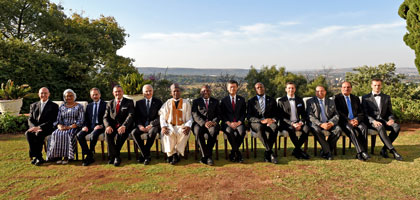
Photo (l-r): Italian Republic - Mr Paolo Cuculi, Guinea (Conakry) - Mrs Hawa Diakite Kaba, Greece - Mr Roussos Koundouros, Serbia - Mr Goran Vujicic, Argentine Republic - Mr Alberto Pedro Da’Alotto, Federal Republic of Nigeria - Mr Kabiru Bala, President Cyril Ramaphosa, Japan - Mr Norio Maruyama, Botswana - Mr Lameck Nthekela, Ukraine - Mr Taras Kuzmych, Dominican Republic - Mr Héctor Galván, Iraq - Mr Arshad Omar Esmaeel and Montenegro Mr Ivan Lekovic. (Jacoline Schoonees/DNS)
President Cyril Ramaphosa has reiterated South Africa’s commitment to working with the international community as the country begins a new chapter after the recently held elections.
Addressing Ambassadors after receiving their letters of credence at Sefako Makgatho Presidential Guesthouse in Tshwane, President Ramaphosa said that South Africa this year celebrates 25 Years of Democracy as it ushers in the sixth democratic administration.
"You formally take up your posts just as South Africa is entering its 6th democratic administration. This is an administration that will be firmly committed to placing the country on the path of renewal, growth and transformation."
|
|
Cuba and South Africa: Many Reasons to Celebrate the First 25 Years of Diplomatic Relations
|
 By Rodolfo Benítez Verson, Ambassador of Cuba in South Africa, Eswatini and Lesotho By Rodolfo Benítez Verson, Ambassador of Cuba in South Africa, Eswatini and Lesotho
Twenty–five years ago, on 11 May 1994, Presidents Nelson Mandela and Fidel Castro formalized diplomatic relations between South Africa and Cuba. That was one of the first foreign policy actions of the new Government in a liberated South Africa.
But before official bonds began, there was already a long history of special relations. Since the triumph of the Cuban Revolution in 1959, Cuba became an active and loyal supporter of the struggle against Apartheid.
In the United Nations and other international forums, Cuba strongly opposed the racist government of South Africa and called for the expulsion of the Apartheid regime from the UN.
Cuba denounced the imprisonment of Nelson Mandela and his comrades when they and their movement were labeled as terrorists by several governments. In his autobiography, “Long Walk to Freedom” Madiba explained that while in prison, he found inspiration in Fidel Castro, Che Guevara and the Cuban Revolution.
As early as in 1961, even before the Rivonia Trial, young South Africans from the anti Apartheid forces started to arrive in our country to receive professional training in medicine and sciences. In the following decades, many more would receive professional education and military training by Cuba. Our country was a home for many South Africans during the dark night of Apartheid oppression.
|
|
Diplomacy and Passion Maserati Quattroporte
|
 Safe and sound is how a diplomat would like to return after carrying out a mission. It may be the most satisfyingly career-enhancing assignment, or a complex and challenging task that needed to be accomplished. Or it may just be to make a statement on arrival. Safe and sound is how a diplomat would like to return after carrying out a mission. It may be the most satisfyingly career-enhancing assignment, or a complex and challenging task that needed to be accomplished. Or it may just be to make a statement on arrival.
The four door Maserati Quattroporte (as the name obviously suggests) is the hallmark of Italian design. It was modelled around people with a certain station in life, people that have proved themselves as worthy of the authority they have been mandated with. This luxury sedan is the perfect fit for professionals who qualify for the position they occupy and deserve the perks associated with the high office.
Unlike diplomacy however, the Maserati Quattroporte is equipped with an adaptive cruise control protocol which automatically maintains a safe following distance while adjusting to increasing and reducing speed flows with aplomb. This standard feature makes the journey effortless, safe and comfortable.
|
|
|
|
|
APRIL/MAY 2019 Print Edition
|
|
|
|
|
|
|
|