Filters

BRICS SPECIAL

Brazilian expert calls upcoming BRICS summit opportunity for trade and investment growth

5 July 2025 - Professor Rafael Dias believes that the summit will help establish mutually beneficial partnerships

The BRICS summit in Rio de Janeiro will be a key platform for strengthening cooperation between the countries of the association, which is particularly relevant given the recent accession of new states to the group. This was stated by Rafael Dias, head of the International Relations Department at the University of Campinas (Brazil) and professor at the Faculty of Applied Sciences, in an exclusive interview with TV BRICS.

BRICS SPECIAL

Indian expert notes need to establish permanent BRICS secretariat

5 July 2025 - It would help BRICS become a more influential player on the global stage, he states

Speaking ahead of the upcoming BRICS summit, Robinder Sachdev, Senior Geopolitical Expert and President of the Imagindia Institute, emphasised the need for stronger coordination mechanisms within the group. In an exclusive interview with ANI, a partner of TV BRICS, he called for BRICS to establish a permanent secretariat to strengthen its institutional framework and ensure effective implementation of decisions.

BRICS SPECIAL

Brazilian expert: BRICS summit to discuss transition to settlements in national currencies

5 July 2025 - He also said that the social agenda will be discussed

Lier Pires Ferreira, Professor at the BRICS Research Centre at the Federal University of Fluminense, described expectations for the upcoming summit, which will take place on 6-7 July, as favourable in an interview with Toda Palavra, a partner of TV BRICS.

BRICS SPECIAL

Chinese expert names key tasks for BRICS summit in Brazil

5 July 2025 - According to Xie Hongjun, the meeting will discuss trade and economic cooperation, global governance reform, and artificial intelligence

Over the years, the BRICS mechanism has evolved from an initial economic concept into a platform for comprehensive cooperation. This was stated by Xie Hongjun, Researcher at the BRICS Research Center of the University of International Business and Economics (UIBE), in an interview with CGTN, a partner of TV BRICS.

BRICS SPECIAL

Expert from Russia calls for synchronisation of environmental requirements in BRICS countries

5 July 2025 - He paid particular attention to the creation of a technological platform that would bring together best practices and solutions

Aleksander Zakondyrin, Director of the All-Russian Research Institute for Environmental Protection, has put forward an initiative to coordinate environmental standards between BRICS countries. He announced this in an exclusive interview with TV BRICS.

Top leaders of Vietnam, China hold talks in Hanoi

The two leaders engaged in in-depth discussions on the situation of each Party and country, the relations between the two Parties and the two countries, as well as regional and international issues of mutual concern.

General Secretary of the Communist Party of Vietnam (CPV) Central Committee To Lam (right) and General Secretary of the Communist Party of China (CPC) Central Committee and President of China Xi Jinping. (Photo: VNA)


14 April 2025 

Hanoi (VNA) – General Secretary of the Communist Party of Vietnam (CPV) Central Committee To Lam held talks with General Secretary of the Communist Party of China (CPC) Central Committee and President of China Xi Jinping in Hanoi on April 14 afternoon.

At the talks, which took place right after the official welcome ceremony for the Chinese leader, Lam welcomed Xi’s state visit, noting its significance during the Year of Vietnam-China Humanistic Exchange and the 75th anniversary of diplomatic relations.

The Vietnamese leader expressed confidence that the visit would mark a new milestone in the enduring friendship between the two Parties and nations, contributing to further deepening the Comprehensive Strategic Cooperative Partnership and advancing the building of a Vietnam-China community with a shared future that carries strategic importance.

In response, Xi expressed his joy at returning to Vietnam - both "a comrade and a brother" - just over a year since his last visit. He highlighted the visit’s timing that coincides with Vietnam’s celebrations of the 95th anniversary of the Communist Party of Vietnam (CPV), the 80th anniversary of the nation’s founding, and the 50th anniversary of the liberation of the South and national reunification.


General Secretary of the CPV Central Committee To Lam and General Secretary of the CPC Central Committee and President of China Xi Jinping at the talk. (Photo: VNA)
 

Xi noted that choosing Vietnam as the first destination for his overseas visits this year reflects the high value the Chinese Party and State place on bilateral relations as well as the deep bond shared by the two countries.

The Chinese leader expressed readiness to engage in in-depth discussions with Party General Secretary Lam and other key Vietnamese leaders to discuss orientations and measures to foster the traditional friendship and shape a vision for the building of the China–Vietnam community with a shared future that carries strategic importance, guided by six major orientations.

As comrades and brothers, China and Vietnam stand united and cooperate closely on the path of socialist modernisation in each country, moving forward together, striving for the happiness of their peoples, and contributing more to human progress, he affirmed.

Lam said the Vietnamese Party and State believe in and support Xi’s continued leadership in steering China toward sustained development and achieving its second centenary goal, while playing an increasingly important role in promoting peace, cooperation, and development in the region and around the world.

Fostering relations with China remains an objective requirement, a strategic choice, and a top priority in Vietnam’s overall foreign policy, he noted.

On this occasion, Lam expressed his gratitude to the Party, State, and people of China for their immense and wholehearted support to the Party, State, and people of Vietnam.

Xi held that under the leadership of the Vietnamese Party and State, the political and social situation in Vietnam has remained stable in recent years, with significant achievements in reforms and an increasingly enhanced international standing.

He also praised the great achievements of the recent bold reforms carried out by the Vietnamese Party and State, believing that under the CPV Central Committee’s leadership with General Secretary Lam at its helm, the Vietnamese people will successfully realise their set goals and tasks, confidently ushering the country into a new era of development.

Xi affirmed that China adheres its persistent policy of friendship with Vietnam, always considers Vietnam a priority in its neighbouring diplomacy and supports Vietnam’s prosperous development and people's happiness.

In a warm, friendly, sincere, and frank atmosphere, the two leaders had in-depth exchanges on the situation of each party and country, the relationship between the two parties and nations, and regional and international issues of common concern.

They agreed that the relationship between the two parties and two countries has made remarkable strides in recent years, guided by the six major orientations. The strategic exchanges at all-levels have been frequent, and substantial cooperation has progressed in areas, particularly in economic and trade ties, which have seen considerable growth. The foundation of friendship has been further strengthened, with highlights in tourism, education, culture, and local exchanges. The two countries have also collaborated effectively in multilateral mechanisms, maintaining open discussions on existing issues.

Regarding the direction for future relationship between the two parties and countries, the two sides agreed to maintain regular high-level exchanges and upgrade the strategic dialogue mechanism between the Ministries of Foreign Affairs, Defence, and Public Security to the ministerial level; strengthen practical all-around cooperation; establish a joint railway cooperation committee between the two governments to promote railway collaboration; and effectively organise events for the Year of China-Vietnam Humanistic Exchange 2025 to further solidify the social foundation. Additionally, the two sides will strengthen multilateral coordination, and properly manage and resolve disagreements.

Lam proposed the two sides to maintain regular strategic exchanges and enhance cooperation between the two parties, particularly in key areas such as diplomacy, defense, and security; and promote strategic transportation infrastructure connectivity by offering favourable terms for concessional loans, technology transfer, and human resources training. He urged the two sides to make the highest efforts to ensure the timely implementation of the Lao Cai-Hanoi-Hai Phong railway project.

He suggested the two countries expand cooperation in digital transformation, and science-technology, making these areas a new "bright spot" in Vietnam-China relations; strengthen cooperation in key technologies; promote more balanced trade, and higher-quality investment; and pay attention to implementing major projects in Vietnam, particularly those that support Hanoi and other big cities in addressing air pollution.

General Secretary Lam expressed hopes that both countries will further consolidate a strong social foundation for bilateral relations. He called for increased public communication and education, especially among younger generations, about the friendship, and proposed the organisation of a theory symposium between the two Parties within the year.

The Vietnamese leader also urged greater cooperation in education, with a particular focus on the training of high-quality human resources across all sectors, including fundamental sciences and emerging strategic high-tech sectors. Furthermore, he called for more Vietnamese and Chinese tourists to visit each other's countries.

Xi endorsed his host’s proposals and suggested both sides deepen strategic trust and further their exchange of state governance experiences, thereby enriching both the theory and practice of socialism and steadily advancing each country’s socialist cause.

The Chinese leader advocated for effective cooperation in linking China’s Belt and Road Initiative with Vietnam’s “Two Corridors, One Belt” framework, as well as for the export of more Vietnamese products to the Chinese market. He encouraged greater investment by Chinese enterprises in Vietnam, while suggesting the sides strengthen cooperation in production and supply chains and expand collaboration in high-tech fields like 5G, artificial intelligence, the Internet of Things, semiconductors, green development, and the transformation of scientific innovation into real productivity.

In addition, he called for rich and diverse humanistic exchanges, suggesting new friendship activities to better tell the story of bilateral friendship. Over the next three years, China will invite Vietnamese youth to participate in a “red journey” to study the revolutionary histories of both nations.

On bilateral engagement at multilateral forums, the two top leaders expressed their hope that the sides will step up judicial and law enforcement collaboration within the Lancang–Mekong cooperation framework.

They agreed to direct relevant agencies and sectors to proactively seek effective solutions to outstanding differences, with a view to enhancing joint work in line with the new level of Vietnam–China relations, all on the basis of international law. Both sides affirmed their commitment to strictly adhering to the ASEAN–China consensus on the implementation of the Declaration on the Conduct of Parties in the East Sea (DOC) and to promoting a substantive and effective Code of Conduct in the waters (COC) aligned with international law and the 1982 United Nations Convention on the Law of the Sea (UNCLOS).

Following their talks, the two leaders jointly witnessed the presentation of 45 cooperation documents across a wide range of sectors, signed between ministries, agencies, and localities of the two countries, marking a comprehensive and fruitful outcome of this state visit.

The two leaders jointly witness the presentation of 45 cooperation documents across a wide range of sectors (Photo: VNA)
 

Later that evening, Party General Secretary Lam and State President Luong Cuong hosted a grand banquet in honour of the Chinese Party and State leader.

KMF equipping the digital generation of thinkers and creators

As part of the Kgalema Motlanthe Foundation Digital Skills programmes, Grade 11 girl learners are taken through Multimedia Podcasting lessons to gain exposure and practical experience with technical broadcast equipment, intergenerational dialogue, ethical leadership and creative storytelling. The KMF is grateful for the valuable partnership with The Arab Gulf Programme for Development (AGFUND) for the support in the Digital Skills programmes for Youth, Women & Girls, implemented by the Kgalema Motlanthe Foundation in South Africa.” The Arab Gulf Programme for Development is an international organisation international partner to KMF
  (photo: KMF)


KMF - TDS
15 April 2025

The Kgalema Motlanthe Foundation(KMF), which is proactively engaged in youth empowerment programs, held an event to showcase some of the activities the former President Motlanthe’s Public Benefit Organization has been engaged in over the past decade.  Welcoming the guests to the KMF Digital Skills Centre in Johannesburg Mrs Gugu Motlanthe, Executive Trustee of KMF, said, "our commitment is to bridge the digital divide and equip the next generation of thinkers and creators."

The KMF Saturday School lessons, which was hosting a cohort of Grade 11 learners from Forte Secondary school in Soweto and Westbury Secondary School, explained Mrs Motlanthe, are split into different subjects and curricula, consisting of:
1.    Robotics, a multi-disciplinary curricular of coding, electronics, physics and algorithms which are at the heart of tomorrow’s innovations. Our robotics programme offers a deep dive into both the hardware and software aspects of robotics. Learners also explore and build their own mini robots and learn how to programme them.
2.    Multimedia Podcasting & Creative Storytelling – this is a powerful medium for education and business, where learners explore communication skills, journalism and how to present a compelling audio-visual story with radio and broadcast equipment.  Our podcasting curricular provides learners with the skills needed to create their own podcasts from scratch, from content creation and editing to distribution and marketing.
3.    Computer Game Development, Design and coding – learners explore computer programming, graphic design and art, user experience and web development skills to build their own video games.  Gamification is not just about playing games, learners learn how to create their own game, integrate game design principles into non-game environments to engage, motivate and inspire people.  The gamified systems we have installed also drive learning, business development and even social change.
 
To end the day some learners participated in practical Drone Flying.

The scope of KMF programmes provided has grown exponentially over the years. These include the onsite and off-site agricultural programme for schools that run concurrently with programmes on the premises for which KMF partners with The Manger Care Centre, a real-world production farm offering education, training and exposure with SETA Accredited NQF level courses in Agricultural Skills and Food Security.

The KMF office premises itself houses greenhouse food tunnels and vegetable gardens for on-site training and are keen to progress onto hydroponics and aquaponics. Beyond the classrooms and gardens, learners receive further exposure through customised tours and excursions and attend career days.

Executive Trustee, Mrs Gugu Motlanthe, and Patron, Former President Kgalema Motlanthe, welcoming guests, curriculum partners, industry experts and facilitators on the day to the Kgalema Motlanthe Foundation Digital Skills & Multipurpose Centre for a showcase of extra-curricular youth, education and training programmes. Pictured with Mr and Mrs Motlanthe are Design Facilitators from the Greenside Design Centre, Mr Richardt Strydom and Susan Neethling


“The KMF is not just a space for learning – it is a community, a support system, and a platform where innovation must thrive. We do this intentionally so that young ambassadors step outside of their familiar environments and choose new careers paths, because they are more empowered and enriched than before, through technology and connectivity. With this exposure comes ambition, and it’s inspiring to see so many of them aspiring to become leaders of tomorrow, ready to shape, a more inclusive future," explained Motlanthe

Last year, the United Nations Secretary-General’s report on Industrial Development in Africa, highlighted the KMF digital skills project for youth as an exemplary model on the African continent. The KMF, with its partners and stakeholders, are embarking on ground-breaking programs for youth who are described as NEET, Not in Employment, Education or Training, due to unfortunate circumstances brought about by lack of access and poor government service delivery.  Many new areas in which skills and knowledge is becoming more relevant are being targeted including, energy, design, logistics and infrastructure, all linked to the emerging green economy.

Group photo includes: Trustees of the KMF, educators, facilitators, mentors, youth, members of the media, civil society and KMF curriculum partners, amongst others.  (photo: KMF)


“We will ensure they gain the relevant skills and accreditation from SETA and earn their own living.  We are in the process of importing this equipment from China because there is none available in the country, what you call a ‘Wind and Solar Bench with electric vehicle modelling incorporated into one system.  We have innovators and boffins at KMF ever-ready to make a difference,” said Motlanthe 

The work of the KMF is sustainable as it looks to the future, building social enterprises, growing its network and bolstering fundraising capabilities and capacity. “I have occasionally had to turn back, to recalibrate, and reboot.  But over time KMF has learnt how to better prepare and more importantly how to recover as we continue to respond to principles, repetition, checklists and feedback,” concluded Motlanthe.


Tradition, tea, and tomorrow: Xi Jinping's stories with Vietnam

 
Xi Jinping, general secretary of the Communist Party of China Central Committee and Chinese president, and To Lam, general secretary of the Communist Party of Vietnam Central Committee and then Vietnamese president, who is on a state visit to China, have a small chat over tea in Beijing, capital of China, Aug. 19, 2024. (Xinhua/Xie Huanchi)
 

by Xinhua writer Shi Xiaomeng

BEIJING,13  April 2025 (Xinhua) -- When To Lam made his first visit to China as Vietnam's top leader in August last year, he started the trip not in Beijing but in the southern metropolis of Guangzhou -- a special arrangement Chinese President Xi Jinping later hailed as "quite meaningful."

It was in Guangzhou, a century earlier, that Ho Chi Minh, the late Vietnamese leader, began his revolutionary activities in China, a period of history Xi described as "a shared red memory" between the two countries' ruling parties.

Xi will soon travel to Vietnam for a fourth state visit as general secretary of the Communist Party of China (CPC) Central Committee and Chinese president. The trip coincides with the 75th anniversary of diplomatic ties between China and Vietnam, two socialist neighbors that have forged an enduring bond as "comrades and brothers."

Behind the metaphors lies more than a diplomatic formality. Xi sees the enduring China-Vietnam friendship as a living cause to be carried forward. His upcoming visit offers a moment to draw inspiration from the storied past to chart the future course of bilateral relations.

"UNCLE HO"

During a state visit to Vietnam in 2017, Xi brought along a special national gift -- 19 issues of The People's Daily, the official newspaper of the CPC Central Committee.

Among the newspapers were 16 yellowed copies carrying news reports on Ho Chi Minh. "These newspapers date back to Chairman Ho's visit to China in 1955. It took us quite some effort to find them," Xi explained.

One notable edition, dated June 26, 1955, featured a full-column front-page photograph of Ho alongside Mao Zedong, Zhou Enlai and other first-generation CPC leaders.

Ho, who founded the Communist Party of Vietnam (CPV) in Hong Kong and led Vietnam's liberation, forged close personal ties with CPC leaders during his 12 years of revolutionary activities in China. "He was like a brother for Chairman Mao Zedong, Premier Zhou Enlai and other Chinese leaders," Xi wrote in a signed article published by the major Vietnamese newspaper Nhan Dan (People) ahead of the 2017 visit.


 Xi Jinping (L, front) talks with then General Secretary of the Communist Party of Vietnam (CPV) Central Committee Nguyen Phu Trong (R, front) at the former residence of late Vietnamese leader Ho Chi Minh in Hanoi, Vietnam, Nov. 13, 2017. (Xinhua/Lan Hongguang)
 

Xi holds dear the indelible contributions these great forerunners made to fostering the China-Vietnam friendship. During his first state visit to Vietnam in 2015, in a speech to Vietnam's National Assembly, Xi quoted Ho's own words: "China and Vietnam enjoy comradely and brotherly friendship."

Xi once shared his personal regard for Chairman Ho while speaking with Vietnamese youth. "We call him 'Uncle Ho'," Xi said. He noted that in the hearts of the Chinese people of his generation, Chairman Ho is remembered as the best friend of the Chinese people.

Back in 2011, Xi, then Chinese vice president, visited Ho's former residence to learn more about his life. Before his departure, Xi left an inscription: "The great man's spirit shall be honored for millennia, and the China-Vietnam friendship shall endure through the ages."

Six years later, during the 2017 state visit, Xi once again toured Chairman Ho's former residence. At a pond near the Ban Sao Nak, the wooden house where Ho once lived and worked, Xi learned to clap his hands before feeding fish, the same practice Ho once used to draw fish closer.

While there, reflecting on bilateral ties, Xi said, "We should learn from Chairman Mao, Premier Zhou and Chairman Ho, and carry forward and develop China-Vietnam friendship for the benefit of both our peoples."

TEA CHATS

During To Lam's 2024 China tour, Xi prepared a tea gathering for him at the Great Hall of People in Beijing. The Vietnamese leader chose China as his first overseas destination only two weeks after being confirmed as general secretary of the CPV Central Committee. An editorial from Nhan Dan (People) highlighted the value both countries place on their traditional friendship.

Peng Liyuan, Xi's wife, also invited To Lam's wife, Ngo Phuong Ly, to a tea gathering, where they enjoyed traditional Chinese performances, including Chinese Opera.


 Peng Liyuan, wife of Xi Jinping, chats over tea with Ngo Phuong Ly, wife of To Lam, at the Great Hall of the People in Beijing, capital of China, Aug. 19, 2024. (Xinhua/Wang Ye)
 

Over the years, tea chats have evolved into a routine yet distinctive tradition during mutual visits between Chinese and Vietnamese leaders, given the two countries' similar tea cultures. "Unlike formal talks, tea talks offer a more intimate and personal form of communication for both leaders," said Pan Jin'e, director of the Department of International Communist Movement, Chinese Academy of Social Sciences.

Gift-giving during tea chats has created lasting memories in bilateral interaction. During Xi's state visit to Vietnam in 2023, then Vietnamese leader Nguyen Phu Trong, in a tea gathering with Xi in Hanoi, presented him with a gift: a painting that depicts a previous tea chat they shared in Beijing. "It might not be particularly remarkable, but the true value lies in the cherished brotherly friendship," Trong told Xi.

Back in 2017, after a tea talk in Beijing, Xi presented Trong with a replica of Chairman Ho's handwritten poem in Chinese entitled "Walking." The poem is about Ho's arduous yet determined quest for his nation's liberation. Xi also quoted the poem in his speech to Vietnam's National Assembly in 2015 to encourage both sides to take a far-sighted view for bilateral ties.

China and Vietnam are both socialist countries led by communist parties with similar political systems and development paths. Xi once said: "China and Vietnam have achieved what we have today because we have insisted on reform, opening up and innovation, and because we have found a development path that meets our own national conditions."

In this era of transformation and challenges, the two neighbors have decided to set their sights higher. During Xi's state visit to Vietnam in 2023, they pledged to build a China-Vietnam community with a shared future that carries strategic significance. Xi told Trong at the end of this trip, "we should walk along this path together."

YOUNG FRONTRUNNERS

Also during Xi's 2023 state visit, Trong arranged a special meeting in Hanoi for the Chinese leader. The event brought together young Chinese and Vietnamese representatives, as well as individuals who had contributed to building the friendship between the two countries.

 
Xi Jinping, Nguyen Phu Trong and their spouses pose for group photos with representatives of young Chinese and Vietnamese and people who have contributed to the China-Vietnam friendship in Hanoi, Vietnam, Dec. 13, 2023. (Xinhua/Yin Bogu)
 

Xi encouraged the attendees, particularly young people, to "take the lead" in promoting bilateral friendship as "frontrunners." It was during this occasion that Le Nguyet Quynh, a Vietnamese student, met Xi for the first time.

Quynh is now a 19-year-old freshman majoring in economics at Tsinghua University, Xi's alma mater. She described her impression of Xi: "He is kind, tall and dignified."

Representing Vietnamese youth, Quynh gave a speech in front of Xi at the event. A picture of that moment has now become the cover image of her profile on WeChat, China's most popular all-in-one messaging app.

"Every time a classmate added me on WeChat and saw that I had met Xi Dada, they were all curious about how it happened," Quynh said. The affectionate term Dada refers to uncle in Chinese dialects, and was given to Xi by Chinese netizens. "It was a marvelous experience, indeed," she said.

Quynh, whose hometown is Vietnam's Nghe An province, the birthplace of Ho Chi Minh, started learning Chinese in junior high. After stumbling upon a video report of Xi's visit to his alma mater, she set her sights on attending Tsinghua University, her dream school.

Like Quynh, many Vietnamese students have chosen to pursue higher education in China. Around 20,000 Vietnamese students studied in China during the 2023-2024 academic year. The number of Chinese students in Vietnam is also on the rise.

Xi's belief that amity between nations lies in the affinity between their peoples really strikes a chord with Quynh. "No matter where you go, if people from two countries can get along well, they'll naturally start sharing elements of their own cultures with each other," she said. "And that's how friendships grow and last."

"And when it comes to maintaining the friendship between our two nations," Quynh said, "it's indeed us the youth who should carry that responsibility forward."

(Xinhua reporter Zou Xuemian in Hanoi also contributed to this story.)

Xi Jinping and his "ironclad friends" from Cambodia


 Chinese President Xi Jinping meets with Cambodian King Norodom Sihamoni in Hangzhou, capital city of east China's Zhejiang Province, Sept. 23, 2023. (Xinhua/Yao Dawei)
 

by Xinhua writers Chang Yuan, Liu Chang

BEIJING, 13 April 2025 (Xinhua) -- In February 2023, Chinese President Xi Jinping hosted then Cambodian Prime Minister Samdech Techo Hun Sen at the Diaoyutai State Guest House in Beijing, an appointment between the two old friends.

Back in early 2020, Hun Sen visited Beijing as China was battling the COVID-19 epidemic. He visited to show Cambodia's staunch support for the Chinese people at a critical moment. Three years later, Hun Sen visited China again as promised.

At their 2023 meeting, Xi recalled the prime minister's trip to China during a heavy snowfall, saying he was happy to fulfill this "three-year appointment" with the visiting leader.

The warm and sturdy friendship between Xi and Hun Sen serves as a faithful reflection of the close bond between China and Cambodia, carefully nurtured by generations of leaders of both sides over the decades. And this relationship, described by Xi as "ironclad," will surely be renewed as the Chinese leader is set to embark on his second state visit to the Southeast Asian country.
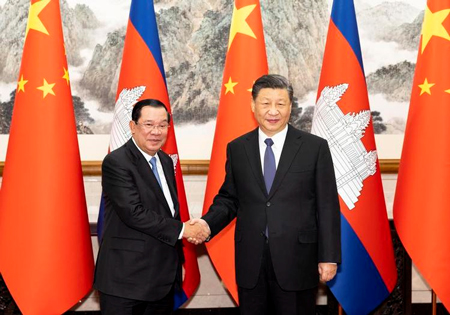

 Chinese President Xi Jinping meets with Hun Sen, then prime minister of the Kingdom of Cambodia, at the Diaoyutai State Guesthouse in Beijing, capital of China, Feb. 10, 2023. (Xinhua/Huang Jingwen)
 

A CHAIR OF UNIQUE FRIENDSHIP

On the very day Xi arrived in the Cambodian capital of Phnom Penh in 2016 for a state visit, he made a special visit to the royal palace to see Queen Mother Norodom Monineath Sihanouk. The queen mother invited Xi to sit in a chair that was frequently used by her late husband, King Father Norodom Sihanouk.

This chair had been meticulously preserved by the Cambodian royal family since the king father's passing -- covered and untouched, until Xi's visit.

"This is a privilege reserved only for the most esteemed and dearest friends," explained Princess Norodom Arunrasmy, who was present.

With a warm smile, Xi spoke fondly of King Father Sihanouk, describing him as "a revered friend of the Chinese people and a symbol of China-Cambodia friendship." The king father's deep personal ties with Chinese leaders since the 1950s have played a pivotal role in fostering the ever-refreshing friendship between the two countries.

More than once, Xi has quoted an old Chinese saying to underscore how the China-Cambodia friendship has withstood challenges and global transformations: "A long journey tests a horse's strength, and a long span of time reveals a person's heart."

In Xi's signed article published by Cambodian media prior to his 2016 visit to the country, he noted that China will never forget Cambodia's role as one of the first nations to recognize the People's Republic of China and a champion of China's rightful seat at the United Nations.
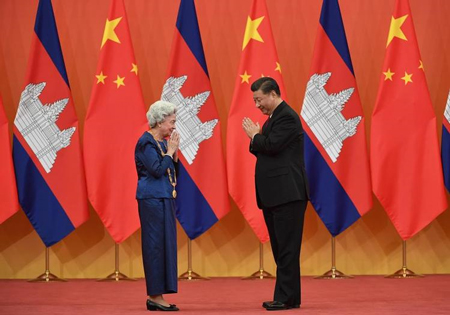

 Chinese President Xi Jinping (R) holds a ceremony to award Cambodian Queen Mother Norodom Monineath Sihanouk the Friendship Medal of the People's Republic of China at the Great Hall of the People in Beijing, capital of China, Nov. 6, 2020. (Xinhua/Zhang Ling)
 

The friendship between the two close neighbors has always been mutual. China has been a steadfast partner of Cambodia, supporting its national independence and economic development, including the construction of Cambodia's first cement plant and thermal power station.

To honor the friendship, Xi awarded a Friendship Medal to the queen mother at the Great Hall of the People in Beijing in November 2020. "This weighty 'Friendship Medal' represents the deep respect of the Chinese people for Queen Mother Monineath and the profound friendship between China and Cambodia," he said.

Xi has also shown particular care for Cambodia's royal family. "Beijing is your home. You're more than welcome to return whenever you like," he said while meeting King Sihamoni and Queen Mother Monineath at Beijing's Diaoyutai State Guesthouse in 2014. He has also made thoughtful arrangements for their medical check-ups in China. Over the past decade and more, King Sihamoni and Queen Mother Monineath regularly come to China, almost twice every year.

Over the years, Xi has also maintained frequent exchanges with Hun Sen. With Hun Manet taking over as Cambodia's prime minister, the friendship has been passed on to the next generation.

In September 2023, Hun Manet chose China as his first official overseas destination after assuming office, a gesture reflecting Cambodia's diplomatic priority. During his meeting with Xi, Hun Manet pledged to further carry forward the ironclad friendship between Cambodia and China.
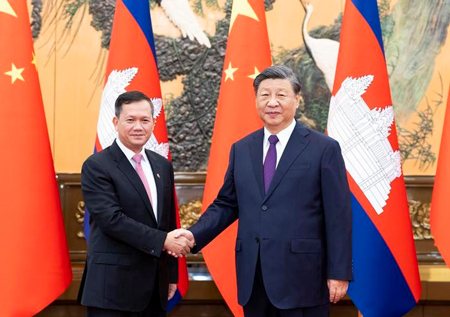

 Chinese President Xi Jinping meets with Cambodian Prime Minister Hun Manet at the Great Hall of the People in Beijing, capital of China, Sept. 15, 2023. (Xinhua/Huang Jingwen)
 

Ek Sam Ol, president of the Cambodia-China Friendship Association, said the relationship between China and Cambodia has not only set an example for big and small countries to get along with mutual respect, equality and win-win cooperation, but also contributed to regional peace and stability, which has brought great benefits to the people of the two countries.

A ROAD TO HOPE

A Cambodian proverb says, "Where there is a road, there is hope." In May 2024, a road in Phnom Penh was named "Xi Jinping Boulevard" by the Royal Government of Cambodia to honor the Chinese leader's historic contributions to the country's development. In 1965, the late King Father Sihanouk similarly named a road after Chairman Mao Zedong.

At the naming ceremony, Hun Manet highlighted that, under the leadership and joint efforts of Xi and Cambodian leaders, bilateral ties have entered their best period in history.

Since 2013, the China-Cambodia comprehensive strategic cooperative partnership has continued to strengthen thanks to flourishing practical cooperation across various fields. The Belt and Road Initiative (BRI), proposed by Xi, has played a significant role in fostering common development and shared benefits for both sides.

Situated along the ancient Maritime Silk Road, Cambodia was among the first countries to join Belt and Road cooperation. Its leaders have attended in China all three editions of Belt and Road Forum for International Cooperation in recent years.

Over the years, key BRI projects in Cambodia have reaped fruitful results: the Sihanoukville Special Economy Zone (SSEZ) has attracted over 200 international enterprises and institutions, generating 32,000 jobs; Cambodia's first expressway, the Phnom Penh-Sihanoukville Expressway, has reduced travel time between the two cities from over five hours to less than two; the Siem Reap Angkor International Airport has helped Cambodia's tourism to take off, operating 17 routes by the end of last year.
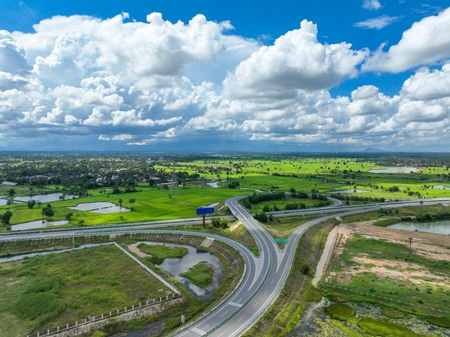

 An aerial drone photo taken on Sept. 25, 2024, shows a section of the Phnom Penh-Sihanoukville Expressway in Kampong Speu province, Cambodia.(Handout via Xinhua)
 

"The SSEZ, along with other flagship BRI projects, has played a crucial role in helping Cambodia achieve its ambitious targets of becoming an upper-middle-income country by 2030 and a high-income nation by 2050," said Neak Chandarith, director of the Cambodia 21st Century Maritime Silk Road Research Center.

Bilateral trade and commerce have also thrived. China has been Cambodia's largest foreign investor and trading partner for several consecutive years. Over the past decade, bilateral trade has nearly quadrupled, official data show. The Cambodia-China Free Trade Agreement and the Regional Comprehensive Economic Partnership have facilitated exports of Cambodian products like rice, bananas, longans and Basa fish to Chinese markets.

Xi advocates for a comprehensive approach to China-Cambodia cooperation. This is why he has repeatedly emphasized the importance of the bilateral "Diamond Hexagon" cooperation framework, which covers six major areas: politics, production capacity, agriculture, energy, security and people-to-people exchanges.

These efforts have provided new impetus for building a high-quality, high-level and high-standard Cambodia-China community with a shared future in the new era, a vision pledged by both nations' leaders, noted Thong Mengdavid, a lecturer at the Institute for International Studies and Public Policy at the Royal University of Phnom Penh.

A BOOK SHARING VALUABLE INSIGHTS

In April 2017, the Khmer edition of the first volume of Xi Jinping: The Governance of China was released in Cambodia, with Hun Sen attending the launching ceremony.

First published in 2014, this 18-chapter book compiles 79 speeches, talks, addresses, interviews, instructions and congratulatory messages by Xi from November 2012 to June 2014. The book series, which now has four volumes, serves as a key venue for readers worldwide to understand Xi's philosophies in running a major country like China.

Speaking before an audience of more than 700 attendees, Hun Sen expressed hope that Cambodian officials, scholars and students could gain valuable insights from the book and apply them to Cambodia's unique conditions, thereby contributing to more effective governance.

Chea Munyrith, president of the Cambodian Chinese Evolution Researcher Association, led the translation team. In his view, Cambodia's recent development is closely linked to learning from China's experience and ideas, many of which are reflected in Xi's book.

One article in the book focuses on poverty alleviation and wealth creation in impoverished areas. Under Xi's leadership, China eliminated absolute poverty in 2020. This achievement enabled China to meet the poverty eradication target in the United Nations 2030 Agenda for Sustainable Development 10 years ahead of schedule.

"Cambodian officials particularly focus on poverty alleviation and closely follow China's governance experience in this area," said Munyrith.

In recent years, poverty reduction cooperation between the two countries has been taking concrete steps, with the establishment of poverty alleviation demonstration villages as a highlight. The Chinese side has shared with its Cambodian counterparts useful experiences in integrating modern agriculture, vocational training and rural development.


 This photo taken on May 12, 2024, shows the Cambodia-China Friendship Multipurpose Building in Tanorn village, Bati district of Takeo province, Cambodia. Once a poor, isolated and quiet village in Cambodia's remote area, Tanorn village has now become a modern one with well-established basic physical infrastructure under a China-aided poverty alleviation project. (Photo by Van Pov/Xinhua)
 

Thanks to those efforts, concrete roads, canals, solar-powered lamps and clean water facilities have been built in villages. According to the UNDP Country Programme Document 2024-2028 released last year, Cambodia has lifted 2.8 million people, or 50 percent of the country's total poor, out of poverty in the past seven and half years.

Xi has supported Cambodia in searching for a development path suited to its unique national conditions. This principle has been central to China's accomplishment of twin miracles: rapid economic growth and enduring social stability.

With his repeated proposal, China and Cambodia are deepening cooperation in aligning the BRI with Cambodia's "Pentagonal Strategy" for national development.

In Hun Sen's eyes, Xi is a great leader and a remarkable person capable of guiding China's development.

"Every initiative he has proposed, such as the Belt and Road Initiative, which bridges past and present, and the Global Development Initiative and Global Security Initiative, reflects his far-reaching vision," said Hun Sen. "Tell me, which other leader possesses such foresight?"

(Xinhua reporters Wu Changwei, Sovan Nguon in Phnom Penh and Zhang Yuan in Beijing also contributed to the story.)


"Flowing water cannot be severed" -- How Xi Jinping promotes China-Malaysia friendship

 
Chinese President Xi Jinping holds a welcoming ceremony for Malaysia's King Sultan Ibrahim Sultan Iskandar, who is on a state visit to China, in the Northern Hall of the Great Hall of the People prior to their talks in Beijing, capital of China, Sept. 20, 2024. (Xinhua/Yin Bogu)
 

by Xinhua writer Zhao Bochao

BEIJING, 13 April 2025 (Xinhua) -- Over three decades ago, when Xi Jinping, then the top official of China's southeastern city of Fuzhou, visited Malaysia on an investment promotion trip, he found himself deeply impressed by two symbolic sites.

One is the Poh San Teng Temple, a long-standing homage to renowned Chinese navigator Zheng He (1371-1433) of the Ming Dynasty. The other is the city of Sibu, which became known as "New Fuzhou" after Wong Nai Siong, a Fuzhou native, migrated to Malaysia with over 1,000 Chinese people more than a century ago.

Both places testify to the millennium-old China-Malaysia friendship, a bond Xi has repeatedly pledged to inherit and cement as China's head of state. During a 2013 visit to Malaysia, he quoted a local proverb to illustrate the commitment: "Flowing water cannot be severed."

It was also during that Southeast Asia tour to Indonesia and Malaysia that Xi invoked again the legacy of Zheng He and put forward the 21st Century Maritime Silk Road, an essential component of the Belt and Road Initiative (BRI).

Now as Xi travels to Malaysia for a new state visit, the two nations are poised to further build on their time-honored friendship and fruitful cooperation, and steer bilateral relations toward a more promising shared future in the new era.

COOPERATION ON FAST TRACK

On a hillside overlooking the East Coast Rail Link (ECRL) project in Malaysia's eastern state of Pahang, a string of bold Chinese and Malay characters stand out against the landscape: "Extensive consultation, joint contribution, shared benefits -- building a better future."

The phrase, concise and resonant, is the main tenet of the BRI, which has now become a leading global infrastructure and development framework and fostered a host of flourishing partnerships across continents.

As a vital node along the ancient Maritime Silk Road, Malaysia is among the first to participate in Belt and Road cooperation. Thanks to joint efforts and Xi's steadfast push, bilateral collaboration within the BRI framework has borne rich fruit.

 This photo shows the launching site of the East Coast Rail Link project in Kuantan, Malaysia, on Dec. 11, 2023. (Photo by Xu Xinyu/Xinhua)
 

A notable example is the ECRL, a 665-km railway whose construction is in full swing. In a sign of the importance Xi attaches to the flagship project, he dispatched a special envoy to its launch in 2017. During his meeting with Malaysia's King Sultan Ibrahim Sultan Iskandar in Beijing last September, Xi once again called for concerted efforts to ensure its success.

The railway, once completed, will bridge Malaysia's less-developed east coast with its economic powerhouse on the west coast, enhancing connectivity and fostering balanced growth. It will also potentially link up with the China-Laos and China-Thailand rail networks, all part of the New International Land-Sea Trade Corridor, a vital international trade route.

"If that were to materialize, the ECRL would be able to tap into Thailand's entire rail network and link with Kunming in southwestern China, via Laos, achieving greater free flow of goods and passengers within the region," said Malaysian Transport Minister Anthony Loke Siew Fook.

Beyond the rail project, China-Malaysia collaboration is expanding across the horizon. China has remained Malaysia's largest trading partner for 16 consecutive years, with the volume hitting an all-time high of 212.04 billion U.S. dollars in 2024. In recent years, Malaysia's tropical fruits such as durian, mangosteen and jackfruit have become increasingly popular among Chinese consumers.

In his meeting with Malaysian Prime Minister Anwar Ibrahim last year in Beijing, Xi encouraged Malaysia to bring more Malaysian quality and specialty products to the Chinese market, and urged closer cooperation in such new areas as digital economy, artificial intelligence and new energy.

"The flourishing economic ties between Malaysia and China demonstrate the resilience and mutual benefits of our bilateral relationship," said Samirul Ariff Othman, an economist at Malaysia's Universiti Teknologi PETRONAS. "The continued expansion of investments in high-value sectors such as technology, green energy and manufacturing will further deepen our cooperation."


 A staff member shows a durian from Malaysia at the Food and Agricultural Products exhibition area during the second China International Import Expo in Shanghai, east China, Nov. 9, 2019. (Xinhua/Cai Yang)
 

FRIENDS IN NEED

In 2012, Yong June Kong, a Malaysian young man who had studied medicine in China, donated his hematopoietic stem cells to a Chinese boy suffering from leukemia, successfully saving the 7-year-old child and making himself the first foreign stem cell donor in China.

During Xi's 2013 visit to Malaysia, the president referenced this moving episode to highlight the deep friendship between the Chinese and Malaysian people. "We will also not forget" the story, Xi said with deep emotion.

"I never imagined that such a simple act would receive such high-level recognition," Yong, now a doctor at Renji Hospital in Shanghai, told Xinhua. "I couldn't sleep the whole night after learning that the Chinese president had spoken of me," he recalled.

Xi's recognition was not only a personal honor but also a tribute to the spirit of mutual support between the nations, Yong added.

"This encouragement has strengthened my resolve to stay in China, to continue my medical career in saving lives, to do more blood donations and other charitable activities, and to become a bridge of friendship between China and Malaysia," he said.

As a Malay proverb once quoted by Xi goes: "A friend who understands your tears is much more valuable than a lot of friends who only know your smile." In his eyes, the two countries are good friends who can get along well, and trust and rely on each other.

Back in 1974, with strategic vision, China and Malaysia broke the ice of the Cold War and established diplomatic ties, with the latter being the first ASEAN member to do so. Later on, Malaysia also became the first to invite China to conduct dialogue with ASEAN and the first to host the China-ASEAN summit.

During his 2013 Malaysia trip, Xi recalled the joint fight of the two countries against the 1997 Asian financial crisis and the 2008 global economic tsunami, as well as the assistance extended by Malaysia to China in the aftermath of the devastating 8.0-magnitude Wenchuan earthquake in 2008. It was also during this visit that bilateral ties were elevated to a comprehensive strategic partnership.

A decade later, Xi and Anwar reached a consensus in Beijing on jointly building a China-Malaysia community with a shared future, opening a new chapter in bilateral relations.


 Chinese President Xi Jinping meets with Malaysia's Prime Minister Anwar Ibrahim at the Great Hall of the People in Beijing, capital of China, March 31, 2023. (Xinhua/Rao Aimin)


At a broader level, Xi highly regards Malaysia's pivotal role in regional cooperation as a founding member of ASEAN and a key driver of East Asia cooperation. The Chinese president has reiterated China's support for Malaysia's ASEAN 2025 chairmanship and its commitment to ASEAN centrality and strategic independence.

"Malaysia-China relations have grown from strength to strength in recent decades," said Othman. "Today, this partnership is more dynamic than ever, underpinned by deep economic collaboration and strong people-to-people exchanges."

COMMUNICATION BETWEEN CULTURES

As China and Malaysia celebrated the 50th anniversary of diplomatic ties last year, Tan Lak Hon, along with 86 other Malaysian students at Tianjin University in China, wrote a letter to Xi, expressing their commitment to serving as messengers and promoters of Chinese-Malaysian friendship, and aspiration to help build the China-Malaysia community with a shared future.

In a message sent later that year to King Sultan Ibrahim marking the historical occasion, Xi expressed his delight in hearing from those students. "I am gratified that the cause of friendship between the two countries will be carried forward," Xi said.

Greatly encouraged, Tan plans to create a social media account to share his study and travel experiences in China with friends back in Malaysia. "I will actively serve as an advocate for our friendship, and help foster meaningful communication between students from our two countries," he said.

Xi himself has been a staunch champion of stronger cultural and people-to-people exchanges between the two nations. He has repeatedly stressed that amity between the people holds the key to sound state-to-state relations.


 Artists perform at the Canton Rhythms for Silk Road concert at Xiamen University Malaysia (XMUM) in Selangor state, Malaysia, Nov. 24, 2023. (Xinhua/Cheng Yiheng)


During his 2013 visit to Malaysia, Xi witnessed the signing of an agreement on establishing a Malaysian branch of Xiamen University, the first overseas campus of a Chinese higher education institute. Xiamen, like Fuzhou, is a major city in China's Fujian province.

The university has a special relationship both with Malaysia and with Xi. It was founded in 1921 by Tan Kah Kee, a patriotic overseas Chinese businessman and philanthropist, who was born in Xiamen and achieved great business success in Malaysia and Singapore. When Xi worked in Xiamen, he developed a profound bond with the university.

Today, the Malaysian branch of Xiamen University has 10 faculties and over 9,100 students from dozens of countries and regions. So far, more than 6,300 students have graduated from that campus, making it a shining example of China-Malaysia education cooperation and a key platform to boost mutual understanding between different civilizations.

Many of those graduates share Tan's determination to promote intercultural communication and people-to-people friendship, a theme that features prominently in Xi's approach to international relations.

"You name it. Which other leader articulates the vision for the future while trying to understand civilization, values and culture," Anwar once noted. "That is why I feel certainly comfortable in exchanges with the president for his foresight and vision."


© 2011 - 2025 The Diplomatic Society | All Rights Reserved | Website Designed by The Website Hoster