


Navi Pillay’s Nobel Peace Prize honours a journey from indenture to international justice
By Anisha Pemjee - TDS
12 October 2026
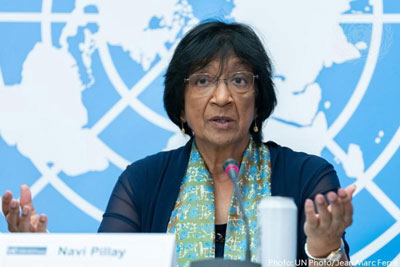
The awarding of the 2026 Nobel Peace Prize to South African jurist Navanethem “Navi” Pillay is a moment of international recognition for a career dedicated to human rights and the rule of law. It is also an opportunity to reflect on a family history shaped by colonial labour exploitation and a life forged under apartheid, two systems that determined who could exercise freedom, dignity and power.
Pillay was awarded the Nobel Peace Prize on 9 October 2026 for her efforts to promote peace and international law. The Norwegian Nobel Committee recognised her contribution to strengthening international justice and the principle that those responsible for war crimes, crimes against humanity and genocide must be held accountable.
Pillay’s family history connects to the arrival of Indian indentured labourers in colonial Natal. Her grandfather was among those brought from India to work on sugar plantations under the British indenture system. Known as Girmityas, indentured workers entered contracts under deeply unequal conditions, facing harsh labour, restricted freedoms and limited protection against exploitation. More than 150,000 Indian indentured workers arrived in Natal between 1860 and 1911, largely to meet the labour demands of the sugar industry.
Although indenture was not legally identical to slavery, it operated within a colonial economy that prioritised commercial interests over workers’ welfare. Pillay’s ancestry therefore reaches back to a period when people were transported across oceans to serve an economic system that offered little regard for their dignity or rights.
Born in Durban in 1941, Pillay grew up under apartheid, a system of institutionalised racial discrimination that restricted opportunities according to race. As an Indian South African woman, she pursued her education and legal career in a society where racial segregation was entrenched in law and access to professional advancement was unequal.
At university, Pillay encountered the Nuremberg trial records, which examined how individuals could be held accountable for atrocities committed under state authority. Those proceedings offered a powerful example of the possibility of justice beyond national borders. The idea that political power could not place individuals above the law would become a defining thread in her career.
Pillay graduated from the University of Natal with a Bachelor of Arts degree in 1963 and a Bachelor of Laws degree in 1965. In 1967, she became the first woman to establish a law practice in Natal. She defended political activists and challenged abuses by the apartheid state. In 1973, she helped secure the right of political prisoners on Robben Island to legal representation.
Following South Africa’s democratic transition, Pillay became the first Black woman appointed to the country’s High Court in 1995. That year, she also joined the International Criminal Tribunal for Rwanda, later becoming its president. Her work at the tribunal contributed to the landmark Akayesu judgment, which recognised that rape and sexual violence could constitute acts of genocide.
Pillay subsequently served as a judge at the International Criminal Court and as United Nations High Commissioner for Human Rights from 2008 to 2014. Her career has centred on accountability for atrocities, the protection of vulnerable populations and the principle that no individual should be above the law.
Her international work has unfolded against persistent challenges to the authority of international legal institutions, particularly when allegations of serious violations involve powerful political actors. Her recognition brings renewed attention to the relationship between accountability, human rights and lasting peace.
Pillay joins a distinguished group of South African Nobel laureates. Chief Albert Luthuli received the Nobel Peace Prize in 1960 for his non-violent struggle against apartheid, followed by Archbishop Desmond Tutu in 1984 for his role in the peaceful campaign against apartheid. Nelson Mandela and F.W. de Klerk jointly received the Nobel Peace Prize in 1993 for their work towards the peaceful termination of apartheid and the foundations of a democratic South Africa.
South Africa’s Nobel laureates also include writers Nadine Gordimer, awarded the Nobel Prize in Literature in 1991, and J.M. Coetzee, who received it in 2003. Sydney Brenner shared the Nobel Prize in Physiology or Medicine in 2002, while Michael Levitt shared the Nobel Prize in Chemistry in 2013. Their achievements span politics, literature and science, reflecting South Africa’s contributions to international thought and public life.
Pillay’s journey is a reminder that the consequences of historical injustice can extend across generations, but so can the determination to challenge it. Her legacy rests on the enduring question at the heart of international law: whether justice can reach those who have the least power and hold accountable those who wield the most.