


Beijing Declaration Opens New Chapter in Africa-China Natural Diamond Cooperation
The South African State Diamond Trader/TDS/Kirtan Bhana
21 September 2026
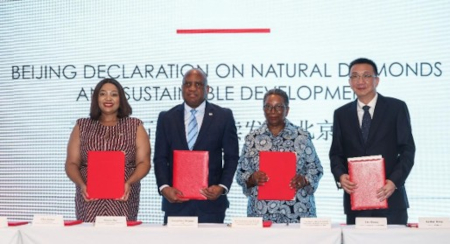
BEIJING, CHINA — A new chapter in cooperation between Africa's diamond-producing countries and China opened in Beijing on 15 September 2026, when South Africa joined Botswana and Namibia in signing the Beijing Declaration on Natural Diamonds and Sustainable Development. While placing provenance, beneficiation, skills and sustainable development at the centre of the industry's next chapter, it linked it to China’s jewellery market.
The declaration brings together the governments and diamond-sector representatives of three major African producing countries with the Shanghai Diamond Exchange, leading Chinese jewellery companies and representatives of the international natural-diamond industry.
The initiative comes at a pivotal moment for the global diamond industry, which is contending with changing consumer behaviour, pressure on natural-diamond demand and the rapid expansion of laboratory-grown diamonds.
For the African producers, however, the Beijing meeting was an effort to deepen the relationship between the economic contribution of diamonds in producing countries and the consumers who ultimately purchase diamond jewellery in China.
The signing was hosted by the Shanghai Diamond Exchange (SDE), which has positioned itself as a bridge between the international diamond supply chain and China's jewellery market. Discussions addressed the state of the global natural-diamond industry, Chinese consumer and retail trends, the socioeconomic contribution of diamonds in African producing countries and opportunities for deeper industry cooperation.
South Africa at the table
South Africa's participation was led by Nosiphiwo Mzamo, Chief Executive Officer of the South African State Diamond Trader, who was one of four principal advocates of the Beijing Declaration.
She was joined among the declaration's advocates by Lin Qiang, President of the Shanghai Diamond Exchange; Prof. Lekoko S. Kenosi, Ambassador of Botswana to China; and Ms. Tonata Itenge-Emvula, Ambassador of Namibia to China. South Africa's Ambassador to the People's Republic of China, Dipuo Bertha Letsatsi-Duba, also attended the ceremony and witnessed the signing.
Mzamo brings extensive experience in South Africa's minerals sector to the initiative. She has a background in geology and mining engineering, has worked across the mining industry and joined the State Diamond Trader as chief executive in October 2023.
For South Africa, the engagement is particularly relevant to the country's longstanding objective of increasing beneficiation and ensuring that its mineral resources generate greater value within the domestic economy. The State Diamond Trader has a statutory role in expanding South African participation in diamond beneficiation, including the cutting and polishing sector.
Recent parliamentary reporting has also highlighted the difficult conditions facing the domestic diamond industry, including weaker polished-diamond demand and broader instability in the international market.
Deeper engagement with China's diamond and jewellery ecosystem provides another avenue through which South African producers, manufacturers and businesses can seek access to an important international market.
A declaration built around cooperation
The Beijing Declaration establishes a cooperation framework with the objective of deepening exchange and cooperation throughout the natural-diamond value chain while supporting sustainable development in the producing countries.
Among the areas identified are support for African countries to strengthen local value creation, expand skills development and pursue economic diversification.
The declaration also calls for more transparent and objective communication with consumers about the origin of natural diamonds and their socioeconomic impact.
The framework is situated within the broader context of China-Africa cooperation and is aligned with the United Nations Sustainable Development Goals and the African Union's Agenda 2063.
The diamond is being positioned as a resource connected to employment, skills, economic activity and, in the case of some producing countries, national development and conservation.
For Botswana, diamonds as a development resource
The importance of that argument was strongly articulated by Botswana's ambassador to China, Prof. Lekoko S. Kenosi.
For Botswana, diamonds have played an important role in the country's post-independence development, supporting investment in education, healthcare, infrastructure and livelihoods.
Botswana has also expanded its participation beyond mining into sorting, cutting and polishing, while seeking to retain greater technology, expertise and economic value within the country.
In his remarks at the signing, Kenosi emphasised that Botswana does not expect consumers to carry responsibility for the country's development. Rather, the objective is for the full story behind a diamond's origin and economic contribution to become more visible to consumers.
The declaration is an attempt to strengthen understanding of the connection between consumption in China and economic activity in the countries where diamonds originate.
Namibia's participation
Namibia's participation adds another significant diamond-producing country to the framework. The country was represented by Ambassador Tonata Itenge-Emvula, one of the declaration's principal advocates.
For Namibia, diamonds remain an important component of the national economy, while the country has also been pursuing greater local participation and value creation in its diamond industry.
Its participation alongside Botswana and South Africa gives the initiative a distinctly African producing-country character rather than positioning the engagement as a bilateral China-industry arrangement.
That three-country configuration also provides the basis for cooperation around shared challenges while preserving the individual national interests and diamond-development strategies of each producer.
China's role
At the centre of the initiative is the Shanghai Diamond Exchange. The SDE was established with State Council approval in 2000 and operates as China's national diamond trading platform. It provides a range of services connecting the international diamond supply chain with China's market, including customs, tax and certification-related services. It is also a permanent member of the Executive Committee of the World Federation of Diamond Bourses.
The Exchange's role gives the Beijing Declaration an important commercial dimension. Its diamond industry includes trading, jewellery manufacturing, retail, certification, logistics and increasingly sophisticated consumer-facing businesses. That ecosystem was visibly represented at the Beijing ceremony.
Major Chinese jewellery companies attending included Chow Tai Fook, Lao Feng Xiang, Chow Sang Sang, Lukfook Jewellery, CHJ Jewelry, Chow Tai Seng, Sino Gem and Kimberlite.
Their participation provides a direct link between the government and industry representatives from the African producing countries and the companies closest to Chinese jewellery consumers.
Shanghai as a bridge
For Lin Qiang, President of the Shanghai Diamond Exchange, the event represented the beginning of a closer relationship rather than the conclusion of a negotiation.
He described the SDE's role as that of a platform and bridge connecting China with leading African diamond-producing countries. He also emphasised the importance of bringing the origins and value of natural diamonds to a growing number of Chinese consumers.
The exchange is expected to remain involved as participants move from the declaration itself towards practical areas of cooperation. Those areas include market-data cooperation, consumer education, cross-border exchanges of industry practices and further cooperation through existing China-Africa sustainable-development mechanisms.
Confidence, employment and sustainable development
Ambassador Letsatsi-Duba described the declaration as a positive and constructive framework for dialogue, cooperation and mutual understanding between African producers and China's natural-diamond industry.
In her remarks, she highlighted the connection between natural diamonds and economic growth, employment and sustainable development.
She also placed emphasis on consumer confidence, particularly given the emotional and symbolic role associated with natural-diamond jewellery.
The country's diamond industry operates within a much larger mining economy, but beneficiation remains a central component of its mineral-development strategy.
The challenge is not only to extract resources but to increase the economic activity, skills, manufacturing and enterprise development associated with them. The Beijing framework creates another international platform through which that objective can be pursued.
International industry gathers in Beijing
The ceremony also demonstrated that the initiative extends beyond the three African governments and the Chinese market.
Among those witnessing the signing were Al Cook, Chief Executive Officer of De Beers Group; Amber Pepper, Chief Executive Officer of the Natural Diamond Council; and Emma Wade-Smith, representing the World Diamond Council.
Cook welcomed the declaration as a framework for strengthening the connection between African producing countries and Chinese consumers.
De Beers has described its approach in Africa under its "Building Forever" strategy, linking diamond production to economic and environmental outcomes.
The company's participation therefore places one of the world's largest diamond companies within a broader dialogue involving producing-country governments, China's jewellery industry and international industry organisations.
The consumer is becoming central
One of the more significant themes emerging from the Beijing meeting is the changing relationship between the diamond and its consumer. The declaration notes growing Chinese consumer interest in authenticity, traceable provenance, cultural meaning and enduring value.
That shift is significant because the diamond industry is operating in a market in which consumers have more choices than they did previously.
Laboratory-grown diamonds have introduced a different proposition based on technological production and price, while natural diamonds continue to be associated with geological rarity, provenance and tradition.
The Beijing Declaration places greater emphasis on explaining the distinctive origin and socioeconomic contribution associated with natural diamonds. This approach is particularly relevant to African producing countries because the economic story begins long before the finished jewellery reaches a Chinese retail counter.
From mine to consumer
For Botswana, Namibia and South Africa, one of the central questions is how much value can be retained or created before a diamond leaves the continent. The declaration's emphasis on local value creation and skills development reflects that concern.
Cutting and polishing are obvious components, but the wider value chain extends into jewellery manufacturing, design, branding, technology, certification, logistics, marketing and consumer engagement.
A stronger relationship with China could create opportunities for African businesses to connect with Chinese manufacturers, retailers and technology companies while developing greater domestic capacity. For South Africa, this complements the country's existing beneficiation agenda. For Botswana and Namibia, it provides another avenue to build upon their established diamond sectors. And for China, it creates a closer relationship with the countries that supply a significant portion of the natural diamonds entering the global market.
A rough framework that needs finishing and polishing
The Beijing Declaration is a framework for cooperation that identifies several areas for follow-up, including industry market-data cooperation, consumer education on natural diamonds, exchanges of global best practice and exploration of additional cooperation through China-Africa sustainable-development mechanisms.
The timing is significant, as the global diamond industry is undergoing a period of adjustment, while China remains one of the world's major jewellery markets.
At the same time, African producing countries are confronting the need to diversify their economies and capture more value from their mineral resources. The Beijing Declaration places these issues within a single conversation. The next test will be implementation.