


India’s 80th Independence Day Highlights Deepening Strategic Partnership with South Africa
By Anisha Pemjee and Kirtan Bhana
26 August 2026
India’s 80th Independence Day was celebrated in Pretoria against the backdrop of an increasingly dynamic India-South Africa relationship, with the upcoming BRICS Summit in New Delhi set to provide another major platform for cooperation between the two countries.
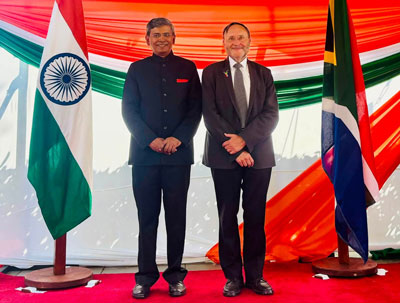
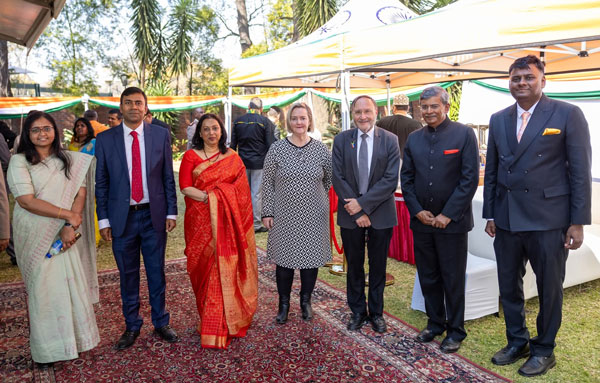
Addressing guests at the Independence Day Reception at the Indian High Commission in Pretoria on 17 August, High Commissioner Prabhat Kumar described the past year as one of significant progress in bilateral relations, highlighting expanding political, economic, business and people-to-people ties.
The High Commissioner recalled Prime Minister Narendra Modi’s visit to Johannesburg for the 20th G20 Summit in November 2025, where he met President Cyril Ramaphosa and participated in the IBSA Leaders’ Meeting. He also expressed India’s appreciation for South Africa’s leadership of the G20 and its hospitality throughout the year.
The relationship received further momentum with Deputy President Paul Mashatile’s visit to India from 29 May to 3 June 2026, accompanied by five ministers and senior officials. A South African parliamentary delegation also visited India earlier in the year.
BRICS takes centre stage
The next major milestone will be India’s hosting of the 18th BRICS Summit in New Delhi on 12–13 September, with President Ramaphosa expected to participate. Kumar noted that South Africa’s active participation in BRICS meetings under India’s chairship has further deepened bilateral cooperation.
India assumed the BRICS chairship in January 2026 under the theme “Building for Resilience, Innovation, Cooperation and Sustainability.” The programme has already included ministerial and sectoral meetings addressing trade, science and technology, energy, environment, urbanisation and other areas of cooperation.
For South Africa, the summit carries particular significance. Pretoria and New Delhi share a longstanding commitment to strengthening the voice of developing countries in global institutions, reforming multilateral governance and advancing a more representative international order.
India’s BRICS agenda also aligns closely with themes highlighted by President Droupadi Murmu in her Independence Day address: development that is inclusive, sustainable and people-centred, alongside a stronger role for India and the Global South in international affairs.
From independence to “Viksit Bharat”
In her address on the eve of Independence Day, President Murmu placed the 80th anniversary within India’s longer-term journey towards becoming a “Viksit Bharat” — a developed India — by 2047, the centenary of independence.
She emphasised that the meaning of independence lies not only in political freedom but in enabling citizens to realise their aspirations. Development, she said, must reach every section of society, drawing on India’s heritage while embracing modernisation.
President Murmu highlighted India's progress in inclusive development, financial inclusion, food security, healthcare, digital infrastructure and physical connectivity. She pointed to the expansion of digital payments, modern highways, railways, waterways and airways, describing these developments as creating opportunities for entrepreneurship, employment and investment.
She also placed considerable emphasis on women and young people as central to India’s future. With around 65 percent of the population below the age of 35, she described India’s youth as one of the country’s greatest assets, while pointing to growing participation by women in education, entrepreneurship, the economy, sport and leadership.
The President further linked India's domestic transformation with its international role. She described peace, cooperation, dialogue and “Vasudhaiva Kutumbakam” — the world as one family — as pillars of Indian foreign policy, while reaffirming India's commitment to the Global South and to greater representation in multilateral institutions.
Trade and investment expanding
These priorities are increasingly visible in India's engagement with South Africa.
According to Kumar, bilateral trade reached US$15.57 billion in the past year, while Indian investment in South Africa stood at approximately R3 billion. The signing of Terms of Reference for a proposed trade agreement between India and the Southern African Customs Union was described as an important step towards further expanding commercial relations.
Critical minerals are emerging as another strategic area. Indian and South African companies, mining experts and academics have been engaging on opportunities for cooperation, including through the India-South Africa Critical Minerals Symposium hosted with the University of Pretoria.
The partnership extends beyond trade. Defence cooperation, education, skills development, tourism and cultural exchanges are also expanding. More than 100 scholarships were offered to students from South Africa and Lesotho under the India-Africa Maitri Scholarships programme, while a new Centre of Specialisation for Artisan Skills is being established at Majuba TVET College.
A relationship rooted in people
The High Commissioner described the Indian diaspora as a “living bridge” between India and South Africa. The relationship is also being reinforced through cultural initiatives, including the installation of a bust of Mahatma Gandhi at the War Museum in Bloemfontein, an Indian Film Festival in Durban and nationwide International Day of Yoga celebrations that attracted more than 20,000 participants.
As India enters its 81st year of independence, its engagement with South Africa is therefore being shaped by more than historical ties. It is increasingly centred on trade, technology, critical minerals, skills, investment, multilateral cooperation and the shared interests of the Global South.
The BRICS Summit will place this evolving partnership in a wider international context. For India, it will be an opportunity to demonstrate its priorities as BRICS chair. For South Africa, it offers another platform to advance its interests within an expanding grouping and deepen one of its most important strategic partnerships in the Global South.
Kumar concluded by expressing confidence that India-South Africa relations would continue to grow in “depth, breadth and ambition”, grounded in shared values, historical experience, strong people-to-people connections and a common commitment to a more equitable and prosperous world.
India’s 80th Independence Day celebration in Pretoria thus offered both a reflection on eight decades of nation-building and a glimpse of the diplomatic agenda ahead — with New Delhi and Pretoria increasingly finding common ground in shaping a more inclusive global order.