


Why South Africa Matters in China's Vision of a New Global Order
Kirtan Bhana/TDS/GCIS
29 June 2026
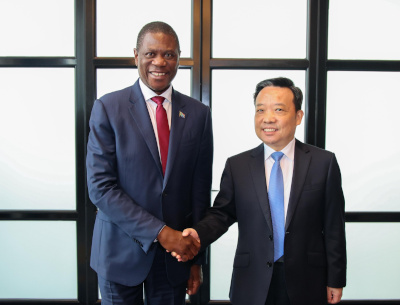
South African Deputy President Paul Mashatile's Working Visit to China signals far more than another diplomatic engagement. It reflects the emergence of a strategic partnership that is increasingly shaping Africa's industrial future and redefining the balance of power in an evolving multipolar world.
International relations are often judged by the grand spectacle of state visits, ceremonial handshakes and carefully crafted communiqués. Yet history is more frequently shaped in boardrooms than banquet halls, in investment forums rather than diplomatic receptions, and in conversations about technology transfer, industrialisation and infrastructure than in speeches filled with diplomatic pleasantries.
Deputy President Paul Mashatile's Working Visit to the People's Republic of China in June 2026 belongs firmly in the latter category.
Stretching from Beijing to the innovation powerhouse of Shenzhen, the visit was not merely a continuation of South Africa's long-standing relationship with China. Rather, it represented another chapter in an evolving strategic partnership increasingly defined by industrial cooperation, technological advancement and shared aspirations for a more balanced international order. Throughout the visit, Mashatile engaged China's political leadership while holding substantive discussions with companies spanning automotive manufacturing, infrastructure, renewable energy, environmental technology, mining, hydrogen fuel cells and advanced industrial development.
These engagements reveal an important truth often overlooked in Western analyses of China-Africa relations.
This is no longer a relationship centred primarily on trade. It is becoming a partnership centred on transformation.
South Africa's Strategic Geography in a Changing World
South Africa occupies an increasingly unique position within global geopolitics.
Few countries simultaneously possess sophisticated financial markets, deep industrial capabilities, globally competitive legal institutions, world-class logistics infrastructure and privileged access to an integrated continental market approaching 1.5 billion people.
The implementation of the African Continental Free Trade Area (AfCFTA) has transformed the continent from a collection of fragmented national markets into what promises to become the world's largest free trade area by participating countries.
For China, whose own remarkable development has increasingly shifted from export-driven manufacturing towards higher-value innovation and international investment, South Africa represents something far more significant than a bilateral trading partner.
It is a continental gateway.
The repeated emphasis by Deputy President Mashatile encouraging Chinese companies to utilise South Africa as their manufacturing and export platform into African markets was therefore neither rhetorical nor symbolic. Whether engaging automotive manufacturers such as Chery and Geely, infrastructure giant SANY, or companies involved in mineral beneficiation and environmental technologies, the consistent message was clear: South Africa seeks partnerships that create local industries rather than merely importing finished products.
This represents a significant evolution in the bilateral relationship.
Instead of simply exporting raw materials and importing manufactured goods, a pattern that has characterised many historical North-South economic relationships, Pretoria is increasingly positioning itself as China's industrial partner on the African continent.
From Diplomacy to Development
Relations between South Africa and China have matured remarkably since formal diplomatic recognition was established in 1998.
Over nearly three decades, cooperation has expanded beyond politics to encompass infrastructure, higher education, science and technology, health, mining, agriculture, finance, digital innovation and green development.
The relationship has been institutionalised through the Forum on China-Africa Cooperation (FOCAC), the BRICS partnership and, more recently, the elevation of bilateral ties into an All-Round Strategic Cooperative Partnership in the New Era.
Mashatile's participation in the Fourth China International Supply Chain Expo (CISCE) demonstrates how diplomacy itself is evolving. Supply chains have become the new strategic frontier of international relations. Nations no longer compete solely for exports; they compete for participation in global value chains where research, design, manufacturing, logistics and innovation are increasingly interconnected.
South Africa's objective, articulated throughout the visit, is therefore not merely to sell more products to China. It is to move further up the value chain.
This explains the consistent emphasis placed on localisation, skills development, electric vehicles, battery technology, hydrogen energy, mineral beneficiation and advanced manufacturing during discussions with Chinese enterprises.
These sectors represent precisely the industries likely to define economic competitiveness over the next half-century.
The Shenzhen Lesson
If Beijing represents China's political heart, Shenzhen symbolises its extraordinary economic transformation. Four decades ago, Shenzhen was little more than a fishing town bordering Hong Kong. Today it stands among the world's leading centres of technological innovation, advanced manufacturing and entrepreneurship.
For South Africa, Shenzhen offers more than investment opportunities, it offers lessons.
China's remarkable development was not accidental. It emerged from long-term planning, strategic investment in infrastructure, industrial policy, education, innovation and consistent governance.
While South Africa's political, historical and constitutional circumstances differ fundamentally from China's, there remains considerable value in understanding how strategic coordination between government, business and academia can accelerate economic development.
Mashatile's extensive engagements with both Chinese government institutions and private enterprises reflected this broader appreciation that development is increasingly built upon partnerships rather than isolated national efforts.
Africa's Industrial Century
For decades, international commentary portrayed Africa primarily as a supplier of raw materials. That narrative is changing. Agenda 2063 of the African Union envisages an integrated, prosperous and peaceful continent driven by industrialisation, innovation and regional trade.
China's own development experience increasingly aligns with many of these ambitions.
Rather than competing for Africa, many Chinese enterprises now seek to manufacture within Africa.
This distinction matters enormously.
When companies establish local assembly plants, supplier networks, technical training programmes and research partnerships, they generate employment, expand domestic capabilities and stimulate industrial ecosystems that extend well beyond individual factories.
Mashatile's meetings with automotive manufacturers and infrastructure companies repeatedly emphasised precisely these objectives: localisation, supplier development, export-oriented manufacturing and technology transfer.
Such priorities align closely with South Africa's own industrial policy while complementing broader continental objectives under the AfCFTA. If successfully implemented, this model offers Africa an opportunity not simply to participate in global supply chains but to shape them.
South Africa's Balancing Act
South Africa's foreign policy has occasionally attracted criticism from competing geopolitical camps. Yet Pretoria's approach has displayed remarkable consistency. The country remains committed to multilateralism, peaceful dialogue, international law and strategic autonomy.
Its participation within BRICS does not preclude constructive engagement with Europe or the United States. Likewise, strong relations with China need not diminish partnerships elsewhere.
Rather, South Africa increasingly reflects the foreign policy philosophy emerging across much of the Global South: nations need not choose between East and West. They can cooperate with both.
This balanced diplomacy is perhaps one of South Africa's greatest strategic assets.
In reaffirming South Africa's unwavering commitment to the One China Policy during discussions with Chinese Vice President Han Zheng, Mashatile highlighted Pretoria's longstanding consistency on issues of sovereignty and territorial integrity.
Such consistency enhances credibility. Investors, governments and international institutions alike place considerable value upon policy predictability.
Politics at Home, Confidence Abroad
Domestically, South Africa continues navigating the complexities of coalition governance, economic reform, energy security and persistent socio-economic inequalities.
These challenges are real. Yet they should not obscure another important reality.
South Africa's democratic institutions remain resilient, its judiciary independent, its financial system sophisticated and its constitutional framework robust.
Perhaps most importantly, successive administrations have maintained substantial continuity in foreign policy, particularly regarding strategic partnerships across Africa, the Global South and emerging economies. This continuity provides an important degree of certainty for long-term investors.
International partnerships rarely flourish under conditions of diplomatic volatility. The stability of South Africa's external engagement therefore represents an often-underappreciated national asset.
A Partnership Beyond Transactions
Critics frequently attempt to reduce China-Africa relations to simplistic narratives of debt, dependency or geopolitical competition.
Reality is considerably more nuanced.
The South Africa-China relationship increasingly encompasses education, scientific research, public health, digital technologies, environmental sustainability, infrastructure financing, cultural exchange and people-to-people cooperation.
The discussions held throughout Mashatile's visit—covering hydrogen technologies, environmental management, infrastructure development, advanced manufacturing and mineral beneficiation—illustrate this widening agenda.
Equally significant is the philosophical dimension underpinning the relationship.
Both countries consistently advocate greater representation for developing nations within global governance institutions, support reform of multilateral organisations and promote international cooperation founded upon dialogue rather than confrontation.
Whether one agrees with every aspect of these positions or not, they reflect broader trends reshaping twenty-first century international relations.
Power is becoming more dispersed. Influence increasingly resides across multiple centres. The era of singular geopolitical dominance is steadily giving way to one characterised by complex interdependence.
Looking Towards 2050
The significance of Mashatile's visit should therefore not be measured solely by investment announcements or memoranda of understanding. Its true importance lies in what it signals.
South Africa is positioning itself to become Africa's premier platform for industrial investment, advanced manufacturing, green technologies and regional supply chains.
China, meanwhile, continues evolving from being simply the world's factory into a partner in technological innovation, infrastructure development and sustainable industrialisation across the Global South.
Together, these trajectories possess the potential to reshape not only bilateral relations but also the broader economic landscape of Africa.
If the twentieth century was defined by ideological confrontation and the early twenty-first century by globalisation, the decades ahead may well be characterised by strategic partnerships built upon shared development, mutual benefit and civilisational dialogue.
In that future, South Africa's relationship with China will matter not because one nation seeks to dominate another, but because both increasingly recognise that prosperity is more sustainable when it is shared.
Deputy President Paul Mashatile's journey to Beijing and Shenzhen was therefore not simply another diplomatic mission. It was a reminder that the architecture of the emerging international order is being constructed today—not only in the traditional centres of global power, but also through partnerships that connect the innovation corridors of China with the industrial ambitions of Africa.
As the Rainbow Nation and the Dragon continue to deepen their engagement, the partnership offers opportunities for trade and investment. It also presents a vision of international cooperation rooted in mutual respect, long-term development and the conviction that Africa is no longer on the periphery of global affairs, but increasingly at the centre of shaping the world that is emerging.