

Pichincha - A Victory that Echoes Across Continents
By Kirtan Bhana and Anisha Pemjee
1 June 2026
The Battle of Pichincha, fought on 24 May 1822 on the mist-covered slopes of the Pichincha volcano overlooking Quito, stands as one of Latin America's defining moments. Under the leadership of General Antonio José de Sucre, Patriot forces secured a decisive victory over Spanish Royalist troops, paving the way for Ecuador's independence and advancing the vision of continental liberation championed by Antonio José de Sucre and Simón Bolívar.
More than two centuries later, the significance of Pichincha continues to resonate. As a military triumph, it was a powerful affirmation of the right of peoples to determine their own destiny. It represented a moment when diverse forces from across the region united around a common aspiration for freedom, sovereignty and regional solidarity.

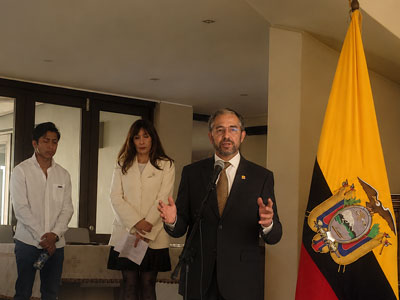
These themes were reflected during a commemoration hosted by Mauricio Montalvo, Ambassador of Ecuador to South Africa, at his residence in Pretoria. Friends of Ecuador gathered to honour the historic victory while celebrating Ecuador's rich cultural heritage. Guests were treated to traditional Ecuadorian cuisine, music and dance, creating an atmosphere that blended remembrance with cultural exchange. Songs by the renowned Ecuadorian singer Julio Jaramillo were performed, while a video presentation connected guests to a performance by the Sinamune Orchestra, showcasing music and dance by people with special abilities under the direction of Maestro Edgar Palacios.
In his reflections on the occasion, Ambassador Montalvo highlighted the enduring values embodied by the heroes of Pichincha – courage, unity and the pursuit of self-determination. These ideals remain relevant in an era when nations increasingly seek solutions through cooperation rather than confrontation.
The legacy of Pichincha also offers an interesting parallel for contemporary regional integration efforts. Just as Bolívar envisioned a united Latin America capable of shaping its own future, Africa today continues its journey toward deeper continental integration through initiatives such as the African Union and the African Continental Free Trade Area. While the historical circumstances differ, both experiences reflect an understanding that unity can amplify sovereignty rather than diminish it.
Recent developments across the Global South have renewed discussions about regional cooperation, economic integration and strategic autonomy. In this context, the memory of Pichincha serves as a reminder that nations can achieve greater prosperity and influence when they work together around shared aspirations and common interests.
As Ecuador celebrates another anniversary of its liberation, the Battle of Pichincha remains a symbol of independence achieved through collective purpose, a message that continues to inspire Latin America in a world increasingly searching for new forms of unity in diversity.