
China and Russia agree to strengthen new-type partnership during talks in Beijing
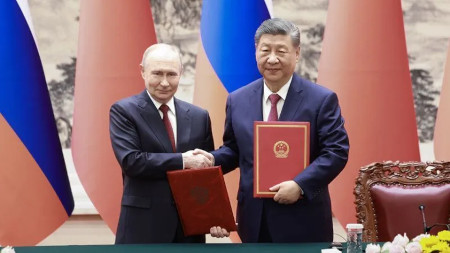
The leaders of Russia and China, together with delegations from both states, signed a number of major documents during the Chinese-Russian negotiations
TV BRICS - 21 May 2026
Talks between Russian President Vladimir Putin and President of the People’s Republic of China Xi Jinping took place at the Great Hall of the People in Beijing. They began with a meeting in a restricted format and continued in an expanded format. Following the talks, the leaders of the two countries signed a Joint Statement on the further strengthening of the comprehensive partnership and strategic interaction and on deepening relations of good-neighbourliness, friendship and cooperation. A Joint Declaration on the formation of a multipolar world and a new type of international relations was also adopted, according to the website of the Chinese government.
The heads of state delivered speeches at the Great Hall of the People. Xi Jinping noted that this year marks the 30th anniversary of the Chinese-Russian strategic partnership and the 25th anniversary of the signing of the Treaty of Good-Neighborliness and Friendly Cooperation Between the People's Republic of China and the Russian Federation. A mutual decision was taken to extend the Treaty. The Chinese leader emphasised the commitment of both states to strategic coordination at a higher level.

"As permanent members of the UN Security Council and important major countries in the world, China and Russia should take a strategic and long-term perspective, drive the development and revitalisation of our respective countries through comprehensive strategic coordination of even higher quality, and work to make the global governance system more just and reasonable" Xi Jinping President of the People’s Republic of China
He also noted that China and Russia adhere to the development of a comprehensive strategic partnership in the new era based on mutual respect, deepening political trust, and the continuous promotion of cooperation in investment, energy, science and technology, as well as people-to-people and cultural exchanges. According to him, Chinese-Russian relations have entered a new stage of more effective and rapid development. He stressed that both sides should make full use of the cooperation mechanism, promoting modernisation in the economy, energy, transport, scientific and technological innovation, and other areas of practical cooperation, Xinhua News Agency, a partner of TV BRICS, reports.
Vladimir Putin, for his part, noted the “unprecedented level” of bilateral relations. According to him, negotiations with the Chinese side took place in a “traditionally warm, comradely and constructive atmosphere”, which made it possible to discuss in detail the key areas of bilateral cooperation. Their priority directions are reflected in the joint statement signed following the talks.
“A very substantial package of intergovernmental, interdepartmental and corporate documents has been concluded, amounting to around 40 in total. Some of them were signed here. Many are aimed at further deepening economic cooperation. I would emphasise that Russia and China are important trading partners for each other. In 2025, trade turnover reached almost US$240 billion, and its structure expanded, including through goods with high added value. The growth of mutual trade was significantly facilitated by modern enterprises in Russia and China. Coordinated steps to shift settlements between our countries as a whole into national currencies were of serious importance. As a result, practically all Russian-Chinese export-import operations are carried out in roubles and yuan. In essence, we have built a stable system of mutual trade protected from external influence and negative trends on global markets,” the Russian president noted, according to the Kremlin website.
Speaking about ongoing cooperation in the energy sector, Putin highlighted the great potential for cooperation in renewable energy, in particular in the implementation of joint low-carbon generation projects. He also stated that the issue of mutual recognition of Russian and Chinese environmental certificates for electricity generation is being worked out. A corresponding memorandum was concluded during the current official visit. In addition, the president noted the desire of both countries to develop new joint value-added chains by introducing advanced technologies and innovations. In particular, he mentioned that the production of Chinese car brands has been established in Moscow and a number of Russian regions, while large-scale projects are being implemented in non-ferrous metallurgy, the chemical and pulp-and-paper industries, biotechnology, pharmaceuticals, aircraft manufacturing, and space exploration, as well as in many other high-tech sectors. The discussion also focused on strengthening partnership in the field of critical elements and metals required for the wider adoption of green technologies.

"We work together for peace and shared prosperity. In this spirit, Moscow and Beijing jointly uphold international law and the provisions of the UN Charter in their entirety and interconnection and cooperate effectively within the framework of the Shanghai Cooperation Organisation, BRICS and other international structures, making a significant contribution to addressing pressing global and regional challenges" Vladimir Putin President of Russia
Strengthening friendship and cooperation is also facilitated, as the Russian leader noted, by interstate humanitarian projects, as well as the visa-free regime: in 2025, more than 2 million Russians travelled to China, while over one million Chinese citizens visited Russia. To continue promoting exchanges, during the talks in Beijing China decided to extend the visa-free regime for Russia until 31 December 2027. This was reported by Xinhua News Agency, citing Chinese Foreign Ministry spokesperson Guo Jiakun.
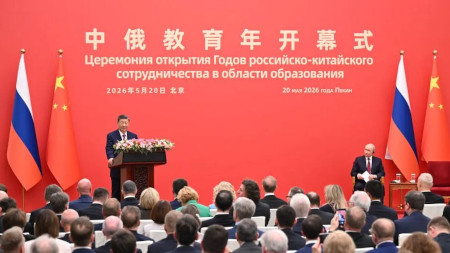
Vladimir Putin and Xi Jinping took part in the official opening ceremony of the Russia-China Years of Cooperation in Education, the holding of which had previously been agreed by the two leaders. The President of the People’s Republic of China described this as a strategic decision taken with the long-term development of Chinese-Russian relations in mind. He emphasised the importance of close cooperation between higher education institutions and research organisations, as well as the joint training of world-class specialists to strengthen the scientific and research potential of the two countries.
“Education is an important bridge connecting the hearts of people and transmitting friendship between nations. […] It is important to put into practice the concept of mutual enrichment between civilisations. […] to cultivate a worthy new generation to carry forward the everlasting friendship between China and Russia. […] A state flourishes when education flourishes. When education grows stronger, the great nation also grows stronger. I am convinced that through the joint efforts of our two countries, the China-Russia Years of Cooperation in Education will certainly achieve complete success, and the cooperation itself will yield the greatest results,” Xi Jinping said, according to the Kremlin website.
Vladimir Putin agreed with his Chinese counterpart and added that Russia and China have established 15 inter-university associations. He also noted that among the near plans is the launch by Saint Petersburg State University, a partner of TV BRICS, and Tsinghua University of the Chinese–Russian Institute of Fundamental Research. The programme of the cross years includes hundreds of projects in higher, secondary vocational and school education. Joint events involving ministries, leading educational institutions and public organisations of the two countries are also envisaged, covering the full spectrum of Russian-Chinese academic and scientific cooperation, the Russian president added.
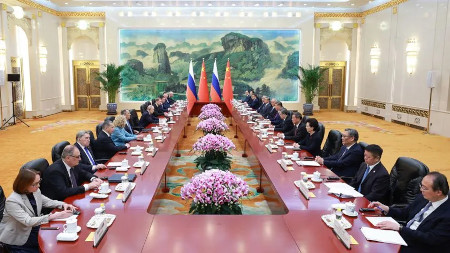
Russian President Vladimir Putin is in China on a two-day official visit at the invitation of the Chinese leader. The Russian president is accompanied by a large delegation, which includes several deputy prime ministers, a number of ministers, heads of state corporations, and executives of major banks and large businesses.