


Việt Nam Chairs NPT Review as South Africa Reinforces Moral Leadership on Disarmament
VNA/DIRCO/TDS
2 May 2026
At a moment of heightened geopolitical tension and renewed nuclear anxieties, the opening of the 11th Review Conference of the Treaty on the Non-Proliferation of Nuclear Weapons at the United Nations headquarters in New York has brought into sharp focus the enduring relevance of multilateral diplomacy. That Vietnam presides over this pivotal gathering signals not only procedural leadership, but a broader assertion of the Global South’s voice in shaping the future of nuclear governance.
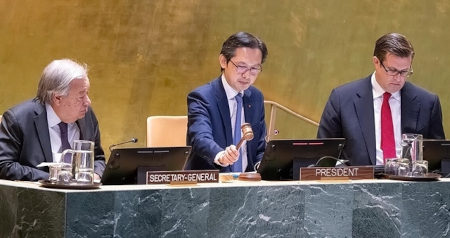
Chaired by Ambassador Đỗ Hùng Việt, Việt Nam’s Permanent Representative to the UN and president-designate of the conference, the session—running from April 27 to May 22—convenes 191 member states to assess progress and chart a path forward on one of the world’s most consequential security frameworks.
In his opening address, UN Secretary-General António Guterres highlighted the NPT as an “irreplaceable cornerstone” of global security, while cautioning against rising risks including the modernisation of nuclear arsenals, eroding trust in multilateralism, and intensifying geopolitical rivalries. His call for renewed commitment to the treaty’s three pillars—non-proliferation, disarmament, and the peaceful use of nuclear energy set the tone for what is expected to be a complex and consequential review process.
Việt Nam’s Diplomatic Stewardship
Việt Nam’s role as chair is both symbolic and strategic. As a non-nuclear-weapon state with a long history shaped by conflict and reconstruction, it brings credibility to calls for equitable, non-discriminatory disarmament. Ambassador Đỗ Hùng Việt has emphasized dialogue, consensus-building, and constructive engagement and principles that are essential in a forum often marked by deep divisions.
Hà Nội’s stewardship reflects a broader diplomatic posture: bridging divides between nuclear and non-nuclear states, and amplifying the concerns of developing nations that are disproportionately affected by global insecurity but often underrepresented in decision-making processes. In this regard, Việt Nam’s presidency is less about authority and more about facilitation—ensuring that diplomacy remains the primary instrument of progress.
South Africa’s Consistent Advocacy
Alongside Việt Nam’s leadership, South Africa has reaffirmed its longstanding commitment to a nuclear-free world. Led by Ambassador Xolisa Mabhongo, the South African delegation enters the conference with a unique moral authority—rooted in its voluntary, verifiable, and irreversible dismantling of its nuclear weapons programme.
South Africa continues to view the NPT as the cornerstone of global disarmament efforts, while insisting on the full and balanced implementation of its three interdependent pillars. In its national statement, Ambassador Mabhongo delivered a pointed critique of nuclear-weapon states, warning that modernisation programmes and expanded reliance on nuclear deterrence undermine prior commitments and risk reversing decades of progress.
This position draws directly on Article VI of the treaty, which obliges nuclear-weapon states including China, France, Russia, United Kingdom, and United States to pursue good-faith negotiations toward disarmament. For Pretoria, the credibility of the NPT rests on whether these commitments are honoured not only in rhetoric, but in measurable action.
Converging Voices, Shared Vision
While differing in geography and historical context, Việt Nam and South Africa converge on key principles: multilateralism, equity, and the urgent need to restore trust in global governance frameworks. Both nations advocate for a balanced approach that does not privilege nuclear-armed states, and both stress the importance of peaceful nuclear cooperation, particularly for development in sectors such as energy, agriculture, and medicine.
Their alignment is especially significant at a time when the global security environment is marked by fragmentation and competition. Together, they represent a coalition of states seeking to re-center the NPT on its foundational bargain: that non-proliferation and disarmament must advance in tandem, while access to peaceful nuclear technology remains a universal right under safeguards.
Building Momentum
South Africa’s diplomatic engagement extends beyond the current review cycle. As president of the upcoming Review Conference of the Treaty on the Prohibition of Nuclear Weapons scheduled for November 2026, Pretoria is using this platform to build momentum toward a more comprehensive prohibition regime. This reflects a growing impatience among non-nuclear states with the pace of disarmament under the NPT framework.
Việt Nam, in turn, is leveraging its chairmanship to encourage consensus which is no small task in an environment where strategic rivalries often overshadow collective security goals.
Diplomacy as the Last Line of Defence
The significance of this conference lies not only in its outcomes, but in the process itself. In an era of “information wars” and fractured alliances, the disciplined practice of diplomacy, patient, negotiated, and inclusive remains one of the few mechanisms capable of addressing existential threats.
Việt Nam’s steady stewardship and South Africa’s principled advocacy together illustrate the enduring power of middle and emerging powers to shape global discourse. Their partnership underscores a simple but vital truth: that the pursuit of a nuclear-free world is not the responsibility of a few, but the collective obligation of all.
As deliberations continue in New York, the challenge will be to translate shared commitments into actionable steps. The credibility of the NPT and indeed the future of global security may well depend on it.