


From Symbolism to Sanction: Will Redefining Apartheid Deliver Justice?
By Kirtan Bhana - TDS
24 February 2026
The life of Winnie Madikizela-Mandela stands as a searing indictment of a system that weaponised law to enforce injustice. While Nelson Rolihlahla Mandela was unjustly imprisoned on Robben Island, as a mother (MADRE), a woman, wife and daughter she endured harassment, banishment, surveillance and vilification at the hands of an apartheid regime that clothed racial supremacy in legal formality.
Apartheid did not collapse because its wording was amended. It fell because sustained resistance, global solidarity, sanctions and moral clarity converged to make enforcement of injustice unsustainable.
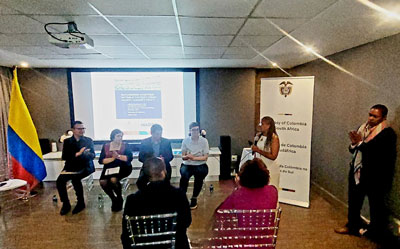
As negotiations continue on the draft Crimes Against Humanity (CAH) Treaty, diplomats and legal scholars recently gathered in Pretoria under the auspices of Maria del Rosario Mina Rojas, Colombia’s Ambassador to South Africa, to reflect on whether modernising the legal definition of apartheid can adequately address contemporary realities of systemic oppression.
The reception brought together voices from transitional justice, international law, gender advocacy and civil society. Among the speakers was Thapelo Mokushane, Deputy Director in the TRC Unit: Stakeholders, Information & Research—linked to South Africa’s Truth and Reconciliation process, which sought restorative justice after apartheid. Wendy Isaack, Senior Legal Fellow at MADRE, the global women’s human rights organisation partnering with grassroots activists worldwide, emphasised the gendered dimensions of systemic oppression. Lisa Davis, an internationally recognised expert on gender-based crimes in conflict and crisis settings and the importance of integrating gender justice into crimes against humanity frameworks. Randa Siniora, General Director of the Women's Centre for Legal Aid and Counselling, which provides legal and psychosocial services to women in Palestine, brought perspective from communities living under protracted occupation. Zaid Kimmie, Executive Director of the Foundation for Human Rights, a non-profit organisation working to protect and promote human rights, reflected on institutional accountability. Artemis Akbary, Executive Director of the Afghan LGBT Organisation, spoke to the intersection of identity-based persecution and the gaps in international protection mechanisms.
Yet beneath the diplomacy and dialogue lingered a harder question:
Will changing the words change the world? Or will it simply refine the language of selective enforcement?
The Limits of Legal Reform Without Enforcement
The current definition of apartheid in international criminal law draws from mid-20th century instruments, including the Rome Statute framework of the International Criminal Court and earlier United Nations conventions. Critics argue that its reliance on biologically framed notions of race constrains recognition of victims subjected to systemic discrimination rooted in ethnicity, religion, gender or intersecting identities.
Proposed reforms seek to move beyond rigid racial classifications, align definitions with contemporary human rights jurisprudence, and strengthen accountability and reparative justice pathways. These are legitimate and necessary discussions.
However, history offers a caution: law without enforcement becomes theatre.
Apartheid South Africa operated under a sophisticated legal architecture. Its brutality was codified, procedural and bureaucratically enforced. The problem was not definitional ambiguity; it was moral bankruptcy backed by power.
Today’s geopolitical environment reflects similar tensions - double standards in sanctions, selective prosecutions, political shielding of powerful actors and the weaponisation of human rights language for strategic interests. Under such conditions, expanding definitions without strengthening enforcement risks producing a more eloquent injustice.
The Deeper Crisis of Human Responsibility and Moral Erosion
While the concept note seeks to modernise the apartheid definition, the broader crisis is not merely semantic, it is civilisational.
Across continents, financial scandals expose elite impunity. Oligarchic wealth distorts democratic systems. Human trafficking and modern slavery thrive in the shadows of globalised supply chains. Religion and identity are manipulated for political gain. A new hierarchy of class and material dominance increasingly replaces the crude racial supremacism of the past.
If apartheid once relied explicitly on race as a social construct to justify dispossession, today’s oppressive systems often depend on economic dependency, surveillance technologies, financial coercion and structural inequality. The social construct has shifted; the asymmetry of power remains.
Will a Revised CAH Treaty Deliver Justice?
The answer lies less in wording and more in enforcement architecture.
First, universal jurisdiction must operate without selectivity. The credibility of the United Nations system depends on ending the perception that accountability applies only to weaker states. If geopolitical alliances shield certain actors from scrutiny, the treaty becomes symbolic rather than transformative.
Second, independent investigative mechanisms must be guaranteed - insulated from political pressure, adequately funded, and supported by protections for whistle-blowers and civil society documentation.
Third, financial accountability must be embedded into crimes against humanity enforcement. Systemic oppression today is frequently economic. Illicit financial flows, corporate complicity and opaque sanctions regimes must be scrutinised consistently, not selectively.
Fourth, reparative justice must extend beyond symbolic recognition. Structured reparations, restitution of dispossessed resources, psychosocial healing and truth-telling mechanisms should form part of treaty implementation. South Africa’s own transition illustrates that political freedom without full economic redress leaves structural inequality intact.
The Palestinian Question and Consistency of Principle
The reception also referenced justice for Palestinians and others living under apartheid-like systems in Palestine and beyond. Regardless of one’s political position, the central issue remains consistency.
If the international community labels one system of structural domination as apartheid while excusing another due to strategic alliances, it erodes the legitimacy of international law itself.
Justice cannot be geographically selective.
Beyond Wording is the Question of Will
The Pretoria reception was timely and necessary. Dialogue builds solidarity. Diplomacy fosters exchange. Legal reform shapes frameworks.
But the legacy of Winnie Madikizela-Mandela demands more than carefully crafted language and diplomatic receptions. It demands courage.
The struggle against apartheid was not won by refining definitions. It was won by confronting power, mobilising global pressure, enforcing sanctions, and insisting that no state, however dominant, stands above the law.
If the CAH treaty reform fails to confront enforcement asymmetry, it risks becoming another document that recognises victims while leaving perpetrators untouched.
Justice is not achieved through vocabulary. It is secured through accountability.
And accountability requires political will, institutional independence, financial transparency, and an unwavering commitment to equal application of the rule of law.
Without these, the international community may succeed in modernising the definition of apartheid while allowing its spirit to persist under new names.