


Lunar New Year brings Tariff-Free Access to China’s Market
By Kirtan Bhana
12 February 2026
The signing of the Framework Agreement on Economic Partnership for Shared Prosperity between South Africa and the People’s Republic of China on 6 February 2026 marks a historic milestone in bilateral economic relations. As part of the broader China-Africa Economic Partnership Agreement (CAEPA), the framework paves the way for duty-free (tariff-free) access for South African exports to China’s super-massive market, with an Early Harvest Agreement expected by March 2026.
This agreement establishes long-term, stable, and predictable institutional safeguards for trade, investment, new energy cooperation and multilateral engagement. It positions South Africa to significantly expand exports of agricultural products, manufactured goods and value-added industrial outputs, while attracting new Chinese investment into productive sectors of the economy.
Importantly, South Africa’s inclusion reflects China’s expanded zero-tariff initiative announced in 2025, which extends duty-free access to exports from all 53 African countries with which China has diplomatic relations. Anchored in WTO principles and the FOCAC framework, this initiative is China’s commitment to reshaping global trade in favour of the Global South.
At a time when South Africa faces rising trade pressures and tariffs from traditional markets, notably the United States, deeper access to China offers strategic diversification, resilience and growth potential.
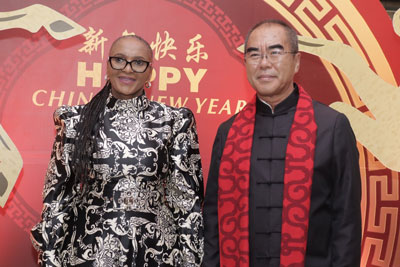
The contemporary significance of this trade agreement cannot be separated from China’s historical journey. As recalled in the speeches delivered by China’s Consul General Pan and Free State MEC Sifuba, China’s modern development emerged from a legacy of imperial subjugation that began with the Opium Wars of the 1840s and culminated in the 1949 revolution. The remarks were delivered at a reception hosted by the Chinese Consulate General in Johannesburg celebrating Spring Festival and the approaching New Year signified by the horse.
Chairman Mao’s declaration in Tiananmen Square that “the Chinese people have stood up” symbolised not only national liberation but a reassertion of sovereignty, dignity and control over development pathways. That experience resonates deeply across Africa, where colonial extraction and externally imposed economic models such as Structural Adjustment Programmes left enduring scars.
China’s rise, now reflected in an economy exceeding 140 trillion yuan, steady growth, technological innovation and improved quality of life for its people, stands as a counter-narrative: development rooted in national conditions, gradual reform and long-term planning. The completion of China’s 14th Five-Year Plan and its forward-looking development trajectory reinforce this model.
The Chinese Consulate General in Johannesburg celebrated Chinese New Year. During the event guests enjoyed Chinese cultural experiences including woodblock printing, tea ceremonies, Dunhuang dance, Chinese drumming, Sesotho Song Choir and a traditional Chinese Fashion Show.
People-to-People Exchanges and Cultural Diplomacy in 2026
The year 2026 has been designated the China-Africa Year of People-to-People Exchanges, giving cultural diplomacy renewed prominence alongside economic cooperation. As emphasised in MEC Sifuba’s address, culture is not peripheral but foundational to sustainable relations.
China’s celebration of its New Year according to its own lunar calendar reflects enduring cultural confidence and civilisational continuity. This cultural pride finds parallels in Africa, including the Basotho New Year celebrated on 1 August, rooted in ancient indigenous calendars. Such shared respect for heritage provides fertile ground for deeper mutual understanding.
The recalibration of the Mangaung African Cultural Festival (MACUFE) presents a concrete platform for cultural exchange. Proposals to incorporate Chinese cultural symbols like dragon dances, traditional dress, zodiac motifs into MACUFE reflect a living, people-centred diplomacy that links heritage, tourism, creative industries and local economic development.
These exchanges echo the Chinese philosophy embedded in the Spring Festival -peace, harmony and amity - values that align closely with African communal traditions.
Diplomacy and Practical Cooperation
China–South Africa relations are increasingly reinforced at provincial and local levels. In the Free State, this has translated into tangible outcomes: humanitarian assistance, technical cooperation programmes, official exchanges with Jiangsu and Jiangxi provinces and high-level participation in China’s national celebrations.
Such diplomacy demonstrates how international relations achieve their most meaningful impact at the domestic and community level - through skills transfer, local investment, disaster response and people-to-people solidarity.
Chinese enterprises and local Chinese communities have also played a constructive role in job creation and socio-economic development, reinforcing the human dimension of bilateral ties.
Shared Vision in a Fragmented World
Against a backdrop of global volatility, rising unilateralism and renewed competition over strategic resources, China’s call for global solidarity, multilateralism and shared development resonates strongly with South Africa and Africa more broadly. The tariff-free access agreement is therefore not merely a trade instrument; it is a political statement about the future of South-South cooperation.
As China and South Africa deepen their all-round strategic cooperative partnership in the new era, the convergence of economic integration, cultural exchange and shared historical experience offers a resilient foundation for mutual growth, one that delivers concrete benefits to people, communities and future generations.
In this sense, the 2026 tariff-free breakthrough stands as both a culmination of past solidarity and a gateway to a more balanced, people-centred global economic order.