


Anglo American and South Africa’s Original Sin: Between Legacy, Liability and the Search for Closure
By Kirtan Bhana

27 November 2025
As the dust settles on the Johannesburg G20, a summit that laid bare the contradictions of a world in transition, South Africa finds itself grappling with a different kind of reckoning, one buried not in geopolitics but in the very rock on which the city is built. Johannesburg, the City of Gold, owes its existence to mining. Yet mining also represents South Africa’s most enduring wound. And at the centre of this paradox stands one company: Anglo American.
For more than a century, Anglo was synonymous with South Africa. It created jobs, built infrastructure, and anchored the Johannesburg Stock Exchange. It helped industrialise the country, while simultaneously entrenching dispossession, racialised labour exploitation, environmental destruction and generational trauma.
Anglo American is not just a corporation in South African history, it is the Original Sin of South Africa’s extractive economy.
Today, as Anglo restructures its global footprint and signals what many interpret as a slow-motion retreat from South Africa, the country must confront a painful question:
Does Anglo American get to leave without answering for the social, economic and ecological devastation created in its wake?
A Century of Prosperity and Pain
In its prime, Anglo American owned nearly 60% of the Johannesburg Stock Exchange, a staggering symbol of its dominance. The company brought modern mining techniques, built hospitals and housing in some areas, and contributed to South Africa’s early economic expansion.
But its legacy is inseparable from:
• Forced removals and dislocation
• Dangerous, racially segregated labour compounds
• Silicosis, TB and occupational diseases that continue to haunt families
• Toxic landscapes, sinkholes and acid mine drainage
• Communities poisoned by dust, polluted rivers and abandoned shafts
For many Black South Africans, Anglo American is not merely a mining giant, it is an architect of humiliation, indignity and structural violence.
BEE: A Partial Liberation, a Convenient Absolution
When the democratic state introduced Black Economic Empowerment (BEE), Anglo American appeared to embrace the policy, unbundling assets and supporting new black-led companies. On the surface, this was progress.
But critics argue that BEE had a double edge:
1. It created a small elite of beneficiaries, giving the appearance of transformation.
2. It absolved mining giants of their historical obligations by transferring older, high-liability assets to new entities or leaving them undercapitalised.
3. It did not dismantle exploitative structures, nor did it ensure adequate rehabilitation funds for abandoned mines.
In effect, BEE softened Anglo’s public image while allowing the conglomerate to gradually externalise its costs—social, ecological and ethical.
The PIC’s Complicity and Responsibility
At the heart of today’s debate is the Public Investment Corporation (PIC), the custodian of government employees’ pensions and one of the largest shareholders in Anglo American.
The PIC has a fiduciary duty:
• to protect the savings of millions of South Africans,
• to support responsible corporate behaviour,
• and to ensure that Anglo’s restructuring, or potential exit, does not leave the country burdened with unfunded environmental liabilities or abandoned communities.
Yet, many argue the PIC has been too passive, too silent, too entangled. As Anglo prepares for restructuring and its proposed takeover of Teck Resources, Parliament is now being asked to step in.
The 100-Year Debt Campaign: Communities Fight Back
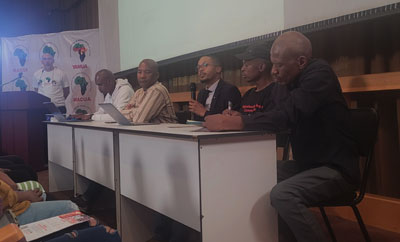
On 26 November 2025, at the Old Johannesburg Stock Exchange on Diagonal Street, symbolic ground zero of South Africa’s extractive injustice, affected communities launched the 100-Year Debt Campaign, handing a formal petition to Parliament. The discussion was facilitated by Christopher Rutledge, Executive Director of Mining Affected Communities United in Action (MACUA).
Mametlwe Sebei, President, General Industries Workers Union of South Africa, National Executive Committee, South African Federation of Trade unions and Reginald Letsholo, Co-Founder of the Tlou Mogale Foundation added their perspectives to the discussion.
Speakers from various communities shared their testimonies:
• Families uprooted through forced removals
• Health impacts from asbestos, silica dust, toxic tailings
• Homes cracked by blasting
• Contaminated rivers and soil and dying livestock
• Generations of economic exclusion despite mining taking place “in their backyard”
The petition demands:
• Parliamentary oversight of the PIC
• Governance scrutiny of Anglo’s restructuring
• Protection of community rights
• Enforcement of historical environmental obligations
International organisations from MiningWatch Canada and the London Mining Network to ACTSA have now endorsed the campaign, signalling a global appetite for accountability.
Media Silence: A Reminder of Corporate Influence
Despite the historic nature of the event, several major South African media houses refrained from covering it, a silence that speaks to the pervasive influence mining conglomerates still wield.
Yet the story could not be suppressed.
Over 10,000 people viewed the livestream, shared through independent and community platforms. South Africans are watching, and they are beginning to speak.
Mining in the South African Psyche: A Story Told in Soap Operas
The hold of mining on South African consciousness is deep. When television first arrived in the country, one of the earliest shows was “The Villagers”, centred on mining life.
After 1994, the iconic soap "Isidingo" continued the mythology, presenting Johannesburg’s wealth as glamour while masking the sacrifices made for that gold.
Culture mirrored reality: mining giants morph and mutate, but their shadow remains long, often unchallenged.
Crisis or Opportunity? A Moment of Reckoning
South Africa now stands at a crossroads.
If Anglo American leaves, it may be the final severing of a colonial umbilical cord. Painful, yes—but potentially liberating.
A crisis, if met with clarity and courage, becomes an opportunity:
• To create a new mining model: clean, community-centred, restorative.
• To strengthen public oversight over environmental rehabilitation funds.
• To ensure future mining licences require local beneficiation, not just extraction.
• To build a transparent, accountable mineral governance regime.
• To attract new investors who understand that South Africa will no longer tolerate exploitation disguised as partnership.
South Africans must decide whether clinging to Anglo’s legacy, both good and harmful, is worth the ongoing burden.
Or whether letting go allows the country to write a new chapter grounded in dignity, justice and sustainable growth.
Toward Closure: Extract the Lessons, Not the Pain
Corporations of Anglo’s magnitude are notoriously difficult to hold accountable. History shows that even with legal rulings, they often outlast institutions, governments and public pressure.
So how does South Africa achieve closure?
By pursuing accountability—without being paralysed by it.
By extracting every lesson, even if compensation remains partial.
By building new mining investments on principles Anglo never embraced:
• environmental justice
• community ownership
• local value creation
• transparency
• intergenerational fairness
Closure, in this context, means owning the narrative, not waiting for Anglo to validate it.
The Original Sin Can Become Original Wisdom
Johannesburg was built on gold, but it can now be rebuilt on truth.
As communities, Parliament, the PIC, and international partners converge in the 100-Year Debt Campaign, South Africa has an opportunity to transform trauma into policy, neglect into reform, and exploitation into empowerment.
Anglo American’s story in South Africa is ending.
But South Africa’s mining future—its ecological, economic and moral future—can begin anew.
And this time, it must be written by South Africans, for South Africans, with dignity restored and justice finally within reach.
For more information visit the MACUA website: https://macua.org.za
Photos credit: TDS