

China achieves remarkable results in improving residents' housing conditions
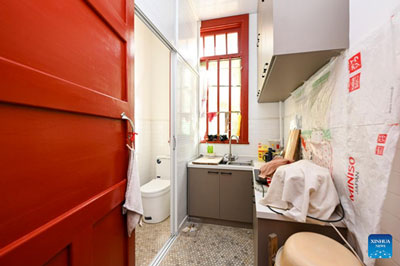
This photo taken on Oct. 29, 2025 shows a toilet (L) and a kitchen after renovation at a household in Yangpu District of east China's Shanghai. Shanghai grappled for decades with a deeply personal challenge for many residents: the humble chamber pot. Cramped living spaces nestled within labyrinthine alleyways transformed even the most basic human needs into a challenging daily struggle.
In the early 1990s, per capita living space averaged just 6.6 square meters in Shanghai. This was exacerbated by the architectural design of most the traditional Shikumen residences, which lacked private sanitary facilities. As a result, entire lanes often shared a single public toilet. To improve the overall living conditions for local residents, Shanghai embarked a redevelopment project for old neighborhoods in 1992. Through three decades of hard work, by the end of this September, Shanghai had largely completed its mission to eliminate the last of these "hand-carried toilets," a monumental task targeting the final 14,082 households identified just last year. The decades-long effort to retire the chamber pot tells a story of persistent, fine-grained urban governance in China's most populous city. (Xinhua/Chen Haoming)
BEIJING, 24 November 2025 (Xinhua) -- China has seen remarkable results in improving its residents' housing conditions since the 18th National Congress of the Communist Party of China in 2012, an official said on the latest episode of China Economic Roundtable, an all-media talk show hosted by Xinhua News Agency.
To address the housing difficulties of the people, renovation of shanty towns, dilapidated houses, old urban residential communities and urban villages has been carried out across the country over the past years, said Pan Wei, an official with the Ministry of Housing and Urban-Rural Development.
China has built over 68 million units of affordable and resettlement housing since 2012, enabling more than 170 million people with housing difficulties to realize their dream of having a stable home. It has also renovated over 300,000 old residential communities, benefiting more than 130 million urban residents, according to Pan.
A multi-tiered housing security system has been built for various groups, such as families living on subsistence allowances, new urban residents and young people, Pan said, adding that policy support, such as tax incentives, financial loans, land planning, and central subsidies, has been provided for the renovation projects.