

A Defining G20 Moment for Africa’s Modernization and Global Leadership
By Kirtan Bhana - TDS
25 November 2025
The 2025 G20 Leaders’ Summit in Johannesburg is historic as the first held on African soil. It was a logistical triumph for South Africa and a substantive demonstration of Africa’s accelerating transformation. The summit, preceded by 133 technical and ministerial meetings, revealed the contours of a shifting global landscape in which Africa is no longer a peripheral participant, but an emerging centre of gravity.
While global headlines initially focused on the U.S. boycott and the missed opportunity for Washington to demonstrate solidarity and global leadership, the summit itself told a different story: one of African capability, composure, and increasingly coherent political will. South Africa’s hosting of over 100 government delegations and 60 heads of state affirmed its established reputation for convening complex, high-stakes international engagements. More importantly, the summit showcased the strength, grace, and institutional maturity of a continent in the midst of long-awaited renewal.
A central thread running through the Johannesburg G20 was Africa’s modernization agenda, anchored in Agenda 2063, the African Union’s strategic blueprint adopted in 2013 and formally launched in 2015. After a decade of slow but deliberate progress, the agenda has gained unmistakable momentum. Its emphasis on integration, industrialization, peace, and shared prosperity has crystallised into a unified continental narrative increasingly visible on global platforms.
The G20 outcomes reflected this shift. Delegates and observers alike noted that the Johannesburg summit represented a glimpse of Africa’s potential as a cohesive, interconnected Union, positioning itself as a driver of global policy in green energy, industrial capacity, and sustainable development.
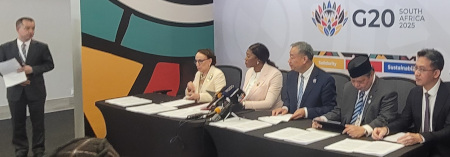
One of the defining features of the summit was the launch of the Initiative on Cooperation Supporting Modernization put forward China and South Africa. The event, which prominently featured remarks from Mr Miao Deyu, Vice Minister of Foreign Affairs of the People’s Republic of China, and Mr Lin Feng, Director-General of the Department of International Trade and Economic Affairs of China’s Ministry of Commerce, emphasized China’s strong alignment with Africa’s development trajectory.
Mr Miao emphasized China’s long-standing commitment to Africa’s integration and Agenda 2063, noting that Africa’s modernization is not only essential for the continent but for global stability and prosperity. He highlighted China’s support for Africa’s infrastructure, industrial cooperation, and human capital development as part of a shared future defined by mutual respect and common progress.
Mr Lin Feng stressed the importance of modernizing Africa’s trade architecture, strengthening local industrial capacity, and ensuring that global supply chains reflect fairness, equity and long-term sustainability. He reaffirmed China’s readiness to deepen coordination on investment, trade facilitation and technological innovation, aligning China’s developmental approach with Africa’s own demands for value addition, green industrialization and equitable global governance.
Together, their remarks framed the initiative within a broader architecture of cooperation whose pillars include:
• Green energy transition and responsible resource extraction
• Stability and sustainability as foundations for growth
• Restructuring of predatory financial systems and unsustainable debt
• Innovation-led industrialization and energy transformation
China situated the initiative within its long-standing philosophy of people-centred development, echoing President Xi Jinping’s 2016 Hangzhou G20 call to support industrialization in Least Developed Countries (LDCs). Since then, platforms such as FOCAC, the Belt and Road Initiative, the Global Development Initiative, and the zero-tariff regime for African exports have strengthened China–Africa cooperation.
Premier Li Qiang, leading China’s G20 delegation, reinforced this vision in the first session of the summit, noting that as a developing country responsible for 1.5 billion people, China sees a self- reliant and self-sufficient Africa as an indispensable partner in achieving global modernization.
China also used the occasion to call on the United Nations—marking its 80th anniversary—to accelerate implementation of the 2030 Sustainable Development Goals, noting that 25 years after the Millennium Development Goals, the development financing gap remains stark.
Their messaging resonated strongly with African delegates who have increasingly embraced people-centred governance models, adapted to African realities and driven by citizen participation.
Critical minerals emerged as a central strategic theme of the summit. Indonesia’s Coordinating Minister for Economic Affairs, Mr Airlangga Hartarto, delivered a compelling presentation on Green Mining and Minerals, stressing that Africa’s mineral wealth, while vast, will only translate into prosperity with value addition and not through mere extraction.
He warned that the global climate finance gap of USD 1.8 trillion annually threatens to undermine development goals unless financing becomes:
• More accessible
• More predictable and timely
• Driven by MDB reforms
• Supported by stronger local capital markets
Indonesia committed to supporting Africa through:
1. Policies incentivising sustainable downstream investment
2. Innovative finance for industrial capacity and technology
3. Stronger regional value chains through shared infrastructure
UNCTAD’s Secretary General Rebeca Grynspan reinforced this point, noting that Africa exports more than USD 250 billion in critical minerals annually but captures only 3% of the value chain, a stark illustration of the need for local beneficiation and industrialization.
At the summit’s close, South Africa’s Deputy Minister of International Relations and Cooperation, Thandi Moraka, affirmed that the G20 had produced tangible, Africa-centred outcomes. She invoked the seven aspirations of Agenda 2063, emphasizing citizen-led development and commending China’s peaceful, mutually beneficial approach to cooperation.
Her remarks captured the essence of the Johannesburg summit that Africa has moved from the periphery to the centre of global decision-making.
The launch of the modernization initiative was both timely and symbolic. Africa has declared unambiguously that the political will exists to unify the continent, industrialize its economies and exercise global leadership commensurate with its demographic, cultural and resource wealth.
With 70% of its population under the age of 30, Africa’s future is bright, it is already unfolding. The world is taking notice of Africa’s millennia-old knowledge traditions, its renewable energy potential and its emerging industrial capabilities.Despite geopolitical distractions such as the U.S. boycott, the consensus was unmistakable: South Africa delivered a successful, vision-driven G20, and Africa has reclaimed its rightful role as a leader in shaping the global future.
The Johannesburg G20 will be remembered as the moment when Africa confident, united, and forward-looking signalled to the world that its era of marginalization is over. The green shoots of transformation have begun to blossom, revealing a continent ready to define the twenty-first century.