

'Cry Freedom’ - Reflections on Dignity and Hope in South Africa
By Dilon Bhana - TDS
18 November 2025
The movie ‘Cry Freedom’, released in 1988 and set in the late 70’s, was screened by the Australian High Commission in Pretoria leading up to Australian Prime Minister Anthony Albanese’s ’s visit to South Africa for the much-anticipated G20 Summit.
The screening took place ahead of the unveiling of the names of three Australians at Freedom Park’s Wall of Names. Tegan Brink, Australia’s High Commissioner to South Africa, said that these three Australians played important roles in supporting international efforts to end Apartheid and their names on the Wall serves as a tribute to their dedication and contributions to South Africa’s journey toward freedom.
One of these people is Bruce Hague, the former 2nd Secretary of the Australian High Commission to South Africa in the late 70’s. Bruce Hague was portrayed in the film as a journalist as the film was released during Apartheid and while Bruce was working abroad for the Australian government. He became friends with Steve Biko and other anti-Apartheid activists and his role of helping the main character, newspaper editor Donald Woods, escape South Africa as a banned person, is portrayed in the film. The film was eye-opening to watch as a born-free South African.
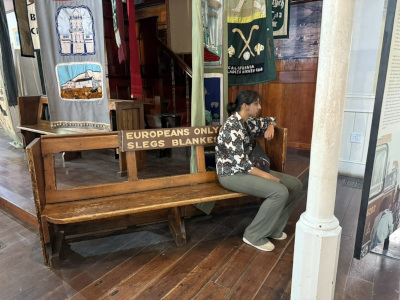
In the above photograph taken earlier this year, I sat down on a bench at the District Six Museum in Cape Town to read a banner without noticing what the bench had written on it. Days later, when I saw the picture I realised what the bench said and reflected on how thoughtlessly I had taken that seat. Watching 'Cry Freedom,' I thought about the obscenity of having to think twice about something so simple and available as sitting on a bench, but which once carried profound indignity for all those categorised by unjust laws. This realisation made me question how deeply such indignities affected individuals who were forced into arbitrary classifications.
Yet, the movie portrays Steve Biko, activist and Black Consciousness pioneer, as a joyful young man. In South Africa today, people still carry a lot of fear, guilt and distrust, yet hope and joy are the overwhelming constants amongst the people I interact with. This contrast led me to ask: How vital is it to foster dignity in order to counteract the fear, guilt and distrust that have been perpetuated by the traumas of the past?
Watching the movie, I was surprised by how similar the vocabulary was to the terms we use today. Understanding that terms like “townships”, “white supremacy”, “white privilege” and “white liberalism” have been used for decades made me wonder if they hold any weight or if they are buzzwords that have lost value over time. This reflection ties directly to Steve Biko’s advocacy for transformative change through shifts in our mindsets and perspectives. Lasting change begins with a willingness to examine and alter how we perceive ourselves and others. Over time, society has taught us to form prejudices based on how people speak or look, and not based on their character or intent. To move forward, it’s crucial to recognise and understand the roots of these prejudices. Only by acknowledging where our biases originate can we begin to let go of them. Most importantly, this process applies not just to how we see others, but also to how we view ourselves.
Leaving the screening, I was deeply affected by witnessing the atrocities of the past and in understanding how it affects the way I move through the world. However, I think we are achieving what Steve Biko wanted us all to bestow upon South Africa in the following quote, “In time, we shall be in a position to bestow on South Africa the greatest possible gift - a more human face.” - Steve Biko.
I walk through spaces which show the true spirit of South African people and the future seems bright.