

The Global South Reimagined
Global Times, People's Daily and Kirtan Bhana - TDS
10 November 2025
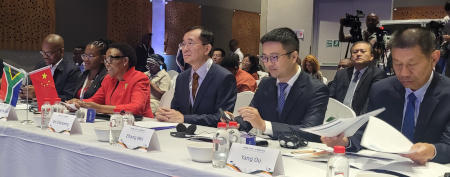
Johannesburg, the vibrant heart of Africa’s diplomacy, recently hosted the Global South Dialogue · China–Africa Roundtable Forum, an exchange that unlocked a defining truth of our era: the Global South is no longer a peripheral player in world affairs, it has become a central force reshaping the principles of global governance, development, and dialogue.
Co-hosted by the Global Times, the National School of Government of South Africa, and the Centre for Public Policy and African Studies at the University of Johannesburg, the forum brought together leaders from government, academia, and the media to deliberate on the future of South–South cooperation under the banner of inclusivity and shared progress.
This year marks the 25th anniversary of the Forum on China–Africa Cooperation (FOCAC) — a milestone that coincides with a broader global realignment. The Global South is not only asserting its voice but also redefining the terms of engagement in global decision-making.
In his opening remarks, Zhang Wei of the Global Times noted that China’s trajectory of high-quality development and high-level opening-up has drawn the world’s attention. “China’s economy,” he said, “is like a vast ocean—resilient, confident, and full of potential.” This strength, he added, will inject renewed energy into joint China–Africa modernization efforts and offer stability in an increasingly uncertain global environment.
From Africa’s side, the sentiment was equally resolute. The continent, through the African Continental Free Trade Area and a surge of innovation across its young population, is no longer waiting for opportunity—it is creating it. As I observed in my address at the forum, “The Global South cannot define itself merely by opposition. We must define ourselves by contribution—by our capacity to lead, to cooperate, and to take responsibility for the shared future we are shaping.”
Phindile Mkwanazi, Acting Principal of the National School of Government, reminded participants that “the Global South is not just a geographic concept. It is a logical and political space.” This redefinition positions the Global South not as a counterweight to the North, but as a co-architect of an equitable, multipolar world order.
Busani Ngcaweni, Director of the Centre for Public Policy and African Studies, captured this sentiment with precision: “The new mood is unmistakable — confidence without arrogance. The new momentum is irreversible cooperation without subordination.”
This spirit of transformation resonates strongly with South Africa’s broader diplomatic philosophy. As a member of BRICS, the African Union, and the United Nations, South Africa continues to champion reforms to global institutions so they reflect the realities of the 21st century — realities where African and Asian nations are key contributors, not peripheral observers.
South Africa’s Deputy Minister for Public Service and Administration, Pinky Sharon Kekana, highlighted that dialogue is not simply a diplomatic exercise but a principle of coexistence. “Through our partnership in dialogues such as this, and through the convergence of media, governance, and citizen participation, we can build a peaceful, democratic, and prosperous Global South,” she said.
Indeed, dialogue is the foundation upon which mutual understanding and trust are built and media, when responsible and visionary, becomes both bridge and beacon.
Yang Ou, President of the African General Bureau of the People’s Daily, called on media institutions to act as “recorders and narrators of development achievements” and to strengthen the public opinion foundation for building the All-Weather China–Africa Community with a Shared Future for the New Era.
Ayanda Hollow, President of TV BRICS Africa, echoed this call for collaboration: “We look forward to partnering with the Global Times in telling the stories of the Global South. Promoting communication in the Global South is also our goal.” His statement reflects a growing consensus — that storytelling itself is a strategic instrument of diplomacy, and that the narratives we share can reshape how nations perceive one another.
Both the Global Times and The Diplomatic Society recognize that information is not merely reportage — it is influence, understanding, and soft power. As platforms dedicated to dialogue, diplomacy, and development, both institutions share a commitment to balanced perspectives and credible storytelling.
Their synergy lies in the belief that global discourse must transcend bias and division. Together, they can pioneer new modes of media diplomacy — collaborative reporting, shared forums, and co-created narratives that elevate understanding between China, Africa, and the broader Global South.
This partnership reflects a broader truth of our age the media can no longer afford to be mere observers of history; it must be a participant in shaping it.
As China and Africa deepen their partnership under the evolving frameworks of FOCAC, the Belt and Road Initiative, and the Global Governance Initiative, the task ahead is clear — to transform solidarity born of shared struggle into solidarity built on shared responsibility.
The Global South’s voice today carries weight not because of numbers or size, but because it speaks for a vision of fairness, cooperation, and mutual respect. It calls for reform not out of resentment, but out of responsibility to build a system that serves all humanity.
In this sense, the Global South is not an alternative to the world; it is an imagination that reshapes it. It is no longer a story told from the margins, but one that defines the centre.
The Global Times may be a publication for the globe — not for the South, East, or any other direction — but through partnerships with institutions like The Diplomatic Society, it affirms a deeper conviction: that a more balanced world begins with balanced narratives.