

GEM – A Gem for Africa and the World
TDS - 4 November 2025
In a dazzling display of light, sound, and symbolism, the Great Egyptian Museum (GEM) was inaugurated in Cairo by President Abdel Fattah al-Sisi, marking one of the most momentous cultural milestones of the century. The grand opening was broadcast live to audiences across the globe, with simultaneous viewings held in major world cities — including a special live crossing hosted in Pretoria, South Africa, in partnership between the University of South Africa (UNISA) and the Embassy of the Arab Republic of Egypt.
This collaboration brought the majesty of ancient Egypt closer to South African audiences and reinforced the growing bond between Cairo and Pretoria — a partnership that mirrors the broader aspiration of connecting Africa from Cape to Cairo, through knowledge, culture, and development.
Standing at the foot of the Giza Plateau, within view of the Great Pyramids, the Great Egyptian Museum is now the largest archaeological museum in the world, a testament to human ingenuity and Africa’s civilizational depth. With more than 50,000 artefacts on display, including the complete collection of Tutankhamun’s treasures, the museum tells the story of one of humanity’s most enduring and sophisticated civilizations.
In his address, President al-Sisi welcomed heads of state, monarchs, royalty, and dignitaries to Egypt, the “Land of Peace”, inviting the world to visit Egypt and experience the roots of human civilization. His words carried both pride and purpose, an assertion that Egypt’s heritage is not only national but continental, a legacy belonging to all of Africa and to all of humanity.
An African Collaboration
In Pretoria, the live broadcast of the Cairo ceremony was marked by academic reflections and expressions of solidarity. Ambassador Ahmad Ali Sharief, Egypt’s Ambassador to South Africa, described GEM as a living monument to Africa’s intellectual and cultural greatness, the largest museum in the world dedicated to the remnants and memories of a single civilization.
He spoke passionately about the museum’s role in strengthening ties between Egypt and South Africa, two pivotal nations at opposite ends of the continent, bound by shared aspirations for continental renewal.
Deputy Minister Alvin Botes of DIRCO, who was guest of honour, paid tribute to Egypt’s second President Abdel Nasser and Egypt's support for Africa’s liberation movements. He praised Egyptians for their ability, capability and capacity to construct a state-of-the-art facility as an accolade to the great African civilization.
UNISA Deputy Vice-Chancellor Professor Malapo emphasized that the Great Egyptian Museum is an academic and cultural bridge that can “unlock the value of intra-African knowledge exchange, foster collaborative research, and inspire a new generation of scholars to rediscover Africa’s ancient contributions to science, architecture, and philosophy.”
This partnership between UNISA and the Embassy of Egypt illustrates how cultural diplomacy can be a catalyst for economic cooperation, academic innovation, and the Pan-African vision of unity and progress.
Technology Meets Antiquity
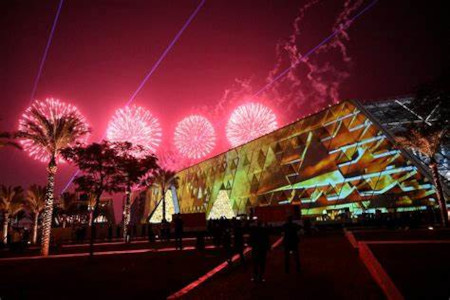
The opening ceremony itself was a spectacular convergence of ancient heritage and modern technology. The museum’s striking glass façade reflected a sky illuminated by synchronized fireworks, while a symphony of Egyptian and international musicians paid tribute to the genius of the Nile civilization.
Using cutting-edge projection mapping, images of hieroglyphics, temples, and gods danced across the museum’s architecture, visually narrating the evolution of Egyptian civilization. The fusion of classical and electronic music symbolized the timelessness of human creativity, the idea that even the oldest civilization on Earth continues to inspire the innovations of the present age.
Every moment of the ceremony reminded viewers that technology, when guided by cultural pride, becomes a bridge between past and future.
The inauguration of GEM has revived an old dream, that of a connected Africa, united by shared heritage and mutual development. The Cape to Cairo vision is being reimagined as an African reality through a network of infrastructure, culture and knowledge, linking the continent’s North and South.
In this sense, the collaboration between Egypt and South Africa is profoundly symbolic. Both nations are continental anchors, one representing Africa’s ancient foundations, the other its modern renewal. Together, they illustrate the continuity of African civilization and the power of continental integration.
As Africa moves forward under the framework of the African Continental Free Trade Area (AfCFTA), cultural institutions like the Great Egyptian Museum remind us that economic unity must be grounded in cultural understanding. GEM as a museum is a living dialogue between Africa’s past and its future. It invites Africans to reclaim their shared history as custodians of a civilization that shaped the world. Africa’s story is not one of darkness waiting for discovery, it is one of light that continues to guide the world.