

China Strengthens Domestic Governance to Lead Global Transformation
By Kirtan Bhana – TDS
31 October 2025
As China’s Communist Party (CPC) concludes the 14th Five-Year Plan and embarks on the 15th, the 4th Plenary Session of the 20th CPC Central Committee marks a critical juncture as a domestic policy recalibration and as a profound statement on China’s evolving role in global leadership. The shift toward consolidating domestic governance, refining internal systems, and fortifying institutional resilience reflects Beijing’s understanding that sustainable global influence begins with national strength, stability, and cohesion.
Since the reform and opening-up era, each Five-Year Plan has been a blueprint of transformation, from the industrial surge of the 1980s to the digital and innovation-led economy of today. Yet the upcoming 15th Five-Year Plan (2026–2030) signals a mature phase of consolidation and refinement of the Chinese era of modernization.
While the 14th Plan focused on technological self-reliance, green transformation, and dual circulation (balancing domestic demand with external openness), the 15th appears poised to deepen internal reform, enhance social governance, and establish what the CPC calls a “new quality productive force.” This shift acknowledges that China’s long-term competitiveness depends not only on technological breakthroughs or global trade but on the robustness of its institutions, the inclusivity of its economic model, and the moral legitimacy of its governance.
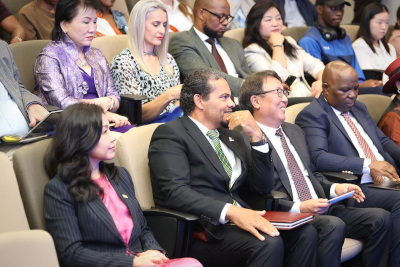
At a recent dialogue hosted by the China Media Group (CMG) at the University of Johannesburg, CMG President Shen Haixiong reaffirmed that “China will continue to expand high-level opening up and foster new prospects for win-win cooperation.” His words reflect the CPC’s conviction that openness and shared development remain pillars of China’s modernization, even as the leadership intensifies its focus on domestic governance.
Ambassador Wu Peng, China’s envoy to South Africa, outlined the forward-looking nature of this next chapter, highlighting that “China has about 463,000 high-tech enterprises,” and has risen from 34th to 12th place in the Global Innovation Index since 2012. New frontiers such as artificial intelligence, photovoltaics, new energy vehicles, and the emerging “low-altitude economy” signal a future where innovation serves as the primary driver of prosperity.
Crucially, Wu emphasized that China’s progress will create “new drivers and new strengths for development,” shared with partners like South Africa and the broader African continent. This spirit of inclusivity highlights China’s belief that its rise must generate shared benefits, not zero-sum competition.
The CPC’s emphasis on internal strengthening, whether through building a unified national data market, advancing ‘AI+’ integration, or deepening enterprise-led innovation, is an acknowledgment that effective global leadership requires a solid domestic foundation.
Parallels with Africa’s Awakening
South Africa, as Deputy Minister of International Relations and Cooperation Alvin Botes observed at the same dialogue, is undergoing its own transformative moment, a process of redefining governance to serve people more efficiently and inclusively. His remarks captured the spirit of a continent reclaiming its agency: Africa is no longer a passive recipient of global trends but an active participant shaping its own destiny.
The reflection that “over-legislation and over-regulation” have stifled entrepreneurship and innovation resonates deeply. Much like China’s shift from state-heavy command to dynamic market-guided governance, Africa’s next phase of growth may depend on liberating its people’s creativity and enterprise.
China’s people-centered governance model, which has lifted hundreds of millions out of poverty and built a 400 million-strong middle class, expected to double in the coming years, offers an instructive example of balancing control with empowerment. The CPC’s capacity to adapt its governance philosophy to changing realities remains its greatest strength.
The Cultural Dimension of Leadership
China’s rise has always been deeply cultural. Its philosophy drawn from the teachings of Confucius and the civilizational values of respect, harmony, and collective purpose continues to inform its governance and diplomacy. The enduring relevance to Confucius reflects a worldview that places moral order at the centre of national progress.
Similarly, Africa’s indigenous wisdom systems, rooted in communal living, respect for nature, and intergenerational balance are increasingly recognized as assets in the global conversation about sustainability and development. As modernization takes hold, the convergence of traditional knowledge and modern science presents Africa with unique opportunities for innovation.
Shared Modernization through Cooperation
The parallels between Yunnan’s eco-industrial landscape and Africa’s biodiversity hubs, such as Kenya’s cut-flower industry, illustrate how shared ecological and scientific approaches can drive inclusive prosperity. This is the essence of China-Africa cooperation — not dependency, but mutual learning and co-development.
The Belt and Road Initiative (BRI), to which South Africa was an early signatory, remains the physical and philosophical expression of this partnership. Through BRI-linked infrastructure, energy, and industrial cooperation, such as Sinosteel’s investment in South Africa continues to translate connectivity into capacity building. It is a modern Silk Road for an interconnected century, built on trade routes and on shared understanding.
Toward a Future of Balanced Global Governance
As the CPC charts the 15th Five-Year Plan, its focus on strengthening domestic governance signals assurance and confidence. It demonstrates China’s awareness that global leadership must rest on stable governance, social trust, and a dynamic economy capable of delivering tangible benefits to its people and partners alike.
Africa’s awakening, from political sovereignty to economic and intellectual independence, finds resonance in this trajectory. Both China and Africa stand at the threshold of a new era: one defined by the pursuit of self-defined modernization rooted in culture, equity, and mutual respect.
In the words of Shen Haixiong, China’s promise of “high-level opening up” is a lived philosophy. It is the same principle guiding South Africa’s and Africa’s evolving engagement with the world. Both are embracing a future built on stability, predictability, and shared progress, a partnership between civilizations, not merely between economies.
As China enters its 15th Five-Year Plan and Africa steps into its century of potential, their intertwined destinies suggest a powerful truth: that the road to global leadership begins at home but its destination is shared with the world.