

Caribbean Tensions and American Contradictions: Venezuela’s Stand for Sovereignty
By Kirtan Bhana – TDS
24 October 2025
The southern Caribbean, often painted as a tranquil blue expanse, has become the latest flashpoint in an increasingly tense geopolitical chessboard. In recent months, the United States has deployed warships—including guided missile destroyers, amphibious assault ships, and a fast-attack submarine—into waters uncomfortably close to Venezuela’s maritime borders. Washington insists the manoeuvres are part of an expanded “counter-narcotics” campaign. Caracas sees something more menacing: a calculated provocation, an act of intimidation dressed in the language of law enforcement.
Venezuela’s President Nicolás Maduro has not remained silent. His government has mobilised troops along border and coastal regions, strengthened naval patrols, and appealed directly to the United Nations Security Council, warning that U.S. military posturing constitutes a “threat to international peace and security.”
The country’s ambassador to the UN, Samuel Moncada, framed the matter succinctly: “We respect the United States and its people who want peace, but we have a duty to defend our nation and protect our way of life.”
This rising tension has revived echoes of an earlier century. The Caribbean, once dubbed “America’s lake,” remains entangled in the long shadow of the Monroe Doctrine, a 19th-century policy that still shapes U.S. behaviour in the hemisphere. Today, the doctrines are updated, but the logic remains: strategic dominance disguised as moral guardianship.
Gunboats and Double Standards
The United States’ naval presence, officially justified as an anti-drug operation, includes destroyers capable of launching Tomahawk missiles—hardware hardly necessary for intercepting smugglers’ boats. Observers across Latin America interpret this as an unmistakable act of coercive diplomacy, where military projection serves political ends.
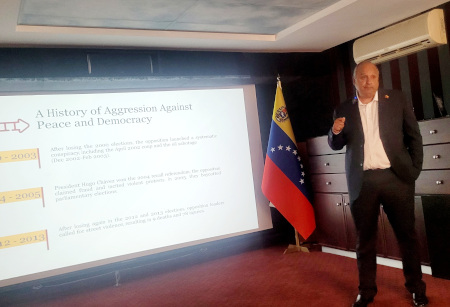
Venezuela’s Defence Ministry has accused the U.S. of targeting civilian vessels in opaque maritime operations, resulting in the deaths of fishermen and sailors off its coast. Venezuelan Ambassador Carlos Feo Acevedo, speaking in Pretoria earlier this month, described these actions as “unprovoked aggression that threatens to destabilise not only Venezuela, but the entire Caribbean basin.”
This is not an isolated episode. The U.S. Treasury continues to freeze Venezuelan assets abroad, exacerbating the country’s economic woes.
Chevron, the American oil giant still operating under special exemptions, has reportedly lobbied Washington to ease the pressure, citing the destabilising consequences for the regional energy market.
Building from Within: Eco-Socialism and Resilience
Amid these external pressures, Venezuela is reshaping its internal narrative. At the World Congress in Defence of Mother Nature, held in Caracas from 9–10 October 2025, over 3,000 delegates from 63 nations gathered to advance an agenda of climate justice and “eco-socialism.” The congress called for decolonising global environmental governance, merging ancestral knowledge with modern science, and promoting cooperation over competition.
President Maduro used the platform to urge global movements to consolidate an international alliance in defence of the planet—a moral counterpoint to what he called “the commodification of life under capitalism.” He linked this directly to the upcoming COP30 in Brazil, framing Venezuela as a voice of resistance and renewal within a global climate discourse often dominated by the very powers deploying warships off its coast.
Venezuela’s domestic innovations mirror this ideological stance. The Petrocasas initiative, developed by the state-owned oil company PDVSA, turns petrochemical by-products into affordable, durable housing. Combined with food sovereignty programs and indigenous-led environmental projects, these measures highlight a drive toward self-sufficiency under siege conditions.
This resilience represents more than economic adaptation—it’s a form of defiance, a declaration that development can emerge from cooperation, not coercion.
The Mirror in Washington
Ironically, as the U.S. flexes its muscles abroad, its own domestic stability appears increasingly fragile. In a display of what some analysts term “internal militarisation,” the federal government has deployed thousands of National Guard troops to American cities, often against the wishes of state governors.
In June 2025, more than 2,000 National Guard members were sent to Los Angeles during immigration raids and protests. The California governor objected, but the federal order stood. A similar pattern unfolded in August when President Donald J. Trump federalised Washington D.C.’s police force and dispatched 800 Guard troops, citing a “crime emergency” despite record-low crime rates. The city’s Attorney General later described the deployment as an “involuntary military occupation.”
Meanwhile, the U.S. federal government entered another shutdown on 1 October 2025, paralysing public services while military operations continued uninterrupted. On 9 October, Congress passed a major defence bill amid the shutdown—a telling symbol of a state that prioritises its coercive apparatus even when governance itself is gridlocked.
Legal challenges are mounting. A federal court in California ruled that deploying National Guard troops for civilian law enforcement violated the Posse Comitatus Act, describing it as “an unconstitutional attempt to construct a national police force with the President at its helm.”
These domestic developments reveal the same cognitive dissonance visible in U.S. foreign policy: a state that professes to defend freedom while steadily eroding it through militarisation—abroad in the Caribbean, and at home on its own streets.
Power, Sovereignty, and the Echo of Empire
The parallels between Venezuela’s external struggle and America’s internal contradictions are striking. Both involve blurred lines between security and domination. Both expose the dangers of unchecked executive power. And both highlight the fragility of sovereignty—whether national or local—when confronted by superior force.
When Washington insists on the right to deploy warships in the Caribbean under vague pretexts, it mirrors its own domestic impulse to deploy troops internally under questionable emergencies. In both arenas, the language of protection conceals the mechanics of control.
For the Caribbean, the implications are profound. The region risks once again becoming the theatre for great-power assertion, where the sovereignty of smaller states is treated as expendable. CARICOM member states have voiced unease, calling for “regional peace through dialogue and respect for international law.” The Bolivarian Alliance for the Peoples of Our America (ALBA) has gone further, condemning U.S. “gunboat diplomacy” as a direct violation of the UN Charter.
Africa, too, has taken note. The African Union’s Peace and Security Council recently referenced the Venezuelan situation as a case study in “asymmetric coercion,” urging reforms to global governance structures that allow such unilateral actions to persist.
Reclaiming the Meaning of Peace
The Venezuelan crisis, at its core, is not only about oil, territory, or ideology. It is about the meaning of peace in an age when warships patrol under the guise of humanitarianism and when democracy is invoked to justify occupation.
In this environment, Venezuela’s call for a new International People’s Movement in Defence of Mother Nature carries symbolic weight. It represents a moral inversion—where a nation under siege seeks to replace domination with dialogue, and coercion with cooperation.
Meanwhile, in the United States, the challenge is introspective: to reconcile the exercise of power with the preservation of democracy. As government shutdowns, executive overreach, and military deployments converge, the world watches a paradox unfold—the self-proclaimed defender of freedom appearing increasingly at war with itself.
The Caribbean-Venezuela confrontation thus stands as both warning and reflection. It warns of the fragility of international law when might overrides right. And it reflects a deeper global condition: the erosion of moral authority in the very nations that claim to uphold it.
Whether the coming months bring de-escalation or confrontation will depend on whether diplomacy can prevail over doctrine. Yet whatever the outcome, Venezuela’s firm assertion of sovereignty amid external pressure and internal renewal represents a rare act of courage in a world too accustomed to submission.