

Defining the National Interest in a Time of Global Disruption
Kgalema Motlanthe Foundation (KMF)
13 October 2025
As the world grapples with overlapping crises — from geopolitical tensions and economic protectionism to the disruptive rise of artificial intelligence — the 2025 Drakensberg Inclusive Growth Forum, hosted by the Kgalema Motlanthe Foundation, convened leading thinkers, global partners, youth voices, and policymakers under the theme: “Defining the National Interest: Our Greatest Priorities Including Geopolitics, Trade and Inclusive Growth.”
Held annually in the tranquil Drakensberg mountains, the Forum has become a platform for urgent dialogue and action-oriented thinking. This year’s gathering was marked by both reflection and resolve — calling for ethical leadership, youth inclusion, and bold, future-focused strategies to confront the structural challenges holding back South Africa and the Global South.
In her opening strategic overview, Mrs. Gugu Motlanthe delivered a piercing assessment of South Africa’s trajectory, warning that “political freedom without economic justice has become an empty vessel.” She called for massive investment in digital skills and grassroots development, emphasizing that “our people are not waiting for handouts — they are waiting for a chance: a chance to build, to work, to rise.” She further reminded delegates that transformation must not be a buzzword but a “moonshot” — demanding imagination, sacrifice, and a shared vision for an inclusive and sustainable future.
Address by Mrs Gugu Motlanthe, Executive Trustee of the Kgalema Motlanthe Foundation and Forum Director
We meet today amid overlapping global crises — deep, urgent, and impossible to ignore. Even by the most cautious of standards, the challenges before us demand that the tone of this 2025 Forum be not only reflective and academic, but decisive, effective, and action-oriented — focusing on what we can do, together, and on actions we can take now to reconstruct a future that is sustainable, inclusive, and just.
As President Xi Jinping rightly observed, “the world is experiencing great changes unseen in a century.” Those words remain profoundly true. Donald Trump has merely accelerated a global realignment, exposing fractures long concealed. In such a shifting landscape, no one can fault us for charting our own course — but we must refuse to be blackmailed into alliances that do not serve the national interests.
This transformation is unfolding alongside the rapid rise of artificial intelligence, the growing influence of nations in the Global South, and sweeping demographic shifts across continents.
At the same time, escalating trade tariffs and protectionist policies have dampened global economic prospects — a trend reflected in recent assessments by the World Bank, IMF, OECD, and regional development banks. Too often, the world fixates on what divides us rather than what unites us. Already, alternative platforms such as the Shanghai Forum are emerging as magnets of economic cooperation.
We are, unmistakably, witnessing the dawn of a new era — one whose shape will be defined by the choices we make today. At 92, Audrey Coleman — a South African of Jewish descent, veteran of the human rights struggle, and mother of Colin and Neil Coleman — recently wrote to the SA Jewish Board of Deputies, saying: “I cry every night when I watch the news and see the atrocities committed against defenceless men, women, and children — whose only crime is to live in Palestine.”
In a time of silence and complicity, her voice rings like a siren. Brecht called such people — Audrey and Max Coleman, Mary and Ben Turok — “the indispensable ones.” Indeed, in moments like these, conscience itself becomes a radical act.
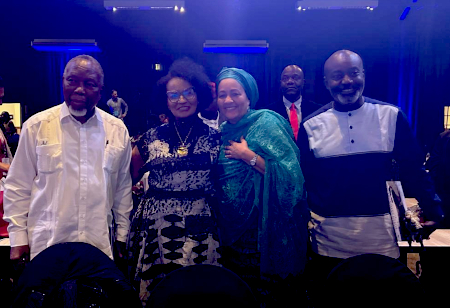
We are honoured to welcome Dr Amina J. Mohammed, Deputy Secretary General of the United Nations, to this Forum. This year marks the UN’s 80th anniversary — a milestone reached amid mounting global challenges and rising expectations. While its responsibilities have expanded, its resources have not, raising questions about capacity to meet its mandate.
Today, young people aged fifteen to twenty-four make up one in every five people on Earth — and Africa remains the world’s most youthful continent. In 2025, South Africa’s median age is 28.7 years; Niger’s, 15.6; Asia’s, 32.5; and the European Union’s, 44.7. Harnessing the energy, creativity, and participation of youth is therefore not optional — it is essential to building inclusion, stability, and shared prosperity.
Across Asia, many leaders are twice the age of their citizens — a gap that has fuelled generational calls for renewal and driven mass movements in Sri Lanka, Bangladesh, and Nepal. Similar youth-led protests — born of frustration with inequality and corruption — have swept across Indonesia, the Philippines, Mozambique, and Kenya. The lesson is unmistakable: when leadership refuses to renew itself and clings to rigid ideologies, the young will demand bottom-up
renewal.
Digitalization is one of the most transformative forces of our time. Artificial intelligence and machine learning are reshaping global capabilities — yet they emerge within contested geopolitics. Between 2013 and 2024, global AI investment reached US$471 billion. Sub-Saharan Africa, by contrast, attracted only US$2–3 billion by early 2025 — US$610 million of that in South Africa, and US$218 million in Nigeria.
These disparities echo the industrial revolutions of the past. For Africa, the challenge is to both catch up and leapfrog — even as AI disrupts labour markets. The truth is, AI doesn’t care about jobs or workers.
China shows that disruption can be managed — but only through deliberate investment in people. They are overhauling vocational education, opening AI night schools, and creating jobs in emerging sectors while developing insurance
and safety nets for displaced workers.
The lesson for South Africa, and for Africa at large, is clear: we too must invest in digital skills, support our youth and entrepreneurs, and design protections for those most at risk. Above all, AI must be a tool to empower our people — not
replace them.
We are also approaching a global milestone: nearly half of all young people are now enrolled in tertiary education – which is unprecedented.
In South Africa, student enrolment has grown from about 495,000 in 1994 to 1.7 million in 2025 — including over 1.15 million university students (91.7% of target), nearly 588,000 in TVET colleges (94.8%), and just under 98,000 in
Community Education and Training colleges — well below the target of 388,000.
While university and TVET enrolments are strong, CET enrolment needs urgent attention. Yet the greater challenge lies beyond graduation: too many of these young people cannot find work.
That is why, at the Kgalema Motlanthe Foundation, we work tirelessly with young people — equipping them with digital skills, nurturing their wellbeing, and building confidence in their potential. These efforts must be scaled dramatically if we are to make a real dent in unemployment and prepare a generation for the technological future.
As South Africa prepares to hand over the G20 Presidency to the United States, one question remains: how do we sustain the momentum gained this year — in drawing global attention to Africa’s pressing challenges, from the high cost of finance and the burden of debt, to the vital role of the critical Minerals in our development?
BRICS brings together rising powers from every corner of the world and offers a platform for shared growth and global balance. But even so, our sustained focus must remain on our largest trading partners — the European Union and
China— where cooperation continues to shape our economic future.
Turning inward, South Africa’s democracy remains fragile, trapped in the shadow of deep inequality. Political freedom without economic justice has become an empty vessel — leaving citizens disillusioned and institutions weakened.
The media plays an indispensable role in shaping public confidence — particularly in times of uncertainty. Yet speculation — such as claims that South Africa may lose access to international payment systems — can be deeply unsettling. Government, business, and the media must work more closely together as partners in nation-building, especially in times of crisis, to ensure that information enlightens rather than alarms.
The youth still expect us to hand over a functioning country — one built on integrity, clean governance, steady power, real jobs, decent healthcare, secure land rights, and future-focused investment. But in recognising our shortcomings, we also renew our resolve — to rebuild what is broken, to restore what has been lost, and to deliver the future dividend our youth so rightly deserve.
We all know the issues that have led to a loss of trust. Repeating them serves no purpose — as Einstein warned, madness is doing the same thing over and overagain and expecting a different result.
The people may not grasp every technical detail of what our economy could — and should — have been: a broader tax base, lower debt levels, full employment. But they understand the consequences — because it is their daily experience.
Such an economy would be a different country altogether.
So we must begin where the need is greatest — in our informal settlements.
Through thoughtful urban planning, we can turn shacks into structured communities; build simple, functional markets that give people a place to trade, to earn, to hope again. Imagine 500 small markets — each costing just R2 million — creating thousands of jobs and breathing new life into the informal economy that already sustains so many.
We don’t need perfection. We need progress. We need employment. We just have to fix it.
Because the truth is — our people are not waiting for handouts. They are waiting for a chance: a chance to build, to work, to rise.
The truth is, South Africa seems to be running without a script. And if there is one, it’s clearly not being followed — because by now, we’d have seen the results. The script would say, “we were meant to be here,” and… well, we’re
not. So maybe there is a script — but if there is, we don’t know who wrote it… and no one seems to be reading it aloud.
What troubles me most is that too few of our political parties think beyond the moment — beyond the election cycle, beyond the politics of survival. We speakoften of progress, yet seldom of the future. We debate policies, yet rarely articulate a shared vision of where this nation should stand twenty or thirty years from now.
The question we must confront is simple, yet profound: in all that we propose and in all that we do — where is genuine development? And at the heart of our decisions — where are our people?
Even amid the chaos of Trump’s America, there remains at least a discernible sense of direction — a script, however contested, for where that nation is headed.
In South Africa, by contrast, our great institutions are crumbling. No major infrastructure is being built. South African Airways may never again be what it once was. Eskom — once the pride of our industrial capacity — now stands on
its knees, financially exhausted. And today, we must ask — can you even send a parcel through the Post Office?
Private sector investment in our state-owned enterprises is welcome, but it must never become privatisation by another name. Partnership should strengthen the state’s capacity to deliver, not replace it.
These are but symptoms of a deeper national malaise — a loss of purpose, of planning, and of faith in the future. As Dr Pali Lehohla reminds us, “If you cannot model it, it is not planning.” His words should challenge us — to think, to learn,
and to rebuild a culture of deliberate, data-driven planning that turns vision into measurable progress.
For a nation to endure, it must believe in something greater than its immediate struggles. It must invest not only in roads, power stations, and airlines — but in its people, in their dignity, and in their hope. Without that, no democracy,
however proud its history, can sustain itself.
Young people, however, understand this instinctively. They see the hard choices ahead and are ready to face them — if only they are trusted and given responsibility.
We gave the world ubuntu — do we still live it?
We are caught in a crisis of leadership — too many have lost their way, where service is overshadowed by self-interest.
The moral compass of our democracy trembles in uncertain hands.
Yet all is not lost. The spirit of ubuntu still lives — in the people and communities rebuilding themselves after loss.
The paradox is clear: our problem is not talent, not ideas, not even resources — it is leadership and organisation. Leadership is everything. Organisation is the scaffolding of society. Without it, bold visions remain empty words; with it, scarce resources can be disciplined, directed, and multiplied for the common good.
Frantz Fanon warned: a revolution without organisation collapses — and elites who fail to build institutions become mere transmission lines for foreign interests.
Business does not operate in isolation. It thrives within a framework of public good— roads, schools, hospitals, law enforcement — all made possible by the taxpayer.
Transformation policies, though imperfect, built South Africa’s black middle class and proved a simple truth: inclusion drives growth. More participation means more ideas, more innovation, more demand — and ultimately, a stronger
economy.
Our economy has become overly financialised — trapped in financial institutions chasing profit, not building and not being ploughed back into production.
Corporate South Africa must do more than give back — it must help build.
Building and supporting small businesses should not be a favour; it should be a responsibility. Real transformation means using corporate power to grow new enterprises, create jobs, and strengthen the economy from the ground up.
And transformation will never be complete while it excludes women, rural communities and the youth from participating in the economic main stream.
Because when women win, communities rise — and when the youth thrive, the nation’s future writes itself, one new day at a time.
Ladies and gentlemen, there is no chair as heavy as accountability — and our system has made it heavier still. Leadership without accountability is hollow.
We remain mired in a leadership crisis, compounded by the illusion that South Africa occupies centre stage on the global front. The truth is, the world is far more complex, multipolar, and unforgiving than any single nation can command.
Yet even as we confront these burdens, there remains much to protect — our institutions, our social fabric, and the promise of opportunity.
Since 1994, we have drifted from being a symbol of liberation to just another struggling country.
In the words of Dag Hammarskjöld, “the UN was not created to take us to heaven, but to save us from hell.” Many parts of the world still need saving.
As I conclude, may the powerful words of the great writer Toni Morrison guide and inspire us: “There is no time for despair, no place for self-pity, no need for silence, no room for fear. We speak, we write, we do language — that is how civilizations heal. The world is bruised and bleeding, and though it is important not to ignore its pain, it is also critical to refuse to succumb to its malevolence. Like failure, chaos contains information that can lead to knowledge — even wisdom. Like art.”
May transformation be our moonshot — because it calls on us to sacrifice, to imagine boldly, and to find the courage to fight for a better world.