


Tolstoy, Gandhi and South Africa - A Legacy of Interconnectedness in a constantly Changing World
By Kirtan Bhana
29 September 2025
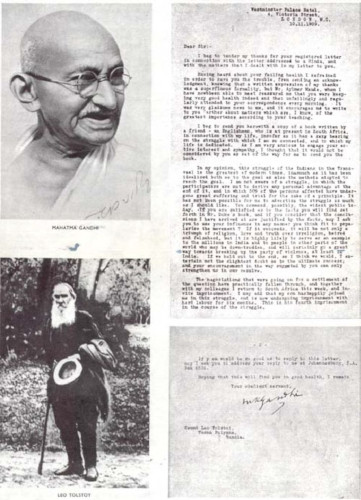
Even before the age of instant messaging and digital connectivity, humanity demonstrated profound forms of interconnectedness. A striking example of this can be found in the correspondence between Russian writer Leo Tolstoy and Indian lawyer Mohandas Gandhi, then living in South Africa. Despite postal delays of up to six months, their exchange of letters captured ideas of peace, non-violence, and human dignity that would ripple across nations and generations. Their connection resonates with the theory of quantum entanglement — distant yet inseparable lives influencing each other profoundly.
This interconnectedness was the theme of a recent event at the University of South Africa (UNISA), hosted in collaboration with the Embassy of Russia and the High Commission of India, marking the birthdays of Tolstoy (9 September 1828) and Gandhi (2 October 1869). The gathering celebrated two global icons whose philosophies continue to shape modern society and highlighted the enduring cultural and political bonds between Russia, India, and South Africa.
Philosophies That Transcend Borders
Opening the discussion, Prabhat Kumar, High Commissioner of India to South Africa, retraced Gandhi’s journey, beginning with his formative years in South Africa. He recalled the defining moment in Pietermaritzburg Station, when Gandhi was ejected from a whites-only compartment, an injustice that ignited his path of resistance. He noted how Gandhi drew inspiration from Tolstoy’s work, especially The Kingdom of God is Within You, which profoundly shaped Gandhi’s philosophy of satyagraha (truth-force).
Ilya Baranov, Counsellor of the Embassy of Russia, reflected on the remarkable patience and conviction embodied in the Gandhi–Tolstoy correspondence. At a time when letters crossed continents over months, their exchange reflected a deeper connectivity beyond physical limitations. He emphasized that their dialogue exemplifies how shared cultural legacies of Russia, India, and South Africa can form the basis of modern cooperation, particularly within BRICS, as South Africa celebrates Heritage Month.
A Shared Historical Journey
The historical interlinkages between the three nations are both profound and practical.
• Language and Culture: The Slavic roots of Russian and Sanskrit of India both trace their origins to the Indo-European family of languages, reminding us of ancient cultural connections.
• Trade and Civilization: Indian traders had contact with the early African civilizations such as Mapungubwe, centuries before colonial encounters reshaped the region.
• Colonial Struggles: During the South African War (Anglo-Boer War), Russians supported the Boers while Gandhi, paradoxically, organized an ambulance corps for the British, only to discover that his “British passport” rendered him a second-class citizen. This bitter realization strengthened his resolve against colonial oppression.
• Tolstoy Farm in Johannesburg: Founded by Gandhi, this settlement embodied Tolstoy’s philosophies of simplicity and non-violence, serving as the cradle for Gandhi’s experiments with satyagraha, which later inspired South Africa’s anti-apartheid struggle.
It was no coincidence that Nelson Mandela himself reflected on this interconnection, famously remarking: “You gave us Mohandas Gandhi, we returned him to you as Mahatma Gandhi.” Russia, for its part, provided material support to South Africa’s liberation movements, weaving a deeper bond of solidarity.
Legacies in the Modern Context
The event at UNISA also served as a platform for contemporary reflection.
• Prof. Boitumelo Senokoane, Executive Director of Institutional Advancement at UNISA, argued that South Africa’s post-apartheid struggles stem partly from adopting the values of former colonizers instead of pursuing a cultural revolution. He quoted Tolstoy: “Money is a new form of slavery, distinguishable from the old simply by the fact that it is impersonal, that there is no human relation between master and slave.”
• Ms. Tatiana Zagorodnikova of the Russian Academy of Sciences, Mr. Alagan Annamalai, Director of the National Gandhi Museum in New Delhi, Mr. Boris Gorelik from the Institute for African Studies in Moscow, and Ms. Charlie Naidoo of the Luthuli Museum, each contributed insights on the legacies of Gandhi and Tolstoy, as well as the responsibilities of present-day societies to carry forward their lessons.
• Ms. Galina Alekseeva, Academic Director of the Leo Tolstoy National Museum-Estate at Yasnaya Polyana, highlighted Tolstoy’s enduring influence, not only as a literary figure but as a global moral compass.
The Road Ahead - BRICS and Beyond
The celebration of Tolstoy and Gandhi’s birthdays was not just about history but also about future cooperation. As the world order evolves, Russia, India, and South Africa are finding renewed ways to collaborate within BRICS and the G20. These platforms echo the values of dialogue, equality, and inclusivity - ideals both Tolstoy and Gandhi championed in their lifetimes.
The trilateral relationship now extends beyond philosophy and literature into trade, technology, security, and cultural exchange, reflecting the dynamism of the Global South. Just as Gandhi and Tolstoy corresponded across continents, never having met in person, today’s partnerships demonstrate that interconnectedness can transcend political, religious, national and ethnic boundaries, nurturing collective progress.
The celebration of Tolstoy and Gandhi at UNISA was a reminder of the profound interconnectedness of human experience. From the battlefield of the Crimean War to the railway platforms of Pietermaritzburg, from Tolstoy Farm in Johannesburg to the halls of the Kremlin and the plains of Gujarat, their stories continue to resonate.
As South Africa, India, and Russia deepen their cooperation in a shifting world order, the wisdom of these two towering figures offers a guiding light: that peace, justice, and shared humanity remain the foundation of lasting relations.