


South African Economy Turning the Corner with Support from China
By Kirtan Bhana
29 September 2025
China will mark the 76th anniversary of the founding of the People’s Republic on October 1. Over nearly eight decades, China has transformed itself into a global powerhouse, lifting more than 800 million people out of poverty, pioneering in science and technology, and contributing positively to global development. Its achievements have not been limited to its domestic sphere — China has shared its knowledge, skills, technology, and even human capital with the Global South, helping partner nations chart their own development paths.
This spirit of shared growth and mutual cooperation lies at the heart of the Comprehensive Strategic Partnership between China and South Africa, a relationship that has steadily deepened over three decades of diplomatic ties. This year, three recent milestones — the celebration of a prestigious book prize, China’s National Day reception in Pretoria, and the 9th China–South Africa Investment Promotion Conference and Trade Fair — all highlight the depth, dynamism, and promise of this partnership.
A Celebration of Knowledge and Culture
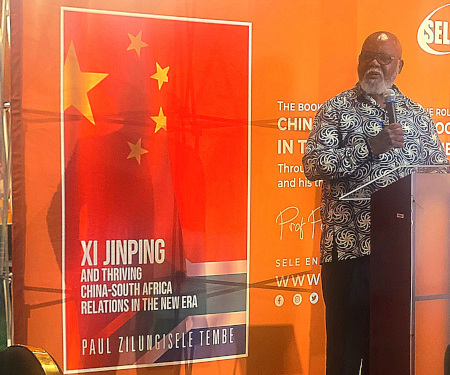
On September 25, at the South African Gallery of Legends in Freedom Park, Pretoria, celebrated China scholar Prof. Paul Zungisele Tembe was honoured for winning the 18th Special Book Award of China. The award, one of the most prestigious recognitions bestowed on foreign experts who contribute to China’s international literary and cultural outreach, was personally acknowledged by Chinese Ambassador Wu Peng.
Prof. Tembe’s recognition is especially symbolic, as it coincided with South Africa’s Heritage Month, a time when the country reflects on its history and honours those who have made lasting contributions to its identity. His decades of work in deepening Sino–South African understanding demonstrate the importance of people-to-people exchanges, which remain one of the five core pillars of President Xi Jinping’s Global Governance Initiative:
The Five Core Concepts of the GGI
1. Sovereign Equality – The principle that no state is too small to matter and none too powerful to dominate. Sovereignty, dignity, and freedom of choice are the non-negotiables.
2. Rule of Law – Global governance requires consistency. The GGI critiques double standards, where powerful states apply international law selectively while imposing unilateral sanctions or interventions.
3. Multilateralism – True multilateralism is not bloc politics but extensive consultation, joint contribution, and shared benefit. The UN must be strengthened, not bypassed, as the legitimate platform for international dialogue.
4. People-Centred Development – Governance must ultimately serve human beings. From tackling climate change to reducing inequality, the wellbeing of people, not abstract geopolitics, should remain the compass.
5. Delivering Real Results – Xi stresses practicality. Governance is not about declarations alone but about solving problems; whether climate change, digital divides, financial instability, or artificial intelligence
The Book Award highlighted how academic and cultural bridges form the foundation of stronger political and economic ties.
China’s National Day - A Shared Celebration
At the Chinese Embassy in Pretoria on September 25, Ambassador Wu Peng hosted a reception marking the 76th National Day of the People’s Republic of China. The event, now a familiar fixture for many South Africans, showcased the strong friendship and exchanges between the people of both nations.
Ambassador Wu emphasized that China’s progress is not only a domestic triumph, but also a shared global good. South Africa, as a comprehensive strategic partner and member of BRICS, has been a key beneficiary of this spirit of solidarity. He reminded attendees that the bilateral relationship is now producing tangible results in areas such as industrialisation, export diversification, and job creation.
The 9th China–South Africa Trade and Investment Promotion Conference
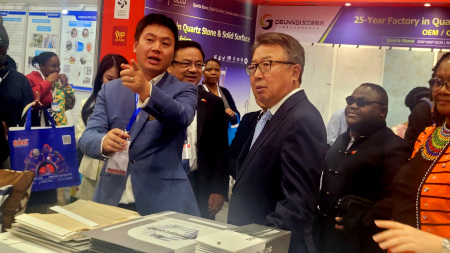
Just days earlier, on September 23, Gallagher Convention Centre in Midrand hosted the 9th consecutive China–South Africa Trade and Investment Promotion Conference. The event drew tens of thousands of visitors and served as a concrete demonstration of South Africa’s economic pivot toward BRICS partners, especially China.
South Africa’s trade with China has not only established China as South Africa’s largest trading partner but also created over 400,000 jobs locally. The fair highlighted South Africa’s growing access to the vast Chinese consumer market, including protocols for exporting pecan nuts, macadamias, and avocados, which now enrich Chinese food baskets.
China’s offer of zero-tariff access for many African exports, in contrast to the tariffs imposed by the United States, signals a major rebalancing of global trade relations. South African business organisations, once sceptical of engaging with China, are increasingly signing agreements and partnerships, recognising the concrete opportunities presented by the world’s second-largest economy.
A notable outcome was the signing of an MOU between the South Africa China Economic and Trade Association (SACETA) and Business Unity South Africa (BUSA). SACETA Chairperson Zhang Chaoyang stressed that the association’s 230 Chinese member companies are committed to localisation, policy synergy, and expanded use of the RMB (renminbi), which will reduce costs and stabilise transactions.
South Africa’s Department of Trade, Industry and Competition (dtic), represented by Lester Bouha, painted a realistic yet optimistic picture: despite challenges, South Africa is “turning a corner,” positioning itself for a new period of economic growth.
Challenges and Opportunities Ahead
While the trajectory of relations is positive, recurring issues such as visa barriers still hamper people-to-people mobility. Streamlining the visa regime, or even pioneering a BRICS free movement framework, could unlock unprecedented opportunities in tourism, academic exchange, and business.
Moreover, as South Africa positions itself as one of Africa’s most diversified economies, its attractiveness lies not just in its domestic market, but in its role as a gateway to the continent. The growing alignment with China and other BRICS partners shows that South Africa’s economic destiny is tied to Africa’s collective rise.
The deepening of China–South Africa relations, celebrated through culture, diplomacy, and trade, reflects a broader pivot toward mutual development, respect, and shared prosperity. From Prof. Tembe’s academic recognition to the symbolism of China’s National Day reception and the practical outcomes of the Investment Conference, the Comprehensive Strategic Partnership is proving to be a powerful framework.
As South Africa “turns the corner,” China’s support and partnership, grounded in the principles of development, peace, cultural exchange, sustainability, and fair governance, will remain a cornerstone of its economic recovery and future growth.