


Brazil’s 203rd National Day - A Rising Global Voice with Deep African Ties
by Kirtan Bhana - TDS
15 September 2025
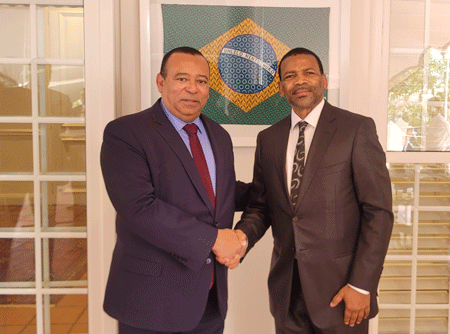
On September 5, the Embassy of Brazil in South Africa marked the 203rd anniversary of Brazil’s independence with a reception in Pretoria. Ambassador Benedicto Fonseca Filho reflected on the growing ties between Brazil and South Africa, describing the relationship as “a time of mutual discovery and special bonds.” His remarks highlighted not only the historic connections between the two nations but also Brazil’s expanding role as a regional leader in Latin America and the Caribbean, and an increasingly influential voice on the global stage.
As the largest country in Latin America and the Caribbean, both in size and population, Brazil has emerged as a natural leader in the region. Under the leadership of President Luiz Inácio Lula da Silva, who returned to office in 2022, Brazil has prioritized rebuilding relations with Africa and reasserting its role in international diplomacy.
Brazil’s hosting of COP 30 in Belém in 2025 highlights its global importance in climate governance. The Amazon, often described as the “lungs of the Earth,” makes Brazil a central player in mitigating climate change. By bringing world leaders to the Amazon basin, Brazil is signalling that the survival of this vital ecosystem is not just a national concern, but a global responsibility. COP 30 is expected to be a turning point in advancing climate justice, especially for developing nations who face the brunt of environmental crises.
Brazil’s significance also lies in its deep cultural and historical ties to Africa. It is home to the largest Afro-descendant population in the world, with tens of millions of Brazilians tracing their ancestry to the African continent. This demographic reality positions Brazil as a natural partner of the African Union (AU), which formally recognizes the African diaspora as its “sixth region.”
Ambassador Fonseca Filho emphasized this connection, noting Brazil’s anticipation of participating in the 9th Pan-African Congress in Lomé, Togo, from December 8–12. This historic gathering, the first since the 2015 edition in Accra, seeks to revitalize pan-Africanism and strengthen ties between Africa and its diaspora. With themes of global governance reform and diaspora engagement at the forefront, Brazil’s presence will highlight its unique role as both a Latin American giant and a diaspora nation deeply linked to Africa’s future.
“The Pan-African Congress is more than symbolic,” Ambassador Fonseca Filho said. “It is about building bridges that strengthen solidarity and reaffirm the shared destiny of Africans and Afro-descendants worldwide.”
Brazil and South Africa share a robust relationship grounded in multilateralism and South-South cooperation. From the India-Brazil-South Africa Dialogue Forum (IBSA), launched in 2003, to BRICS+, which Brazil hosted in Rio de Janeiro earlier this year, the two countries have consistently stood shoulder-to-shoulder in advancing the voice of emerging economies.
As members of the G20, both nations are committed to reshaping global governance structures to better reflect the realities of the Global South. Brazil’s support for South Africa’s G20 presidency in 2025 was warmly received, with the Ambassador commending South Africa’s “strong leadership despite global challenges.”
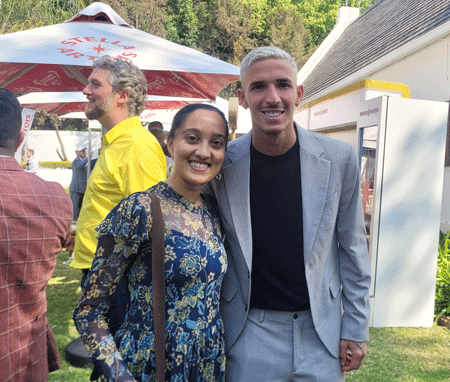
Beyond government-level cooperation, ties between the two countries are flourishing. A growing number of Brazilian companies operate in South Africa, while South African firms are expanding their presence in Brazil. Academic exchanges, commercial flights that resumed in 2023, and a surge in tourism all reflect closer people-to-people links.
Ambassador Mxolisi Bona of DIRCO and Guest of Honour, speaking at the reception, emphasised the value of cultural diplomacy, noting the increasing exchanges in sports, arts, and creative industries. “Our shared love for football, music, and performance art is more than entertainment, it is a bridge of understanding and collaboration between our peoples,” he said.
Brazil’s journey reflects both resilience and aspiration. As Latin America’s largest economy, its leadership in forums like BRICS, IBSA, and the G20 positions it as a vital advocate for the Global South. By deepening ties with Africa, through the AU, the Pan-African Congress, and direct partnerships with South Africa, Brazil is helping to shape a more inclusive and equitable world order.
Ambassador Fonseca Filho captured this spirit in his closing remarks, “Brazil and South Africa are living in a time of mutual discovery. Our bonds, rooted in history and enriched by shared values, are the foundation of a partnership that can inspire progress, not only for our nations, but for the entire Global South.”
As Brazil celebrates its 203rd National Day, its growing influence across the Atlantic and beyond reaffirms its place as both a regional powerhouse and a global leader. From climate diplomacy in Belém to pan-African solidarity in Lomé, Brazil is proving that its independence, celebrated since 1822, is not just a national milestone but a platform for shaping the future of the world.