

Vietnam at 80 - From Đổi Mới to Vision 2045
By Kirtan Bhana – TDS
3 September 2025
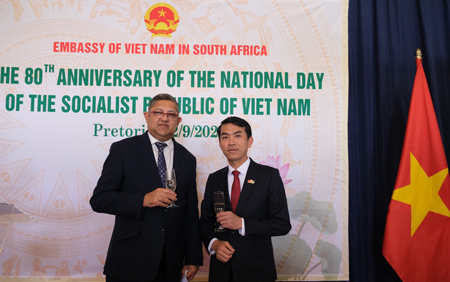
Vietnam’s journey from colonial subjugation and devastating wars to one of Asia’s most dynamic economies is a story of resilience, pragmatism, and humility. This year, as the Socialist Republic of Vietnam marks its 80th National Day, the celebrations in Pretoria highlighted both the remarkable triumphs of its past and the promise of its future.
Hosted by Ambassador Hoang Sy Cuong, the commemoration gathered diplomats, South African officials, and international guests in a reflection on Vietnam’s legacy and modern achievements. Among the attendees was Deputy Minister of Forestry, Fisheries, and the Environment, Narend Singh, who represented the Government of South Africa. Singh highlighted the shared values of justice, resilience, and freedom between the two nations and pointed to Prime Minister Pham Minh Chinh’s upcoming participation in the G20 Summit in Johannesburg as a sign of Vietnam’s rising global role.
Eighty years ago, on September 2, 1945, President Ho Chi Minh declared Vietnam’s independence, ending nearly a century of colonial rule. Yet the road ahead was fraught with trials. Wars of resistance, national reunification, and economic isolation left the country scarred and impoverished.
But through its defining policy of Đổi Mới (Renewal), launched in 1986, Vietnam transformed itself. By opening its doors to the world, embracing a socialist-oriented market economy, and diversifying its international partnerships, Vietnam steadily shifted from a war-torn state to a rising economic powerhouse. Today, it is one of the most vibrant economies in the Asia-Pacific, firmly integrated into global trade and diplomacy.
Ambassador Cuong described the 14th National Congress of the Communist Party of Vietnam, to be held next year, as a pivotal moment. Sweeping reforms, from restructuring government systems to streamlining administrative tiers and merging provinces, signal Vietnam’s determination to build an effective, forward-looking governance system as it advances towards its Vision 2045 of becoming a high-income, developed nation.
Vietnam’s resilience finds resonance in South Africa’s own struggle for freedom. Both nations honour iconic leaders, President Ho Chi Minh and President Nelson Mandela, whose lives embodied sacrifice and liberation. This shared legacy continues to inspire a “Partnership for Cooperation and Development” that is growing deeper with each engagement.
The relationship has seen notable progress this year. A pivotal phone call in April between General Secretary To Lam and President Cyril Ramaphosa charted a clear strategic direction for bilateral ties. Trade has already reached $1.7 billion annually, with opportunities expanding in sectors such as high-tech agriculture, renewable energy, and digital industries.
South Africa, now a Sectoral Dialogue Partner of ASEAN, provides Vietnam with a gateway to the African continent, while Vietnam serves as South Africa’s bridge into ASEAN. This alignment is significant of multilateral cooperation in a world marked by complexity and rapid change.
Vietnam’s role on the global stage continues to expand. Prime Minister Pham Minh Chinh’s attendance at the G20 Summit in Johannesburg will highlight Vietnam’s contributions to global economic governance. President Cyril Ramaphosa, in turn, will attend the ASEAN Summit, an affirmation of the strategic importance both nations place on the relationship.
Vietnam’s President Luong Cuong recently completed a significant visit to Africa, where he consolidated trust and expanded cooperation with partners in Egypt and Angola, and held key discussions with the Arab League in Cairo. These engagements illustrate Vietnam’s growing diplomatic footprint, extending solidarity beyond Asia to Africa and the Middle East.
Vietnam’s Vision 2045, to become a high-income, developed country by its centenary, offers an inspiring roadmap not only for its people but also for its partners. For South Africa, this is a unique opportunity to align with Vietnam’s trajectory, building synergies in trade, industrialization, green energy, digital transformation, and people-to-people exchanges.
By positioning itself as a strategic partner in Vietnam’s long-term growth, South Africa can deepen cooperation not just bilaterally but also across regional blocs such as SADC and ASEAN. Together, the two countries have the potential to shape a model of South–South cooperation that reflects resilience, inclusivity, and mutual respect.
Ambassador Cuong’s address emphasized Vietnam’s enduring qualities; resilience, creativity, optimism, and humility, as the country continues its rise. The Ubuntu philosophy, often cited in South Africa, resonates deeply with Vietnam’s belief in solidarity and cooperation.
From the battlefield of the past, Vietnam now stands as a beacon of peace and prosperity, forging friendships across regions, and shaping a more inclusive global order. As it approaches its centenary in 2045, Vietnam’s story is no longer just one of survival, it is one of global leadership built on the foundations of humility, dialogue, and shared progress.
Photos and video: Vietnam Embassy in South Africa