

Science Diplomacy Empowering Women – Tunisia and South Africa
By Jayde Bhana - TDS
29 August 2025
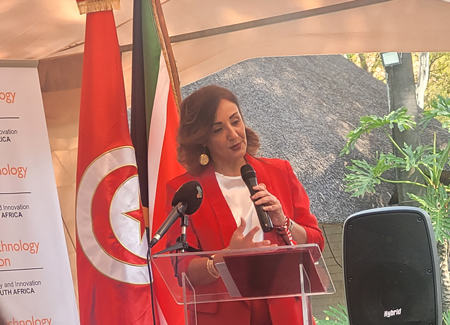
On the 28th of August, Karima Bardaoui, Ambassador of Tunisia to South Africa, hosted guests at the Tunisian residence in Pretoria at an event to celebrate and discuss the empowerment of women in STEM and how to best use science diplomacy for this purpose. The event was hosted in partnership with the Department of Science, Technology and Innovation of South Africa (DTSI) and the Science Diplomacy Capital for Africa (SDCfA).
This event follows a recent strengthening of a partnership through science, technology, and innovation (STI) called Scaling up Tunisia - South Africa Strategy, which includes a Plan of Action and Joint Research Call. It was appropriate to focus the discussion on women’s empowerment as both South Africa and Tunisia celebrate their national women's day in August (9th and 13th of August respectively).
In her opening remarks Bardaoui informed the audience that Tunisia ranks first in the world in the percentage of female students enrolled in STEM fields (Science, Technology, Engineering, and Mathematics), with a rate of 43.3%. They are proud of their near gender parity (with women making up the majority in some cases, such as the health sciences) as their society is successfully implementing empowerment strategies. The Ambassador draws inspiration from her own daughter who works in health sciences as she urged the attendees to dream big, work hard, and never give up. The call for perseverance and resilience from women pursuing science careers and studies was a recurring theme throughout the discussions.
The keynote address was delivered by Nomalungelo Gina, the Deputy Minister of Science, Technology, and Innovation of South Africa. She was emphatic in her message that science indeed does not know borders, and in fact collaboration is the very essence of the subject. In the same way, science does not know gender, and old perceptions are now changing. Representation in science continues to grow in South Africa, and Gina acknowledged that South Africa and Tunisia face similar challenges, which further highlights the importance of collaboration.
The Deputy Minister highlighted some of the work that the DSTI is doing specifically to empower women in the field. With focus on innovation and preparation for the future, the DSTI has deployed many funding schemes (e.g. NRF bursaries, grants, and grassroots innovation programs) to support women pursuing higher education degrees. She also reminded us that mental and physical wellbeing are also important. “We should not forget ourselves,” was the take home message.
On the topic of science diplomacy as a pillar in the empowerment of women, a panel consisting of members from the Commission for Gender Equality, the Steering Committee of the Science Diplomacy Capital for Africa, and the African Union Development Agency - NEPAD discussed strategies to increase the representation of women in science careers. The strategies need to be implemented from school children all the way through to leadership positions to ensure a steady representation of women through all levels of education and careers. The DSTI is also implementing the international protocol for gender equality and is focussing on empowering women who do not always have equal access to resources and technology in this rapidly evolving digital world. Having a clear vision will ensure a deliberate approach to implementation. Recognition and validation is also important in order to increase visibility. An example of this is the annual South African Women in Science Awards held by the DSTI (the most recent being held in Bloemfontein on the 21st of August). As a conclusion to this panel discussion a prerecorded video showcased Tunisian women working and thriving at research and higher education institutes in Tunisia and the audience was given an insight into some of their life stories.
On the topic of ways to boost the role of science diplomacy in women’s empowerment, members from the DSTI, the University of Pretoria, and Traversing Liminality discussed creating meaningful spaces for women and the development of mentorship programs. It was noted that there is a lack of entrepreneurship in STEM and women tend to prioritize integrating into the working world. A challenge that many women face after qualification is the question of, “What next?” The emphasis is then on supporting women to have confidence in themselves and their mastery and giving them the tools and skills to be able to network.
It was again emphasised how important it is to facilitate women taking breaks and taking care of their health so that a return to work or studies does not make them feel left behind. All of the strategies to empower women should not stop at gender parity, rather they should be stable and sustainable. Diplomacy is about the people-to-people relation and so the focus must be on giving the necessary resources to the people. Another pre-recorded video this time shared stories of a few of the many Tunisian women who work in health care in South Africa and their experiences, again highlighting the collaborative efforts in effect between the two countries.
The future looks bright. In Africa, the representation of women in STEM is comparable to global averages, and as the continent with the youngest population there is much opportunity to implement development programs that will have a real and lasting effect on the population. Of course men are an important part of the conversation as they play a role in supporting women’s empowerment. It was discussed how men should not be left behind as they learn how to create and exist in spaces for women.
The event facilitated an eye-opening experience into the world of science diplomacy and showcased the many strategies and developments regarding the empowerment of women. We are reminded that as much strength, resilience and perseverance women show, they are also in need of support, whether that be the reassurance that they can take a break or the necessary resources to launch their innovations.
Guests were treated to a musical performance by local artist Asi Omhle before a buffet lunch was served to promote the ever important networking and furthering of discussion.
Jayde Bhana is an MSc Candidate at the University of Pretoria