


Commemorating victory is not about triumphalism
Marking 80 Years Since the Victory in the War of Resistance Against Japanese Aggression and the World Anti-Fascist War
By Kirtan Bhana
1 August 2025
As the world marks the 80th anniversary of the victory of the Chinese People’s War of Resistance Against Japanese Aggression and the World Anti-Fascist War, China reaffirms a message long rooted in its foreign policy: “Never forget history, always promote peace.”
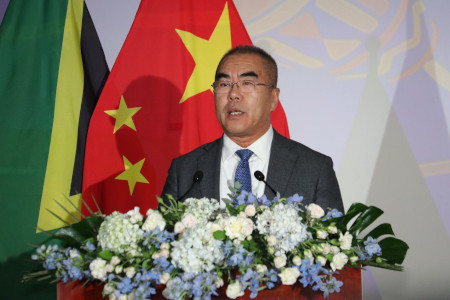
At the Chinese Film and Photography Exhibition held in Johannesburg on July 30, 2025, Mr. Pan Qingjiang, Chinese Consul General in Johannesburg, emphasized the dual purpose of the commemoration — to honor the victory over fascism and to use the past as a guide for peaceful development. The commemorative event coincided with the founding of the People’s Liberation Army (PLA) on August 1, highlighting China’s transition from a war-ravaged nation to a stable global actor committed to peaceful growth and defense. Mr. Pan stressed that while China has built a formidable military capacity over the decades, the PLA remains rooted in a defensive doctrine: “The Chinese military exists not to wage war, but to safeguard peace,” he noted, reflecting a stance that reinforces China’s long-standing policy of non-aggression.
A Legacy of Sacrifice and Global Solidarity
China’s role in defeating fascism is often understated in Western narratives. Mr. Pan reminded attendees that the Chinese people held firm for 14 years in the Eastern front of World War II, at great human and economic cost. This massive effort not only contributed significantly to global victory over fascism but also served as a formative chapter in modern China's sense of international responsibility. In honoring the past, the speeches made clear that remembrance is not about perpetuating animosity, but about awakening “goodwill in people’s hearts for peace and perseverance,” and ensuring that history’s darkest hours are not repeated. Speaker of the Gauteng Provincial Legislature, Hon. Morakane Mosupyoe, echoed this sentiment: “Those who cannot remember the past are condemned to repeat it,” she quoted, reminding that commemoration must go hand in hand with proactive peace-building. She noted South Africa’s solidarity with China, not only in remembrance but in advocating for a multipolar world that rejects imperialism, subjugation, and unilateral aggression.
Defense-Driven, Peace-Oriented
Though the PLA has evolved into one of the world’s most advanced militaries, China maintains that its use is strictly defensive. This principle is underscored by its adherence to the Global Security Initiative, one of three diplomatic pillars introduced by President Xi Jinping — alongside the Global Development and Global Civilization Initiatives. These frameworks are designed to promote global peace, inclusive growth, and respect among civilizations. As Mr. Pan explained, “We must… oppose all forms of hegemony, bullying, and power politics, and work together to pursue the path of peaceful development.” This doctrine stands in contrast to increasing global militarization and unilateral interventions by powerful states. China's model emphasizes sovereignty, multilateral dialogue, and the rule of international law — particularly the post-WWII international order shaped by the United Nations.
BRICS and the Shared Future of Peace
The commemoration also brought focus to China-South Africa ties, with both nations sharing a commitment to peace and development. Within the BRICS framework, they work jointly toward reshaping the global order into one that respects sovereignty and equality. South Africa’s active role in peace efforts — from the Russia-Ukraine conflict to crises in the Middle East and central Africa — demonstrates its alignment with China’s stance against aggression. As Speaker Mosupyoe stated: “Our bilateral relation becomes even more relevant today when the world is beginning to experience the resurgence of narrow nationalistic sentiments which threaten world peace and solidarity.” This shared commitment underscores the relevance of historic memory in shaping today’s military and foreign policy postures — ones that prioritize defense over domination, and cooperation over confrontation.
The 80th anniversary of the victory over fascism is more than a historical milestone. For China, it is a reaffirmation of a military and diplomatic identity forged in the crucible of global war — one rooted in peace, memory, and multilateralism. The PLA, though powerful, is not a tool of aggression but a safeguard for a nation committed to stability and development.
As geopolitical tensions rise worldwide, China calls not for war, but for wisdom — and for a collective remembrance that fosters peace rather than division. The message from Johannesburg is clear: commemorating victory is not about triumphalism, but about honoring sacrifice with resolve — to never let history repeat itself.