


‘Global South’ Momentum Leads Global Socio-Economic Balance
Kirtan Bhana - TDS
31 July 2025
Does hosting the G20 in a developing nation like South Africa, the first summit to be held on the African continent, give new relevance to this association of the world's 'top' 20 economies? Or is it merely the departure terminal for the BRICS+ train? Are countries like Indonesia, India, Brazil, and now South Africa, developing nations that have emerged as key players, poised to hold the so-called developed world to account for its double standards and political machinations that have fractured the global order? Or is this just another ploy to deflect responsibility and deliver empty political promises?
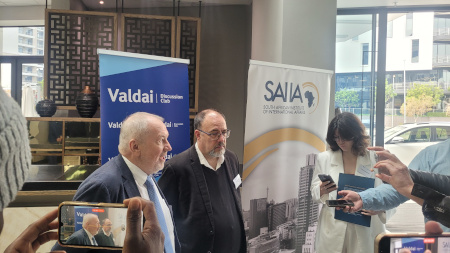
In Pretoria, South Africa, July 28, Africa’s pivotal role in adding momentum to an emerging alternative geopolitical order came under discussion at the multifaceted 3rd Russia-Africa Conference, hosted by the Valdai Discussion Club of Russia and the South African Institute of International Affairs (SAIIA). The programme, titled “Realpolitik Responses in a Fractured World: Rethinking Russia–South Africa Ties in a Global and African Context,” provided much food for thought.
Africa is almost twice the size of Russia and considerably larger even when compared to the combined landmass of the former USSR, which was dismantled in 1989 following the Cold War, leading to the formation of several new Eastern European states, including Ukraine. Geographically, Russia is situated in the northeastern hemisphere of continental Eurasia, while Africa spans all four hemispheres, with Europe as its closest neighbor and lying centrally between the Americas and Asia.
Politically, Russia is a federation comprising 21 republics, 46 regions, 4 districts, and two cities of federal subordination, Moscow and St. Petersburg, with a population of approximately 150 million. In stark contrast, Africa, arbitrarily divided by European colonisers during the 1884 Berlin Conference, today consists of 54 sovereign states, each with its own constitution, capital city, government, bureaucracy, and diplomatic protocols. The continent is home to nearly 2 billion people, with a significant youth population, 70% of whom are under the age of 30.
Given this historical landscape, the formation and steady expansion of the BRICS grouping more than 15 years ago, alongside platforms such as the Shanghai Cooperation Organisation (SCO) and the Russia-Africa Forum, signal the emergence of a new global paradigm that is rapidly gaining traction.
The former USSR was a committed supporter of African liberation movements during their struggles against oppressive colonial regimes. These efforts were acknowledged and appreciated by newly independent African states. The USSR’s involvement in the Battle of Cuito Cuanavale in Angola (1987–1988) played a decisive role in liberating Namibia and paving the way for South Africa’s eventual democratic transition. The 1989 fall of the Berlin Wall marked the dissolution of the USSR and the emergence of the Russian Federation along with 15 newly independent states.
During World War II, Russia faced threats from Nazi Germany in the west and Imperial Japan in the east, playing a pivotal role in the Allied victory—an 80th anniversary commemorated this year. This was not the first time Russia resisted European domination; Napoleon Bonaparte of France also failed in his conquest. Today, NATO’s aggressive stance is repeating history—and failing again. Despite its European cultural roots and post-communist efforts to align more closely with the West, Russia has refocused its global engagement towards its long-standing partners in Asia and Africa.
South Africa, too, has recently faced antagonism despite being a constitutional democracy guided by principles of equality and justice. The punitive sanctions and threats of diplomatic censure for its foreign policy positions reveal the persistent double standards and misplaced moral authority projected by some Global North nations.
At the upcoming G20 Summit in Johannesburg, this new global dynamic must be addressed. As chair of this seminal conference, South Africa has the opportunity to facilitate meaningful dialogue between East and West, North and South. It is a chance for multi-polarity and multilateralism to move beyond rhetoric and engage in genuine realpolitik