


Reflections on South Africa - Thailand Relations in a Changing World Order
Paisit Boonparlit, Chargé d’Affaires of the Royal Thai Embassy speaks to The Diplomatic Society
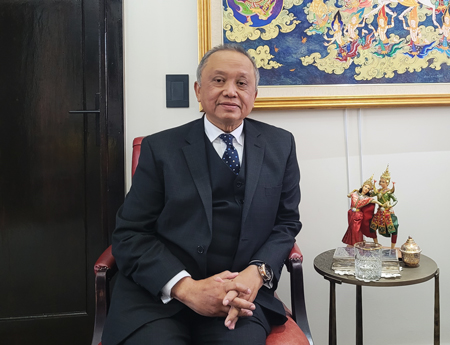
14 July 2025
As Paisit Boonparlit prepares to retire from his post as Chargé d’Affaires of the Royal Thai Embassy in South Africa, he reflects on a remarkable journey that spans not only a distinguished career in Thailand’s civil service but also a pivotal period of transformation and deepening relations between Thailand and South Africa. For the past seven years, Boonparlit has observed first-hand the evolution of bilateral ties between two countries separated by geography, yet increasingly connected by shared values, mutual respect, and common aspirations.
Thailand established diplomatic relations with South Africa in 1993, during a historic moment as the apartheid regime came to an end and a democratic South Africa was born. "The transformation of South Africa is profound," Boonparlit reflects. “Having endured colonialism and the brutal apartheid system, the country has emerged resilient and with great potential. Thailand deeply respects this journey.”
Over the past three decades, these two countries have built a relationship founded on solidarity, trade, people-to-people exchange, and growing multilateral cooperation. As South Africa takes its place as a prominent African voice on the global stage, Thailand, never colonized and always open to the world, has embraced a dynamic and increasingly outward-looking foreign policy.
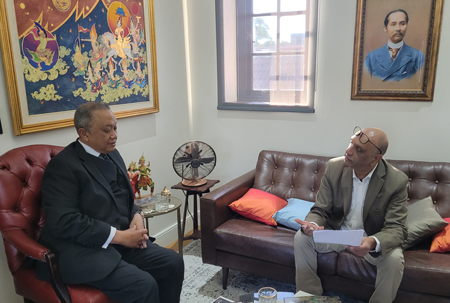
Boonparlit highlights the significance of regional cooperation frameworks such as ASEAN and the African Union, and the growing convergence of their goals. "ASEAN and the AU have similar aspirations—economic integration, peace, and inclusive development," he says. “Now, with South Africa and Thailand both part of the expanded BRICS+ architecture, we are entering a new phase of multipolar diplomacy.”
This alignment, he believes, offers great opportunity for South-South cooperation. "It is not just about governments—it’s about businesses, civil society, artists, and professionals coming together. That is the future."
Among the pillars of Thai–South African cooperation is trade, particularly in the automotive and medical sectors. One of the most tangible signs of this is the presence of Thai Summit Group, a leading auto parts manufacturer, which operates in South Africa. “The automotive industry is a cornerstone of our collaboration,” Boonparlit says. “It demonstrates confidence in South Africa’s capabilities and in the potential of this market to serve the broader continent.”
On healthcare, Boonparlit points to the Thai government’s long-standing emphasis on universal access and public health innovation, an experience that resonates with South Africa’s ongoing development of its National Health Insurance (NHI) system. “Thailand can share its experience and expertise in public health infrastructure, community-based care and medical tourism,” he notes. “We see strong possibilities for collaboration.”
Cultural exchange has also featured strongly during Boonparlit’s tenure. He has championed Thai cuisine, arts, and especially Muay Thai, the traditional martial art that has gained popularity across the globe. Under his watch, the Muay Thai EFL Gladiator's Cup was hosted in Pretoria, drawing attention to sport as a powerful tool of diplomacy and youth development.
“Muay Thai is more than a sport—it’s a philosophy of discipline, respect, and self-mastery. It speaks to the spirit of our people,” he says.
The arts, cultural performances, and exchange programs have steadily grown, enhancing understanding between the peoples of Thailand and South Africa.
Yet, challenges remain. Chief among them is the issue of visas—a concern that Boonparlit says has slowed tourism, business travel, and academic exchange. "Simplifying and streamlining visa processes is vital for unlocking the full potential of our relationship,” he urges. “It is important not only for Thai tourists visiting South Africa but also for South Africans wanting to explore Asia through Thailand.”
Skill development and educational exchanges are other key priorities. "We want to see more South African students and professionals coming to Thailand to study, train, and share experiences—and vice versa."
One of the defining features of Thailand, Boonparlit explains, is its uncolonized history and deep-rooted tradition of openness. "Thailand has always welcomed people from all corners of the globe," he says. “Our practice of Buddhism, with its emphasis on compassion, balance, and acceptance, shapes our worldview and our foreign policy.”
This philosophy is evident in Thailand’s diplomacy—one marked by neutrality, bridge-building, and non-alignment, even as the world faces increasing geopolitical divisions. “We maintain strong relations with our traditional partners, but we are also opening to new ventures—Africa, Latin America, and the Global South more broadly.”
Boonparlit recalls the pivotal moment in the 1980s, when Thailand opened its economy and welcomed countries like Japan and South Korea to be part of its national development journey. “We did not fear partnership. We welcomed ideas, investment, and innovation. And we created the conditions for prosperity while maintaining our cultural identity,” he says.
South Africa, he notes, is on a similar trajectory but faces different structural and historical challenges. “What is important is long-term planning, policy stability, and nurturing local talent. Thailand is ready to be a partner in that process.”
As his diplomatic chapter draws to a close, Boonparlit expresses hope and confidence in South Africa’s future and in the Thai–South African partnership. “There is enormous potential between our countries,” he says. “My role has been to plant seeds—of understanding, cooperation, and friendship. I believe those seeds will grow.”
From economic corridors to cultural bridges, from martial arts to medicine, the legacy of Chargé d’Affaires Paisit Boonparlit will be felt long after his departure. His reflections are a testament to the quiet power of diplomacy in building a better, more connected world.
Boonparlit has served as Minister, and Deputy Head of Mission at the Royal Thai Embassy in Pretoria, Republic of South Africa since August 2017. He entered the Thai foreign service in 1988 and during his over 30 years of public service has been assigned to the Royal Thai Embassies in Kuala Lumpur (Consul/Economic Officer/Public Relations Officer), Malaysia, Washington D.C. (Political Officer), United States of America, and Mexico City, (Deputy Chief of Mission and Head of Chancery) Mexico, prior to his posting to Pretoria, South Africa. He attained a Bachelor of Science Degree in International Studies at Bradley University, Peoria, Illinois with a Minor in Mass Communications and assigned to various high profile duties which required expertise and experience during his illustrious career
His dynamic network covers the ASEAN region, North America and a large number of African countries, having served as a Thai diplomat in these three regions. Beyond his retirement from Government Service, Paisit is planning a second career to be associated with academic engagements, business ventures through public and private synergy and the promotion of cultural activities on a global level.
Photo: TDS