


Dialogue Among Civilizations, A New Dawn for Humanity
By Kirtan Bhana - TDS
13 June 2025
June 10, 2025, marked a watershed moment in the annals of human history, the first International Day for Dialogue Among Civilizations, officially declared by the United Nations and initiated by the People's Republic of China. It is not simply a commemoration, but a clarion call to humanity to reconnect with its ancestral wisdom and collective purpose in a rapidly changing global order.
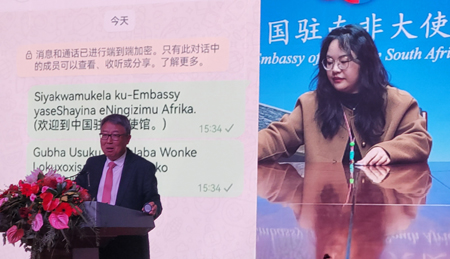
Held at the Embassy of China in Pretoria, South Africa, the inaugural celebration of this day was deeply reflective, infused with ancestral memory and forward-looking vision. Chinese Ambassador Wu Peng welcomed guests to a gathering that brought together high-ranking diplomats, African thought leaders, and civil society representatives, affirming that dialogue is the antidote to division and conflict.
The event was grounded in the profound realization that civilizations, ancient, diverse, and enduring. are the bedrock of humanity’s shared identity. From the Yellow River basin to the Nile, from the Indus Valley to the Andes, our ancestors cultivated not only crops, but codes of ethics, systems of governance, and expressions of the divine through art, music, and oral traditions.
Today, we inherit not only their ruins and relics but also their aspirations. As Wang Yi, China’s Foreign Minister, noted in his video address, “Human society is an indivisible community with a shared future... Civilizations complement and inspire each other. It is prime time to promote dialogue among civilizations.”
This statement echoes the ancient Chinese value of harmony in diversity, a worldview increasingly necessary in the face of today's crises, from geopolitical conflict and climate change to technological disruption and economic inequality.
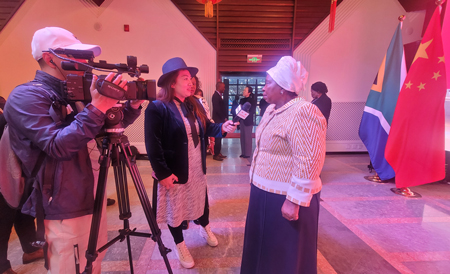
South Africa, with its unique struggle against apartheid and its commitment to peaceful transition, stands as a living testament to the power of dialogue. Former African Union Commission Chairperson Dr. Nkosazana Dlamini-Zuma reminded guests, “South Africa is the prime example of civilizations in dialogue. We resolved to sit down, not to fight; to speak, not to shoot.”
She connected the ethos of the Freedom Charter, which celebrates its 70th anniversary this year, to the global need for dialogue. The charter’s declaration that “There shall be peace and friendship” resonates far beyond the borders of South Africa, affirming a universal truth: dialogue builds where violence destroys.
Dr. Dlamini-Zuma also highlighted China’s historical engagement with Africa, long predating colonial contact. Artifacts and chronicles from the Tang and Ming Dynasties reflect this rich exchange. “We now know through scholars like Prof. Li Anshan that Du Huan of the Tang Dynasty visited Africa in the 8th century. Porcelains found here are physical evidence of that contact.”
In this way, Africa and China are not strangers. They are ancient friends rekindling an old and noble conversation.
Busani Ngcaweni, Director-General of South Africa’s National School of Government, introduced a concept that is gaining ground - pluriversality. It is the recognition that no single civilization holds a monopoly on truth or progress.
“Dialogue affirms our belief in the coexistence of civilizations... A pluriversal world rejects the notion of a single universal civilization.”
His words are a direct rebuke to the theory posited by Samuel Huntington in The Clash of Civilizations, which predicted inevitable conflict between differing cultures. Instead, Ngcaweni and the speakers assembled offered hope for harmony, anchored in mutual respect, diplomacy, and shared prosperity.
He also warned of “soft violence”, the economic and structural inequities that plague the global order today. “The turbulence in global economic governance is driving a polycrisis... This is a form of economic violence that undermines our shared goals.”
Dialogue among civilizations, he argued, is essential to reimagining institutions such as the G20, the United Nations, and the African Union to serve solidarity, equality, and sustainability, South Africa’s theme as G20 chair.
In his address, Wang Yi presented China’s vision for the future of civilizational dialogue under the Global Civilization Initiative introduced by President Xi Jinping. This vision is based on three principles:
1. Equality among civilizations – Rejecting the superiority of any one culture or system.
2. Exchanges among civilizations – Learning from each other to tackle shared global challenges.
3. Advancing the progress of civilizations – Using tools like AI and technology not to divide, but to enhance shared human knowledge and creativity.
“Humanity has only one Earth and only one shared future. Let our dialogues play a harmonious symphony... toward a better future,” said Wang Yi.
China’s readiness to support and even host platforms like the UN Alliance of Civilizations Global Forum in 2028 and fund mechanisms for inter-civilizational dialogue are gestures of global stewardship at a time of fragmentation and fear.
This dialogue is not merely diplomatic, it is cosmic. As we learn more about our origins, the interconnectedness of all life, and the universe’s boundless mysteries, a new civilizational era dawns. In this age of transition, the ancestral spirits of humanity, those who built the pyramids, carved the mountains, mapped the stars, and sowed the seeds of language and law, call out for unity through understanding.
As we celebrate this inaugural International Day for Dialogue Among Civilizations, let us remember that our greatness as a species does not lie in domination, but in cooperation. We are the sum of our shared stories, struggles, and aspirations.
Dialogue is not an option, it is a necessity. It is how we move forward not just as nations, but as one humanity. Let us embrace it with the wisdom of our ancestors and the hope of our children.