


An integrated Africa - 30 years of Korea and South Africa
Ambassador Chull-Joo Park of Korea addressing delegates
25 August 2022
Since the establishment of diplomatic ties in December 1992, the Republic of Korea and South Africa have signed 16 bilateral agreements covering cooperation in sectors such as air transport, protection of investments, taxation, science and technology, mutual legal assistance in criminal matters, extradition, ICT, vocational training and energy. In 30 years, relations have strengthened in all aspects which has seen South Africa become Korea’s largest trading partner on the continent with trade volumes reaching over US$ 2 billion. This trend has continued its upward trend despite the impact of the COVID-19 pandemic and the geo-politic instability of recent months.
The Embassy of the Republic of Korea, the Korea-Africa Foundation (KAF) and the South African Institute of International Affairs (SAIIA) hosted a seminar commemorating this milestone event of 30 years of diplomatic relations between the Republic of Korea and South Africa. Ambassador Woon-Ki Lyeo, President of the Korea-Africa Foundation spoke of the specific emphasis of Korean policy on Africa and the partnership platform connecting Korea and Africa in his opening remarks. KAF was set up in 2018 as an affiliate of the Ministry of Foreign Affairs of Korea to strengthen exchanges and cooperation with African countries and enhance mutual understanding between Africa and Asia. KAF aims to create greater awareness of Africa in Korea to boost trade which stands at 1% and investment of only 0,7%.
READ ALSO: Africa’s youth dividend and Korea
READ ALSO: The Diplomacy of Korean Culture
Speaking of his first encounter with South Africa in 1994 Ambassador Chull-Joo Park was part of a delegation that spent 10 days here negotiating the Double Taxation Avoidance Agreement. He returned as Ambassador to South Africa and is fortunate to serve at this momentous time when the countries celebrate 30 years of relations. He noted that 40 Korean companies have set up thriving businesses here and looks forward to growing exchanges especially in the travel, tourism and arts, sport and culture industries. He also called for a feasibility study to uncover the impact of a bi-lateral free trade agreement between the countries.
 Minister Naledi Pandor with Samsung's Global CEO, Jong-Hee Han (photo credit: Dirco)
Ambassador Ntombizodwa M Lallie, Deputy Director General at the Department of International Relations for South Africa (DIRCO) delivered congratulatory remarks describing South Africa’s integration into global manufacturing supply and value chains for the continued, dynamic and vibrant links between the two countries. We have to honour our obligations said Lallie and referred to the recent meeting between Samsung’s Global CEO, Jong-Hee Han, DIRCO Minister Naledi Pandor and DTIC Minister Ebrahim Patel on the company’s commitment and ambitions in contributing to South Africa’s economic transformation and prosperity.
Researchers from SAIIA, POSCO and the Institute of Foreign Affairs of Korea made presentations on the AfCFTA, green industries and climate justice which were moderated by Elizabeth Sidiropoulus, CEO at SAIIA. She noted the robust and growing interactions between research and academic institutions since Minister of Foreign Affairs of Korea, Dr Kang Kyung-wha addressed a public-private international economic forum hosted at SAIIA at Wits University in Johannesburg in 2019.
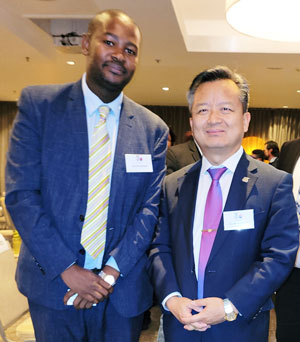 Percy Koji with Ambassador Woon-Ki Lyeo, President of the Korea-Africa Foundation
Also attending the function was Percy Koji, co-founder and president of the Africa Economic Leadership Council – AELC who recently travelled to Korea to explore opportunities in Travel and Tourism. AELC, which looks to promote self-reliance and entrepreneurship on the continent in line with the economic integration, has launched chapters in Namibia, South Africa and Botswana since its inception this year. Koji travelled to Brussels, Belgium to receive the prestigious Crans Montana award for leadership presented by the Swiss based foundation that supports entrepreneurship and community based initiatives.
Africa and Korea may have shared similar histories of colonial subjugation and the devastating effects of war and conflict, but they also share a unique challenge of unification and integration of North and South Korea and Africa in overcoming the colonial barriers of divide and conquer. The stark differences, however, remain on the world development indexes and the opportunity and potential of closing this gap.
K Bhana